The Irish in America


2 Comments

The Famine: Views from Ireland and Abroad

“The Coffin trade is the most flourishing one at present here.”

This quote appeared in the January 8, 1847 edition of the Cork Examiner.  Steve Taylor of Vassar College has compiled a fascinating collection of newspapers, illustrations, and other items from Irish and British sources pertaining to the Great Famine.  The collection, Views of the Famine, is available online and provides a glimpse into how the press was reporting the crisis, and what people were doing (or not doing) to cope with the disaster.

"The causes of emigration in Ireland." 13 January 1849 (from Views of the Famine)

The collection includes excerpts from the Cork Examiner during 1846-47.  The weekly reports of death by starvation and disease and a pervasive sense of hopelessness can be difficult to read.  Entire families perished, their lifeless bodies found on the dirt floors of make-shift huts, post-mortem exams showing not even a trace of food in their stomachs and intestines.  Columns reporting over-capacity in the workhouses appear alongside advertisements for steerage passage to North America costing more than most Irish could ever afford.

On September 1, 1847, a column Emigrant Disasters ran in the Cork Examiner.  The column explains why the journeys of emigrants bound for the United States were more “successful” than those destined for Canada.  The major difference was the ships used to transport emigrants to Canada were timber ships, vessels utterly unsuitable for passengers.  The Examiner explains: “…less attention to be paid to their [ship’s] sea-worthiness, since they are laden half the way with what can’t sink, and the other with a freight, which is thought no loss if it do.”

The passage to Canada (British America) was cheaper and the preferred route for much of the “assisted emigration” that took place during the Famine years.  Owners of the large estates in Ireland who favored a more “humane” method of getting rid of tenants, chose to send them to Canada rather than merely evict them from the land.

The destination for many of these emigrant ships was New Brunswick, Canada.  The New Brunswick Archive offers a collection of online databases pertaining to the Irish who came to Canada.  Specifically, there are some useful resources related to assisted emigration.

The Fitzwilliam Estate Emigration Books 1848-1856 lists the tenants evicted from the Coolattin estate of Lord Fitzwilliam in County Wicklow, Ireland.  The archive provides an informative introduction, a narrative by Jim Rees providing context, a finding aid, and a transcript, complete with genealogical information.  Quite an interesting and useful tool.

The New Brunswick Archive also has a collection of letters, transcribed and available online.  I will address some of these letters in my next post, but I would like to turn your attention to a group of letters, Letters from Irish Emigrants and others, put in by Sir Robert Gore Booth Bart: [1846-1849].  Click here and scroll to the last group to read these letters.  Sir Robert owned an estate in Sligo.  These letters speak to the conditions and challenges faced by the Irish in the New World.

For more information on the Famine Irish in New Brunswick, read this essay by Dr. Stewart Donovan of St. Thomas University, In the Wake of Dark Passage: Irish Famine Migration to New Brunswick.

Just a couple more examples of the resources available online to help us better understand the Irish experience in America (and Canada, too!)

Resources:

Views of the Famine

New Brunswick Irish Portal

Irish Canadian Cultural Association


2 Comments

One of the Foleys: What do you think?

Unidentified from the Foley family collection

Several years ago, my mother received a trio of photographs from her cousin Lorna.  Lorna knew that two of the photos were her great-grandparents (see below), but she had no idea about the identity of the woman pictured above.  All that Lorna could offer was, “Well, I am sure she’s one of the Foleys…”

Do you think she could be this guy’s mother?

Patrick T. Foley

This is my great-great-grandfather Patrick Foley who arrived in America in 1864.  He came from Kilmichael Parish, County Cork and settled in Fisherville, New Hampshire before heading West to Clontarf, Minnesota in the late 1870s.

Or, could the caped woman be this lady’s mother?

Mary Crowley Foley

Mary Crowley married Patrick Foley on November 13, 1869 at St. Joseph Catholic Church in Providence, Rhode Island.  Mary also came from County Cork.  Patrick and Mary’s photographs are tin-types.

I really can’t tell who she is, nor do I know where the photo was taken.  If anyone has input or information regarding these photos, please leave a comment.  I would love to know more about the costume in the first photograph, and if you see any resemblance.


14 Comments

Kilmichael Roots

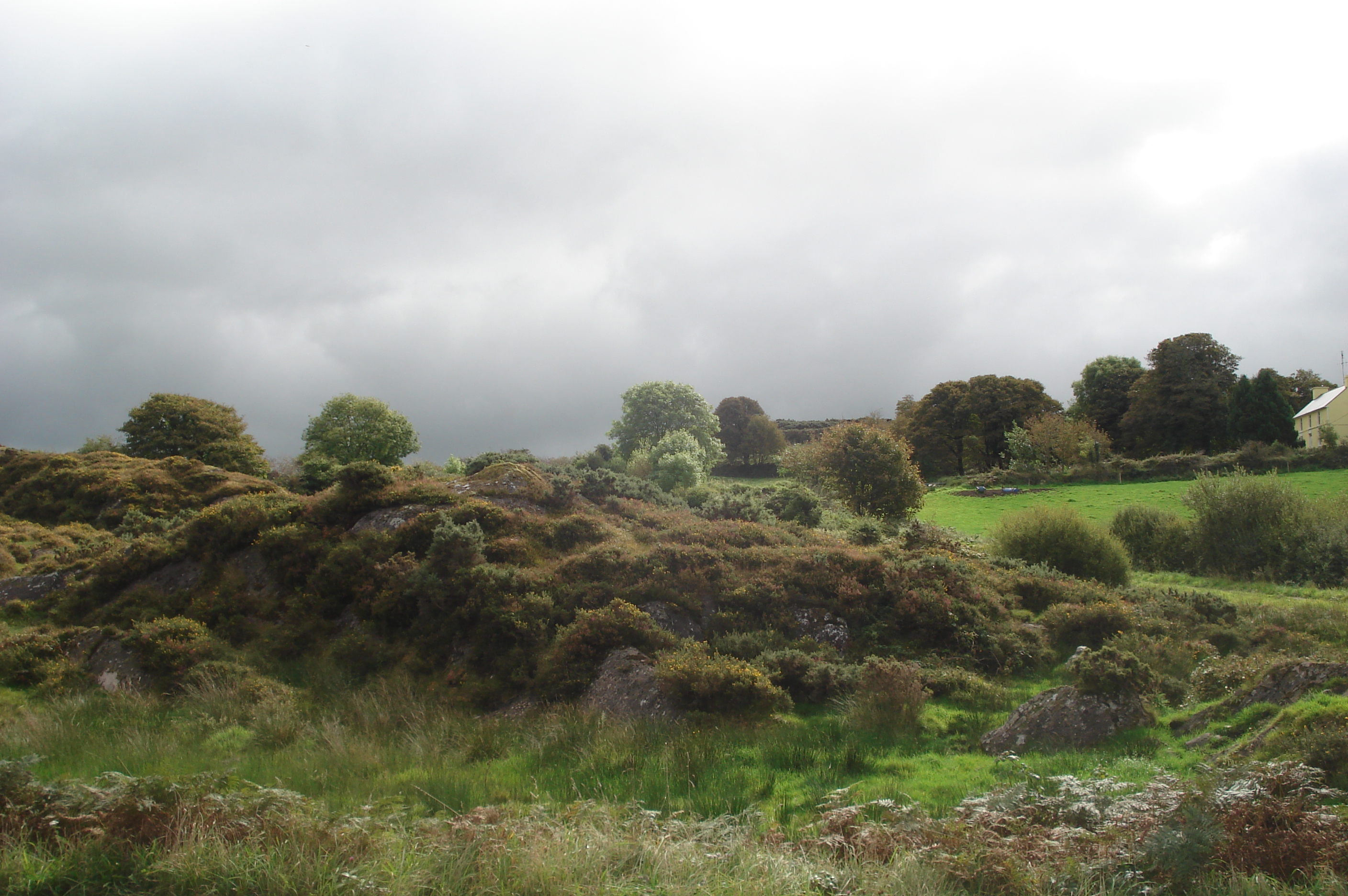
In 2009 I visited with Father Jerry Cremin of Kilmichael Parish in County Cork.  He shared some records he had on my family.  Two of my great-great-grandfathers (John Regan and Patrick Foley) left the parish in 1864 and came to the United States.  Father Cremin’s descriptions of the history and the landscape of Kilmichael were enlightening and entertaining.

View from Kilmichael Ambush memorial, County Cork (2009, Regan McCormack)

When I saw this search topic that brought someone to The Irish in America –  Irish immigrants able to read and write? – I immediately thought of my visit with Father Cremin.  Census data from when John Regan settled in the U.S. shows that he was unable to read or write.  Father Cremin told me that this was not unusual for a man from Kilmichael in the mid-19th century.  He continued to say that John Regan most likely didn’t even speak English, let alone read or write it, when he left Kilmichael.

John Regan

I am a bit embarrassed admit that I had not even considered that any of my ancestors were Irish speakers, but it stands to reason.  Perhaps John Regan never gained command of the English language.  “Old Johnny Regan” is remembered by his grandchildren as a somewhat gruff man, who didn’t seem that interested in young children.

Patrick Foley, who also came from Kilmichael, was literate.  My grandma always told me that her grandfather Foley received his education in a hedge school in County Cork.  In the U.S., Patrick Foley was active in township government and held offices in the Ancient Order of Hibernians and St. Patrick’s Benevolent Society.  My grandma seemed proud of her grandfather, but she would say that the Foleys thought they were better than everyone else.

Patrick Foley

I have a book with Patrick Foley’s  name in gold on the cover, O’Halloran’s History of Ireland.  I am not sure of the exact origin of the book, but I suspect he acquired it while living in New Hampshire, after emigration.  Perhaps it was connected to his participation with the St. Patrick’s Benevolent Society or AOH.  Has anyone else seen this book?  Let me know by leaving a comment!

Last week a couple more search topics appeared on the list:

  • Regan family Kilmichael
  • Foley Macroom

I wish the person who searched for these items would have left a comment…maybe we are talking about the same families!  Click here to read about the first generation of Foleys and Regans born in the United States.

Happy St. Patrick’s Day to you all!


Leave a comment

Happy Anniversary

To one of my favorite Irish American couples…my great-grandparents Annie Hill and Cornelius Regan.  They were married 100 years ago today, February 21st, at St. Malachy Catholic Church in Clontarf, Minnesota.  Annie came from Kill Parish in County Kildare in 1899 and settled in Clontarf, Minnesota.  Neil was born in Fisherville, New Hampshire, his parents were Mary Quinn from County Clare and John Regan of Kilmichael, County Cork.

Annie Hill and Cornelius Regan - February 21, 1911

Happy Anniversary Annie and Neil!