The Irish in America


Leave a comment

Back to the Beginning

Mom and I began sorting through the research we had compiled on the 300 Cashel Street house in Clontarf, Minnesota. It has been fun looking through the folders and making sense of the floor plans Mom drew up nearly twenty years ago!

It is challenging to write about a house that no longer stands. It would be wonderful to walk around the house to see how it fits into the environment. But that’s OK…at least we have some photos of the place before it was dismantled.
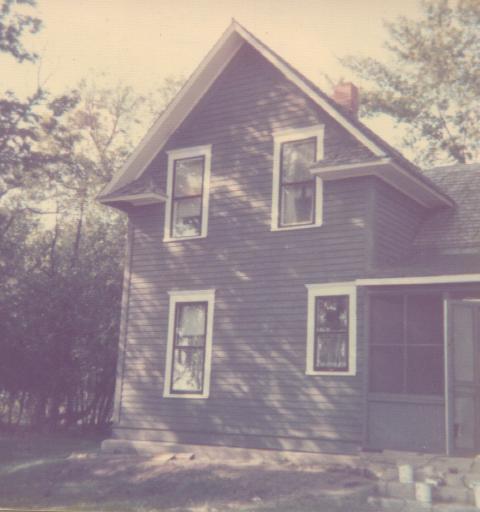
300 Cashel Street, north side (Private Family Collection)

We realized we didn’t know when the house was built, and then we realized we only had property deeds for 1906-1934.

I called Carla Roberts, the department head of the Swift County Land Records Office, and asked if they could tell from their records when a house was built. Carla said to me that information is not usually included in the records held by their office since they are concerned with the transfer of land titles and deeds. She suggested we visit the Assesor’s Office (just across the hall from her at the Swift County Courthouse in Benson, Minnesota). We may see a change in taxes assessed, indicating new construction took place.

Too bad there were no building permit requirements. Mom and I wonder if there might be any building information in the Clontarf Township Records. I believe those are located at Swift County Historical Museum. We, of course, made tons of photocopies.

We are planning a trip to Clontarf in July, so we will visit the Land Records Office and the Assessor’s to see if we can find records before 1906 and ascertain when the house was built. We can’t remember if we looked at any earlier deeds and didn’t make copies of them. This is why it is essential to always keep good notes with your research!

We also need more details on what happened after 1934. In 1934, a foreclosure involved the Home Owners’ Loan Corporation (HOLC), a government program established to offer homeowners in default options for refinancing to avoid foreclosure. Obviously, the program was not successful in the case of the Regan family. We are looking into HOLC for further information. HOLC was a New Deal program during the Great Depression – check out this great site for tons on the New Deal.

Up next…a former resident of 300 Cashel Street has a landmark anniversary of their birth on Wednesday, so check back for a special tribute.

6 Comments

Irish in Minnesota

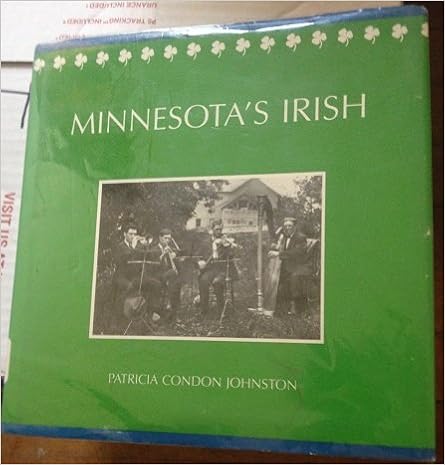
I remember when Patricia Johnston’s book, Minnesota’s Irish first appeared at our house. It was 1984 and Ireland was my new obsession. I was reading everything I could get my hands on about Ireland or written by someone with an Irish name. I listened to nothing but U2 and poured over Mom’s Ireland of the Welcomes magazines, dreaming of living in a dramatic coastal castle or a quaint village cottage.

When I cracked open the book, I assumed it would mostly be about my family. We were the most Irish people I knew in Minnesota. I looked at the index first, expecting to see significant entries for my family names, McCormack, Regan, Foley, Flannery, McMahon. Imagine my surprise when there was nothing.

That is not entirely true. There was one photo of St. Malachy’s Church in Clontarf, the Swift County town where my maternal relatives lived. The people in the photo were all so tiny, there was no chance of identifying any individuals. I was disappointed. I thought my Irish family deserved at least a mention. I also thought Ms. Johnston should have called my grandma for some better material.

The book opened my twelve-year-old eyes to the idea that there were a lot of Irish people who made Minnesota home. I was not as unique as I believed. The experiences of the Irish in Minnesota were more diverse than I had been aware. Now, all these years later, my mom and I are taking a dive into the history of the Irish experience in Minnesota, beyond our own family’s history in Swift County and Minneapolis.

Unidentified Town Scene — private collection

My mom and I love to do research. We are great at identifying resources, following leads, discovering connections, uncovering hidden nuggets, and accumulating information. We find it difficult to stop researching, to feel like we are ever finished. This project has “work in progress” written all over it. There is so much to discover and the research is too much fun.

I would love to hear from you about where your Irish and Irish American relatives put down roots in Minnesota. Is there a township or a village in Minnesota you would like to learn more about? Need some help with research? I think of this as part genealogy, part local history, with some folklore and oral history thrown in the mix. I will share what Mom and I are finding here on the blog. Leave a comment below to get in touch!

The Irish in Minnesota came from every county in Ireland (I actually don’t know that for sure, but I will find out!), endured hardships and celebrated successes at every stage of their migration. Minnesota was the last stop for some Irish immigrants and their families, others pushed further west, and a few even returned to previous homes. Regardless, they all made contributions to the social, cultural, and political fabric of Minnesota.