The Irish in America

Making the Connection

Leave a comment

The first comment left on this blog was from Mai in County Wexford back in early October.  Mai was interested in learning about her mother’s cousins who left Ireland and settled in Pennsylvania, USA.  With the few details Mai provided, I was able to do a quick search of US genealogy records and find her family.

Mai told me the names and birth dates for her mother’s aunt and uncle who emigrated to the USA.  She also knew the place-name of their residence, as well as the names of the children.  These details were just enough for me to identify the family on a passenger list on a ship from Ireland, their residences in the US Census for 1920 and 1930, and listings in the Social Security Death Index.

Last week I received an email from Mai:

Hi Aine Thanks for your help in finding my relatives in Pennsylvania. I  have made contact with them and we now e-mail  regularly. They are delighted at finding us too. Thanks again…

I am not surprised that Mai’s American relatives were delighted to hear from her; there are many Irish Americans who would be thrilled to receive an email from a long-lost Irish relative.

Have you reached out to your American relations, or have you been contacted by an Irish relative?  Please share your experiences by leaving a comment!  I would love to hear your stories…

This gallery contains 0 photos


Leave a comment

Well now, of course they did!

When I read the headline, How the Irish Saved Thanksgiving, on IrishCentral.com, I was curious, but not surprised.  After all, what aspect of American culture and society has not been influenced, and quite often saved, by Irish immigrants and their descendants?

Everyone knows that the Kennedy clan changed the face of American politics, and it is impossible to imagine American business and industry without Henry Ford, but did you know that the co-founder of Southwest Airlines, Herb Kelleher, is of Irish descent?  Or Tom Monaghan, the founder of Domino’s Pizza, claims a couple of Irish grandparents?  Perhaps they did not “save” the airline industry and home pizza delivery, but these two Irish Americans have had tremendous influence on how business is done in America.

While the story on IrishCentral.com was entertaining, I am not certain I agree with the premise that the Irish saved Thanksgiving.  The contributions of Irish immigrants have definitely made America a better place.  And not just for inexpensive, home-delivered pizzas…

Happy Thanksgiving!


1 Comment

Week of Welcomes: McCormack Style, Part II

I was relieved when the party in Ballyedmond drew to a close, that meeting my Irish relatives was neither traumatic nor depressing.  In fact, it was quite the opposite!  We had a perfect evening full of great food, stories, laughter, and teasing (read about our welcome party and my family’s attempt to throw a party in Ireland here.)

The next day as my mother, sister, and I rehashed the details of the party, I felt some of the old apprehension creep back.  Certainly, we had a fabulous time, but did the Irish side of the family share our enthusiasm?  They seemed amenable to a party later in the week, but maybe it had nothing to do with us, after all, who doesn’t like a party?  My mother was the real hit with the relatives, she and Jimmy exchanged friendly banter all night long, but even she questioned whether the relatives enjoyed themselves as much as we did.  We decided not to dwell on it, and figured the next time we would see the relatives would be at our party later in the week.
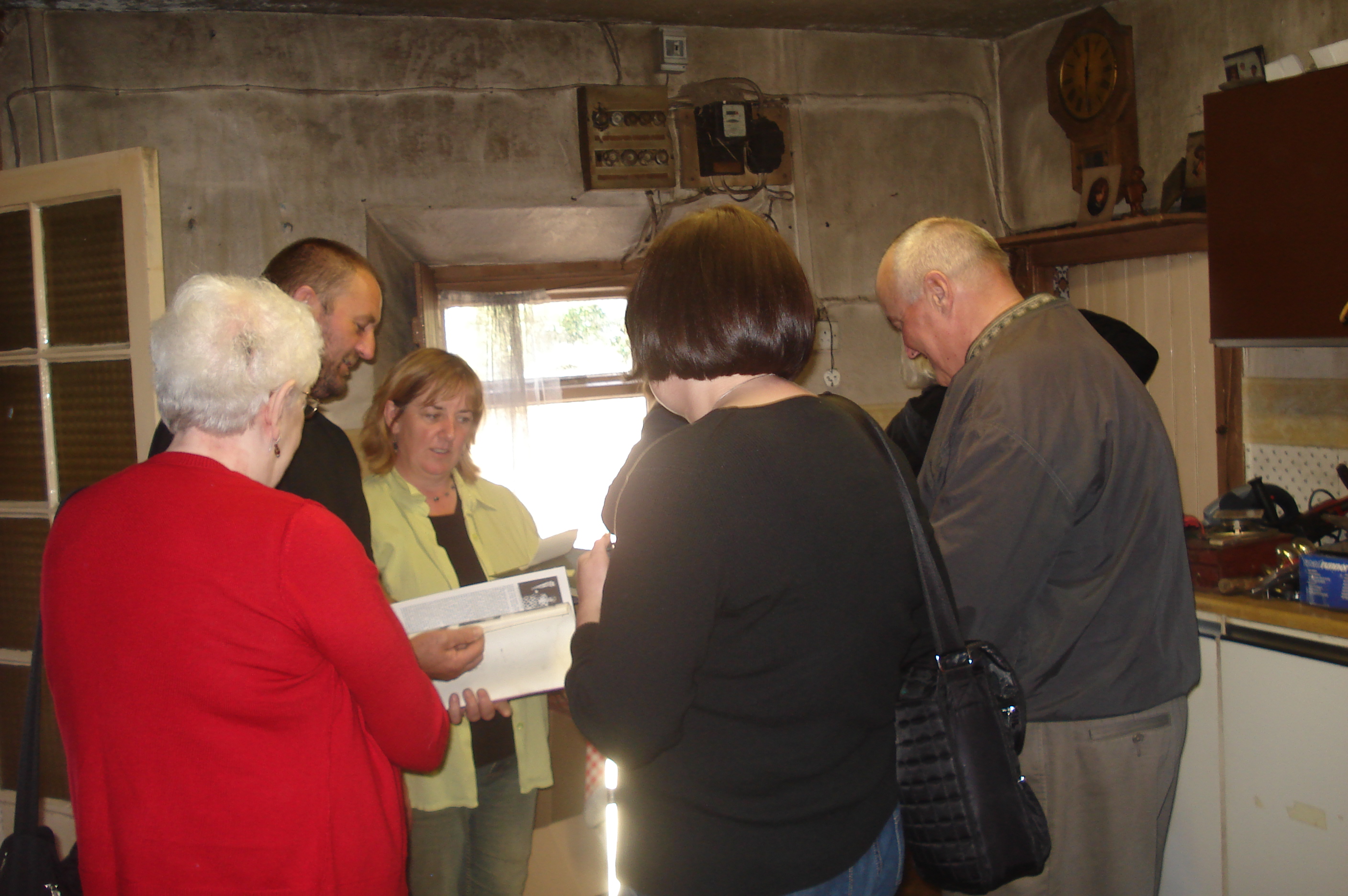
Jimmy and Helen showing us something at the old house

If we annoyed them or were impositions, then the McCormacks were gluttons for punishment.  On Sunday, my dad and aunt attended cousin Jenny’s camogie match, and we met for dinner later that evening at an Italian restaurant in Urlingford.  Helen brought us two cell phones to use during our stay, since she knew we had trouble getting service with ours.  We joked that she wanted to keep tabs on us.  Helen chuckled and said that she surely did; she wanted to make sure she had warning before we showed up on her doorstep in the morning expecting breakfast!

The next afternoon we received a call on one of our new cell phones from Jimmy inviting us down to their local pub, Touhy’s in Rathdowney, that night.  Touhy’s is fantastic – a tiny place filled with dusty Western American paraphernalia (cowboys, Indians, etc.)  When the musician invited others to come up and give a song, our cousin Ellen’s husband Nicky sang a couple of tunes, wowing everyone at the pub.

My dad spent quite a bit of time at the farm with Jimmy that week.  Allegedly, he helped Jimmy move cattle, but we all knew that Helen did most of that!  He helped dig potatoes in the garden, and picked carrots for our party on Friday.

Friday was a busy day.  Paddy and Maura McCormack (Paddy and my grandfather were first cousins) had us to their home for tea and we had to stop at the grocery store for last-minute party shopping.  We were running short on time, we needed to get back to our house and get cooking – Helen was doubting the roast would be done in time.  Read about our stab at entertaining in Ireland here.

They hired a mini-bus to bring them to our party...

Saturday we were set to leave for a week in County Cork, but Jimmy had one last thing for us.  It was a gorgeous late September day in Ballyedmond, and the gardens looked beautiful (Helen made sure we knew it was all for our benefit!)
Jimmy and Mom supervising tree planting

The plan was for the Irish sisters (Jenny and Sarah) and the American sisters (me and Regan) to plant a tree in their garden.  Jimmy chose a California Redwood, we each took a turn at placing a shovel full of dirt by the tree, and the ceremony was complete.  Such a neat idea and perfectly executed!


Cousins planting a tree

That wasn’t the last we saw of the McCormacks.  They joined us for a night in Youghal, County Cork and we drove up to Lismore, County Waterford the next day.  When they left us, and we left Ireland a couple of days later, we were very blue. I had anticipated feeling depressed upon meeting my Irish relatives, not leaving them.  It was definitely bittersweet.

McCormacks in Lismore, County Waterford

Can you see why I think the folks at the Week of Welcomes could benefit from a few pointers from Jimmy and Helen?

Next time I will share another experience from this visit to Ireland, when we venture to the Gaeltacht of Connemara…

16 Comments

Week of Welcomes: McCormack Style, Part I

Over the past twenty-two years I have visited Ireland six times, and it wasn’t until my last trip in 2009 that I actually spent time with my Irish relatives.  My heritage is completely Irish, but I was always hesitant to establish a connection with my Irish relations.  While this attitude may have its roots in a general feeling of shyness, it was cemented by experiences I had in Ireland.  I was content to remain a casual visitor who had a great time in Ireland and leave the sentimental homecoming production to other Irish Americans.

Two examples of encounters I had in Ireland explain why I chose to forgo the pursuit of my Irish family.  The first occurred during a visit to Ireland when I was sixteen-years-old on a summer program for American high school students called The Irish Way.  On a free day from classes, I  accompanied a friend on a day trip to visit her relatives who lived in the village where her grandmother was born.  My friend was anxious and excited to meet her relatives, the family of whom her grandmother spoke so fondly.  The entire situation made me nervous, but I was only a spectator.

Sixteen and somewhere in Galway in 1988

The afternoon was a complete disaster.  Meeting the family did nothing to calm our nerves.  They weren’t rude, just not very  friendly, and for some reason they seemed suspicious of us.  We both felt uncomfortable, unwelcome, and overly scrutinized.  There was no connection; no family chemistry.  My friend was disappointed and hurt – she had expected a warm welcome by people just like her grandmother, but instead received the cold shoulder.

The second encounter that stayed with me was a conversation I had with a wonderful woman from near Belfast.  We were chatting one evening at the Nesbitt Arms Hotel in Ardara, County Donegal.  She told me that Irish people dread the sight of Americans on their doorstep, searching for their grandmother’s birthplace, or trying to locate cousins they hadn’t heard from in years.  I can hear her saying with a laugh, ” You hear the doorbell and look out and see a couple of Americans in their khaki pants and runners, looking so pleased with themselves…”

I certainly did not want to be one of those Americans, nor did I want the disappointment of meeting my relations only to have them be disinterested, unfriendly, and annoyed.  So, I remained content to visit Ireland, have a fantastic holiday, and leave any notions of locating relatives to my imagination.

I provided the background so that you might better understand why I was caught off-guard by the Week of Welcomes (to steal the phrase from the pilot program described here) my family experienced in 2009 when we visited Ireland.  Actually, it was nearly three weeks of great times with relatives and friends all over Ireland, but I will begin with the warm welcome offered by the McCormacks of Ballyedmond, County Laois.

Our week was punctuated by two great parties – one at the beginning, and one at the end.  My father, mother, aunt, sister, and I arrived at the home of Jimmy and Helen McCormack late in the afternoon on Saturday and immediately received ribbing for our late arrival.  My father had done extensive genealogy research and had reconnected with the McCormacks in Ballyedmond about ten years prior to our visit.  Irish Jimmy and my father Jimmy are second cousins – their grandfathers were brothers.

The Jimmys having a laugh outside the old house in Ballyedmond

Read the story of our parties with the McCormack clan here.  In my next post, I will share the details of our week with the McCormacks, including a trip to their local, a tree-planting ceremony, and what I learned along the way.


2 Comments

Ireland Reaches Out: A Visit Home

I saw this item in an email from IrishCentral.com this morning and I had to find out more information…

Irish economist, writer, and broadcaster David McWilliams is behind a project called Ireland Reaching Out, which aims to bring emigrants (and their descendants) back to their home parishes in Ireland for a visit.  This is  a pilot program focusing on thirty parishes in southeast County Galway.  An article in the Connacht Tribune says that the plan is to contact 44,000 emigrants from parishes in places like Gort, Portuma, and Loughrea, and invite them back for a “Week of Welcomes” in June of 2011.

This “Week of Welcomes” will include a program of activities in the parish of origin, including lectures, tours, and samples of local culture, food, and drink.  The hope is that these visits will provide a short-term boost to the local economy as well as promote future investment in the region.

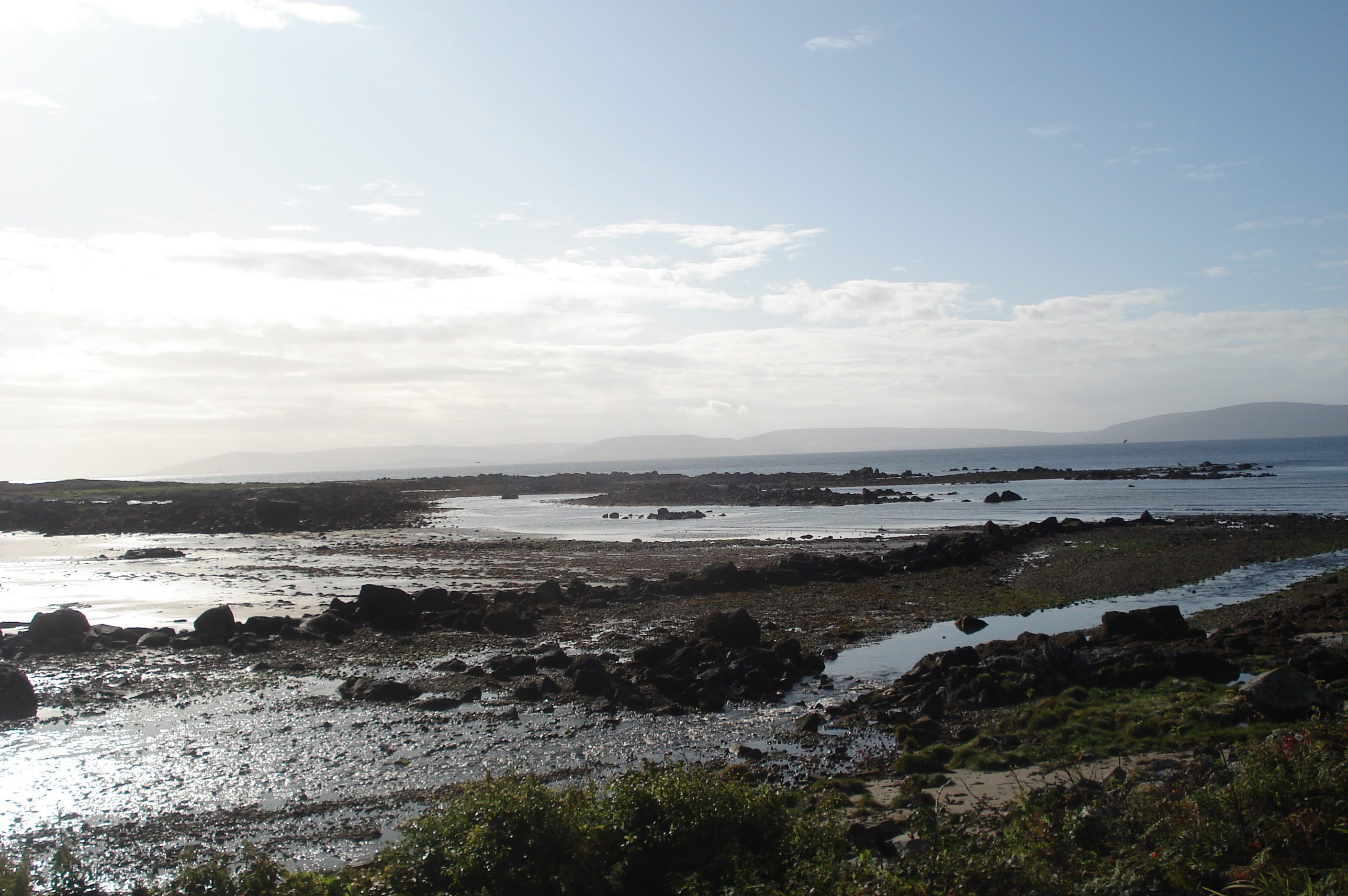
County Galway (2009, Regan McCormack)

I read some comments from recent emigrants who seemed angry and bitter and wanted nothing to do with a program like this.  Maybe for these individuals, their feelings about having to leave home are too raw; the wounds of emigration are too fresh.  I cannot tell you how many times I hear Americans engaged in family history lament that the older generations of immigrants never spoke of Ireland.  In my own family story, all we were ever told was that they came from Cork.  Many, many Irish immigrants in America came from Cork, and practically all of them left from Cork.

Further removed from emigration, you will find Americans eager to make a connection with the place their family came from in Ireland.  Granted, in light of the recent economic downturn Americans may be taking fewer vacations overseas.  But there are Americans who, if given the chance to have a pint at the local pub their grandfather frequented before coming to America, would seize the opportunity to visit Ireland.  I know it sounds a little corny to Irish people, but the attraction of Ireland to Irish Americans is undeniable.  It makes perfect sense for the Irish to capitalize on this pull.  These days it may take more than the Blarney stone to lure American tourist dollars.

Mr. McWiliams describes the program in his own words in his piece on Independent.ie – click here to read the editorial.  In my opinion, the fact that a program like this is underway in Ireland is proof that although the bubble may have burst, the Irish people are using their strengths to imagine their future.  A future deeply rooted in history…that’s nothing new for Ireland, is it?

Near Erke cemetery, County Laois (2009, Regan McCormack)

Next time I will share a bit about our most recent visit home.  By the way, Mr. McWilliams if you are reading this, you must hire my cousins Jimmy and Helen McCormack of Ballyedmond, County Laois as consultants for Ireland Reaching Out. You will have to read my next entry to see why…


2 Comments

The AOH: From Concord to Clontarf

I wanted to write about Irish fraternal organizations and societies that emerged in nineteenth century America as the population of Irish immigrants grew, but then I realized I really don’t know anything about the subject.  Instead, I will share some thoughts on the Irish immigrant experience, with a bit on Irish-American organizations.

When I was in Concord, New Hampshire early in October, the parish secretary of St. John the Evangelist Catholic Church pointed to a house where Mass was said in the days before the church was built and the parish established in 1869.  She said that the Irish (who were more or less the only Catholics in Concord at the time) had to be careful because they could be evicted for having a priest say Mass in their home.

St. John the Evangelist Catholic Church - Concord, NH (photo by Regan McCormack)

My great-great-grandfather came to live in Concord shortly after arriving in America in 1864.  His name was Patrick Foley, and he came from Kilmichael Parish in County Cork (see the last post.)  Patrick Foley could read and write, and at various times served as doorkeeper, secretary, and president of the St. Patrick’s Benevolent Society in Concord.

Another one of my great-great-grandfathers, John Regan, came from Kilmichael Parish in County Cork as well and settled in Concord.  He could neither read nor write, and very likely couldn’t even speak English when he left Ireland.  If the people of Concord were intolerant of Catholics, one can imagine they did not have much time for non-English speakers.  Organizations such as the St. Patrick’s Benevolent Society and the Ancient Order of Hibernians (the AOH, who had a branch in Concord) would have been very important in helping new immigrants adjust to life in America and help protect their religious rights.

My great-great-grandfathers moved west to Clontarf, Minnesota in the late 1870s as part of Bishop John Ireland’s Catholic colonization efforts.  Most of the early settlers were fellow Irishmen and women who had worked for ten years or more in the crowded cities on the East coast or farmed small plots of rented land, saving what money they could for a chance to own land and live in a community where they had their own church and their own priest.

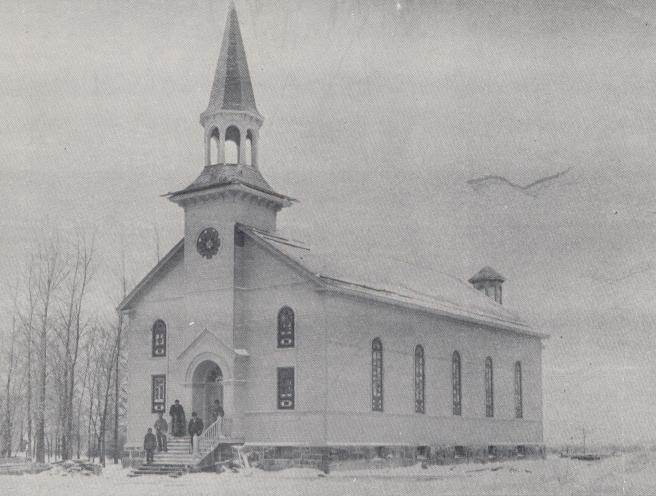
St. Malachy Catholic Church Clontarf, MN

The AOH hall still stands in Clontarf, Minnesota and serves as St. Malachy Parish Hall.  On the prairie of Western Minnesota, the goals of the AOH began to shift.  They could turn their attention toward selling insurance policies and planning St. Patrick’s Day programs now that they were free to practice their religion.

What does any of this mean to you, as you search for your Irish relatives who came to America?  Not sure, exactly, except I hope it contributes to your understanding of what life was like for Irish immigrants in America.

The AOH still exists today.  There are a number of local branches throughout America.  Go here for a list.  Maybe your relative was once a member, or your cousins still are…


Leave a comment

The Young Americans

First Generations Americans      (click to enlarge)

This photo appeared in the December 2008/January 2009 issue of Irish America Magazine.  The following text accompanied the photo:

In March 1864, boyhood friends John Regan and Patrick Foley from Macroom, County Cork, arrived in New York port on the City of Baltimore sailing from Cobh.  They took to life in America quickly and in 1870 both were married.  John Regan married Mary Quinn and they had four sons and two daughters: Cornelius (Neil) , Ellen, John, Patrick, Jeremiah (Jerry), and Mary.  Patrick Foley married Mary Crowley and the couple had four children: Margaret, Timothy, Mary, and John.  After 15 years at work in the mills and machine shops of Fisherville, New Hampshire both families seized the opportunity to move west, own their own land, and raise their families in an Irish Catholic community.  By 1880, the Regan and Foley families were established in Tara Township near Clontarf, Minnesota – active in township government, members of St. Malachy Catholic Church, and proud farmers on land they owned.

This photograph of the sons of John Regan and Patrick Foley – four first generation Americans – captures one of those moments in American history when anything seemed possible.  It is the turn of the twentieth century and Neil, Jack, and Jerry Regan and John Foley look poised to take on what the world had to offer.  Their confidence is palpable and represents the optimism shared by many Americans at the time.

Over the years, confidence waned as youth faded and the realities of life took hold.  This included falling crop prices, farm failures, personal hardships, and economic depression, but on the day this photograph was taken, with cigars pursed in their lips and hats perched jauntily on their heads, these four young men look as if the world is their oyster.

The Regans and the Foleys came together again in the next generation –  Mary Foley  was my grandmother’s mother and Cornelius (Neil) Regan was my grandfather’s father.

(Submitted by Aine C. McCormack, Saint Paul, Minnesota)

Since the photo was published, I have learned that Patrick Foley and John Regan came from Kilmichael Parish in West Cork.

My great-grandfather Cornelius Regan is seated on the left, next to John Foley.  These two men were members of the Ancient Order of Hibernians, a fraternal organization formed in 1838 largely in response to discrimination faced by Irish Americans throughout the country.  These types of organizations became very important for new immigrants from Ireland, as well as to more established Irish Americans.  More to come about these Irish American fraternal societies in a future post…


2 Comments

Family and Emigration

While reading up on Irish emigration, I found an interesting article by County Fermanagh historian John Cunningham on the Cassidy family website.  In the article Mr. Cunningham considers the effects emigration has had on Ireland and the Irish people.  Click here to read the article, which is actually a lecture given by Mr. Cunningham.

Mr. Cunningham uses his own experiences to show how family members who stayed in Ireland felt about emigration.  He tackles the often complex and emotional issue of emigration in a straightforward manner with a bit of humor thrown in for good measure.  I found the account of his mother’s visit to America particularly insightful, as well as the description of the parcels and letters from America.

As his mother learned firsthand, letters home to Ireland often didn’t tell the whole story of the emigrant’s experience in their new home.  Regardless of their accuracy, letters are one of the best resources for learning about your emigrant relative by providing tangible evidence as to where the relative lived, possibly where they worked, or names of spouse and children.  Consider yourself lucky if you have an emigrant letter!

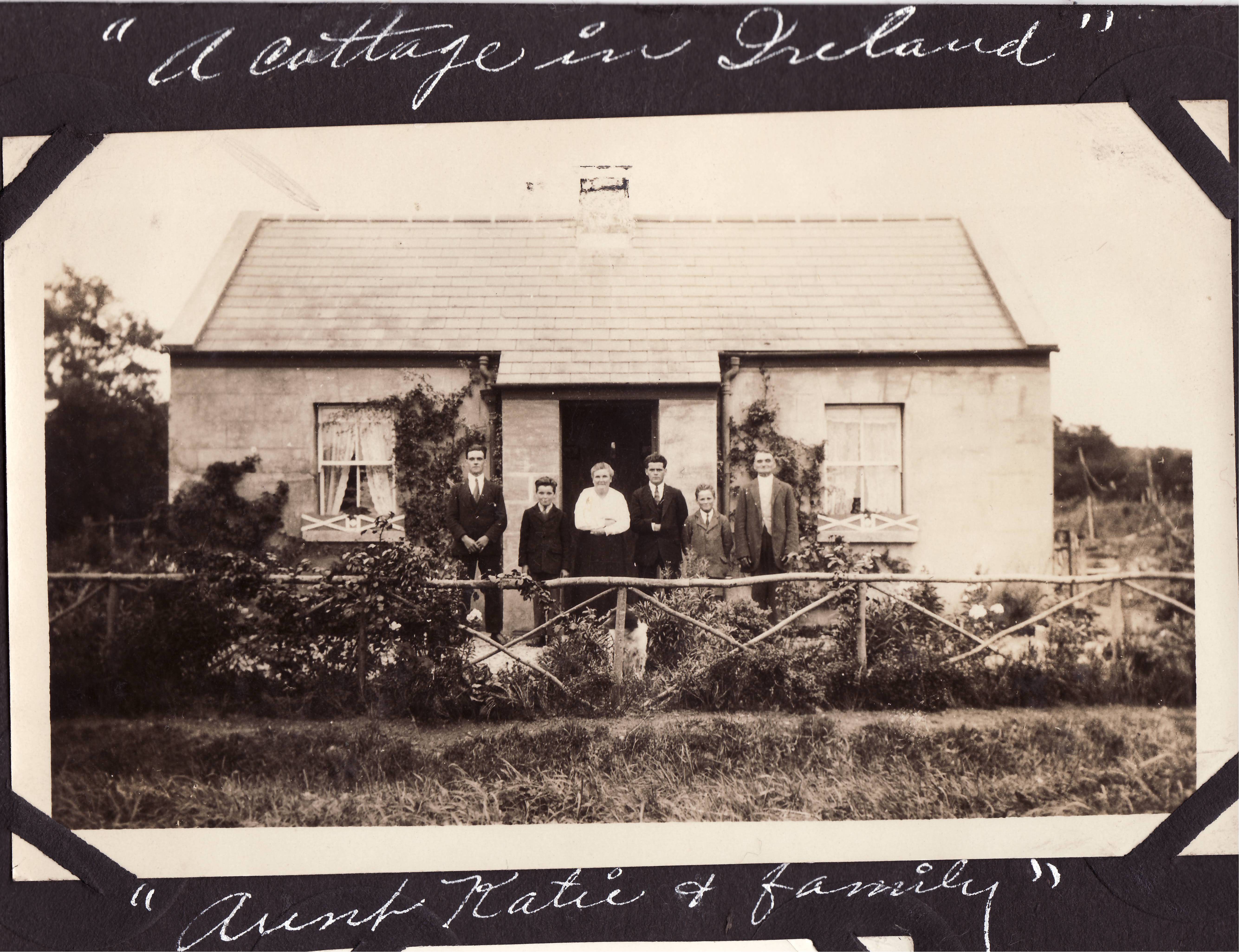
My great-grandmother came to the United States in 1899, joining an older sister who had arrived six years earlier.  A sister and a brother remained in Ireland, and one sister has previously emigrated to Manchester, England.  Unfortunately, no letters survive (on the American side) from relatives at home, but there are a few postcards, greeting cards, and photographs that were sent to my great-grandmother and her sister.  The following photograph was included in an album belonging to a niece of my great-grandmother who lived in Montana, USA.

John and Catherine (Hill) Howe Family, Johnstown Co. Kildare

John and Catherine (Hill) Howe Family - Johnstown, Co. Kildare (courtesy of M. Jeffrey Harshman)

Among the few items belonging to my great-grandmother is a sweet little Christmas card from her sister Katie (Catherine, pictured above), as well as a torn and tattered photo postcard depicting a Whitsunday parade.  It is intriguing to see what pieces of someone’s life survive for later generations.  These bits and pieces have helped us learn a great deal about my great-grandmother’s life before she came to America.

So, if you don’t have a letter, all is not lost in your quest for information about your emigrant relative.  Letters can make the initial search easier, but other information can prove to be as useful.

I invite you to share your family’s emigrant stories by leaving a comment!  Let me know what clues you have, and I will help you begin your search for information on your relative.  If you think you don’t have any information to go on, but really want to learn about what may have happened to a relative, you should leave a comment, too.  We never know what we will find when we start looking!


Leave a comment

Emigration Networks

Last week I received a comment from a woman from County Wexford who was interested in learning about her great-uncle’s family, the Coadys, who left for America in the early twentieth century.  Her mother had kept in contact with a cousin in America for many years, but eventually lost touch.


Sample of 1930 US Federal Census (click image to enlarge)


She had a few solid clues: the names and birth dates of the parents, the children’s names, and the town in Pennsylvania where they once lived.  I did a quick search and found the correct Coady family in the 1920 and 1930 U.S. Federal Census.  I also found the ship manifest for their voyage to America, and even the uncle’s death as registered with the Social Security Administration.  This is but the tip of the iceberg for the Coady family in America; much more information is available.

When I searched the census, I came across an interesting tidbit of information that helps illustrate the point I made in my last post regarding the predictable nature of Irish emigration.  My search of the 1920 census brought up the Coady family I was looking for as well as a second family – a generation older, but with the same surname.  There were even three grandchildren with identical names to the children in the original Coady family.  The three girls were older, so I could be fairly certain it wasn’t an error.

Clearly the family who immigrated in 1914 were not the first Coady family to come to this part of the United States.  The older family had been here since 1888 and were firmly established in Pittsburgh, Pennsylvania.  The presence of kin would have helped the young immigrant family tremendously to adjust to life in America.  Ten years later, in 1930, the young Coady family moved to another town in Pennsylvania where Mr. Coady found work in a sanatorium for tuberculosis patients.

The network had been in place for generations before the Coady family came to America in 1914.  Emigration had become an accepted option for so many in Ireland.  In the book Emigrants and Exiles, author Kirby Miller describes how changes in Irish society affected emigration during the years 1856-1921:

“Many emigrated eagerly or at least without protest, either alienated from a society impoverished in more than economic respects, or conditioned to join relatives abroad whose letters and remittances promised advantages unavailable in Ireland.”

What about those they left behind in Ireland?  I wonder if they were relieved to not have to leave home, or were they envious of those who went to America?


Leave a comment

Patterns of Migration

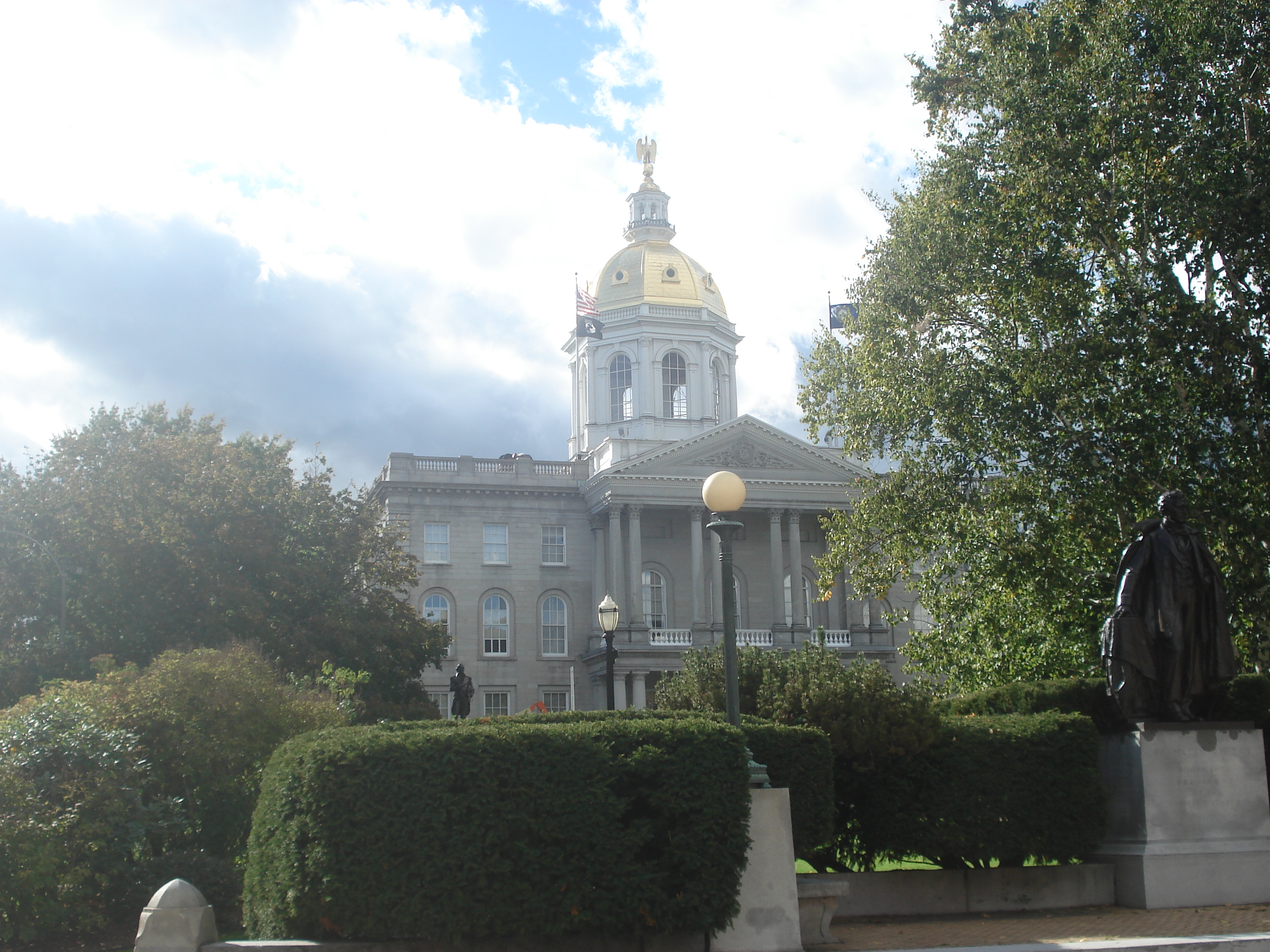
I just returned from a trip to New Hampshire.  New Hampshire is a state located on the East coast of the United States, north of Massachusetts.  My sister and I conducted research on several families who came from County Cork in the mid-1800s and settled in Concord, New Hampshire before moving west to Minnesota.


New Hampshire State House - Concord


Our first stop was the New Hampshire Historical Society research library.  We scoured the city directories and looked through other pertinent items in their collection.  We made some interesting discoveries, and along the way I was struck by a common pattern of Irish migration.

From the city directories it was very clear how the Irish came to the US.  They immigrated in waves, joining relatives who had previously settled in a certain area.  Given this pattern, the new arrival would have a place to stay, possibly a job waiting for them, and a community of family and fellow Irishmen ready to welcome a new member to America.

This is a key thing to remember when researching your relative who came to America: most often emigrants followed a path made by previous family members or neighbors.  Of course this was not always the case, but the migratory patterns of Irish coming to America are somewhat predictable.

Does anyone have a story to share, perhaps one that would prove the exception to my “theory”?  Please leave a comment.

I received the first inquiry and have found some promising results that I will share with Margaret.  She made it easy – she had some names, dates, and the place where they lived in America.  If you have a similar query, please don’t hesitate to ask me for help.

I would also be interested in hearing from anyone whose relatives settled in New Hampshire.  All over the state are towns named after towns or counties in Ireland, including Derry, Dublin, and Antrim.  The mills of Manchester and Concord, as well as the building of the infrastructure they required, created hard-laboring jobs for new immigrants.  The story was the same in most major American cities and towns during the Industrial Revolution.