The Irish in America


2 Comments

The Famine: Views from Ireland and Abroad

“The Coffin trade is the most flourishing one at present here.”

This quote appeared in the January 8, 1847 edition of the Cork Examiner.  Steve Taylor of Vassar College has compiled a fascinating collection of newspapers, illustrations, and other items from Irish and British sources pertaining to the Great Famine.  The collection, Views of the Famine, is available online and provides a glimpse into how the press was reporting the crisis, and what people were doing (or not doing) to cope with the disaster.

"The causes of emigration in Ireland." 13 January 1849 (from Views of the Famine)

The collection includes excerpts from the Cork Examiner during 1846-47.  The weekly reports of death by starvation and disease and a pervasive sense of hopelessness can be difficult to read.  Entire families perished, their lifeless bodies found on the dirt floors of make-shift huts, post-mortem exams showing not even a trace of food in their stomachs and intestines.  Columns reporting over-capacity in the workhouses appear alongside advertisements for steerage passage to North America costing more than most Irish could ever afford.

On September 1, 1847, a column Emigrant Disasters ran in the Cork Examiner.  The column explains why the journeys of emigrants bound for the United States were more “successful” than those destined for Canada.  The major difference was the ships used to transport emigrants to Canada were timber ships, vessels utterly unsuitable for passengers.  The Examiner explains: “…less attention to be paid to their [ship’s] sea-worthiness, since they are laden half the way with what can’t sink, and the other with a freight, which is thought no loss if it do.”

The passage to Canada (British America) was cheaper and the preferred route for much of the “assisted emigration” that took place during the Famine years.  Owners of the large estates in Ireland who favored a more “humane” method of getting rid of tenants, chose to send them to Canada rather than merely evict them from the land.

The destination for many of these emigrant ships was New Brunswick, Canada.  The New Brunswick Archive offers a collection of online databases pertaining to the Irish who came to Canada.  Specifically, there are some useful resources related to assisted emigration.

The Fitzwilliam Estate Emigration Books 1848-1856 lists the tenants evicted from the Coolattin estate of Lord Fitzwilliam in County Wicklow, Ireland.  The archive provides an informative introduction, a narrative by Jim Rees providing context, a finding aid, and a transcript, complete with genealogical information.  Quite an interesting and useful tool.

The New Brunswick Archive also has a collection of letters, transcribed and available online.  I will address some of these letters in my next post, but I would like to turn your attention to a group of letters, Letters from Irish Emigrants and others, put in by Sir Robert Gore Booth Bart: [1846-1849].  Click here and scroll to the last group to read these letters.  Sir Robert owned an estate in Sligo.  These letters speak to the conditions and challenges faced by the Irish in the New World.

For more information on the Famine Irish in New Brunswick, read this essay by Dr. Stewart Donovan of St. Thomas University, In the Wake of Dark Passage: Irish Famine Migration to New Brunswick.

Just a couple more examples of the resources available online to help us better understand the Irish experience in America (and Canada, too!)

Resources:

Views of the Famine

New Brunswick Irish Portal

Irish Canadian Cultural Association


2 Comments

She Liked Nice Things

Over the past several months, I have used the items left behind by my great-grandmother Annie Hill Regan to help tell the story of an Irish woman who came to the United States at the turn of the last century.

Items have included a sweet Christmas card from a sister in Ireland, a small photo-pin of a priest, some memorial cards, and a Whitsun postcard.

I find these remnants from Annie’s life fascinating, and they have provided tiny, yet invaluable peeks into her life.  They have also complicated my vision of Annie, creating new questions and contributing to ongoing mysteries.  This is especially the case with the photographs.

Nearly all of Annie’s photographs are unidentified.  There is ONE photo with the label, John’s Aunt Mary.

John's Aunt Mary

Initially I was so excited to find an identification that I forgot I had no idea who this Aunt Mary was!  I assumed the “John” was my grandpa, and he had an Aunt Mary Regan, but she died when she was thirty-years-old.  This Aunt Mary appeared older than thirty.  And the photo was one of Annie’s, so this Aunt Mary must have come from her side.  I knew so little about Annie’s family, so I set the photo aside and I would think about it later.

Later turned out to be seven years ago my mother and I began looking into our family history.  When we learned that Annie had a sister named Mary Hill O’Brien who lived in Montana, I remembered the photo.  Some lucky timing brought me in contact with Mary’s grandson who still lived in Montana.  Jack O’Brien has this same photograph of his grandmother, Mary.

Here is one last postcard that was among Annie’s things.  This is from Mary to Annie:

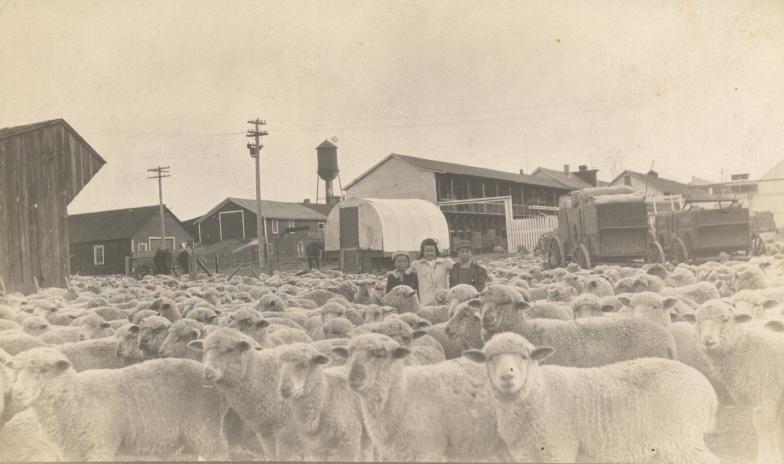
Lucille O'Brien amongst the sheep

from Mary to Annie

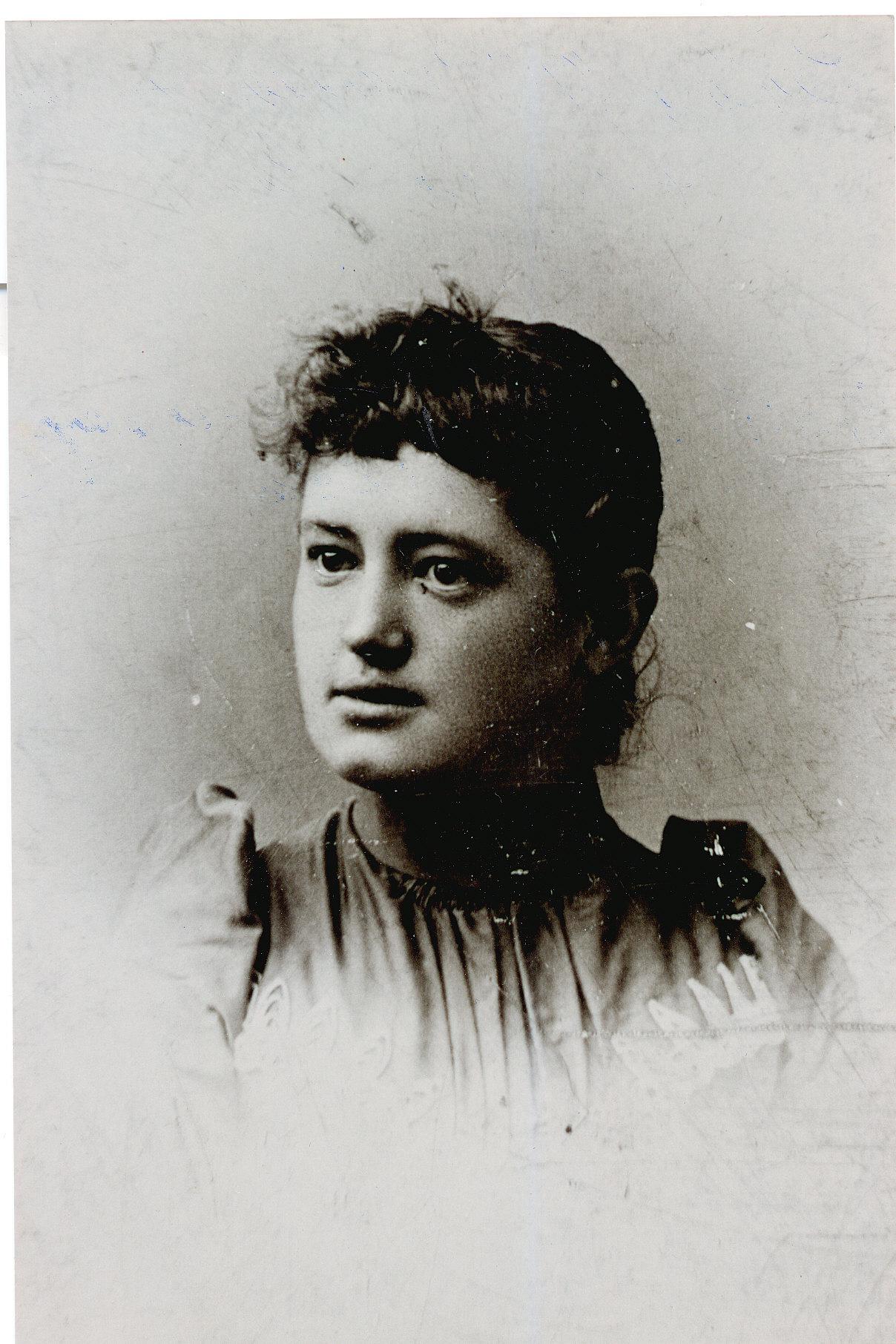
Annie, ca. 1900

Click here to read my story in the current issue of Irish America magazine about how meeting two of my great-grandmother’s nephews has brought me closer to developing an understanding of the woman Annie was.


13 Comments

Oops…was it a mystery or memory block?

Father John J. Molloy

The “mystery” from last time was actually solved a few years back.  My mom reminded me that we confirmed the identity of the priest when we compared the photo-pin to a photograph of Father John J. Molloy that we found in the book Meet Shieldsville, by Mary L. Hagerty.  I spaced this discovery out, and I must admit that this was not entirely an accident.  At times I become overwhelmed with my own family history research, and when a discovery opens up a new can of worms and I don’t have the time or energy to deal with it, I will slip the cover back on and vow to deal with it at a later date.  This is precisely what happened with good old Father Molloy.

Priest Pin

Above is a reproduction of the photo of Father Molloy.  It is not of the highest quality, but I think you can appreciate the resemblance to the photo-pin on the right.  My great-grandmother worked as Father Molloy’s housekeeper (1905-1910) before she was married.  While I was pleased to learn the identity of the priest, it meant that there was even more to learn about Father Molloy.  The first thing I wanted to know was how Annie came to know Father Molloy.

John J. Molloy was born in County Mayo, Ireland and educated at St. Patrick’s College Maynooth, County Kildare.  He was ordained in 1891 and arrived in Minnesota later that year.  Father Molloy served as an assistant pastor for a number of parishes throughout Minnesota before settling at St. Patrick’s in Shieldsville.  He served the community for fifty-two years.

All of that was well and good, but I couldn’t find anything in the biographical information on Father Molloy that could point to a connection to my great-grandmother.  That was until I read in his obituary that he was survived by one sister named Delia in Manchester, England.  Immediately I  thought of the dozen or so photographs taken in the studios of Manchester, England that Annie had saved.  Of course, none of the photographs were identified, but I assumed they were of family members.  Annie had one sister who moved to Manchester and raised a family (Bridget) and another sister who lived there for a few years before returning home to Kildare (Catherine, who I have mentioned before.)  Manchester could be the connection, but it made my head hurt and I told myself I would tackle this another day.

I believe the day has come.  It is time to dust off my Manchester file and see if I can’t figure this one out.  A wonderful book, The Reynolds Letters, provides considerable insight into the lives of Irish emigrants living and working in Manchester during the 19th and early-20th centuries.  I will use the resources available on ancestry.com and elsewhere on the internet to see if I can learn anything more about a possible Molloy-Hill connection in Manchester. 

Here are some of my of mystery Manchester photographs…


Probably one of the Hill girls...

Unknown Couple from Manchester

Perhaps Annie's sister and family?

The Hill sisters that I believe spent time in Manchester are:

Margaret (Maggie)

b. 1866

Catherine (Katie)

b. 1872

m. John Howe

Bridget (Delia)

b. 1876

If anyone has experience researching Irish emigrants in England, specifically Manchester, please let me know.  I will keep you posted…


3 Comments

Belle of the Ball

Guest contributor Jim McCormack shows us how family history research can lead us in unexpected directions.  Jim’s research has extended from his direct lineage to learning about the earlier wave of McCorma(i)cks who came to America – the families of his grandfather’s uncles.

One of the fun aspects of family history research is you often get sidetracked by interesting stories or people. A good example involves my study of the family of Patrick McCormick. Patrick was one of my grandfather’s uncles and an early settler in Camden Township, Carver County, Minnesota. Patrick and his wife Catherine Glendon had a total of fourteen children. My search for Andrew Francis, the couple’s sixth child took me from Carver county Minnesota to the mountains of Tuolumne California where he died in 1911.

Andrew McCormick was born in 1864 and was a graduate of the State University Law Department. The promising young attorney was tall, handsome, and athletic.  On July 10th, 1894 Andy was married to the lovely Belle Hagen, the best known and popular young lady in Camden.  Within three years Andrew had uprooted his young family and taken them to the gold fields of California. By Jan 1st 1911 Andrew was dead and Belle was responsible for raising their five children. My search for Andrew (which I will discuss in a later post)and the California branch of the family introduced me to a cousin in California Rosemary Arca. Besides sharing many stories of the family, she graciously shared treasured family photos. Among those were photos of Belle Hagen McCormick, Belle’s mother Ellen Sweeney Hagen and a photo that I think is of Isabella Sweeney Ellen’s mother. Whether it was the similarity with my own mother who was left a widow with young children to rear or all of the feminists in my family or seeing these photos, I began to dig into the Belle Hagen McCormick story.

Ellen Sweeney Hagan - Belle's mother

Isabelle (Belle) was born in 1870 to Ellen Sweeney and Peter Hagen. She was the second of three children born to the couple. According to Peter’s obituary Ellen died in 1874. In the state Census of 1875 Peter and the three girls were living as a family in Carver. By 1880 the three Hagen girls were living with their Grandmother Isabella Sweeney and their father Peter had been committed to the State Hospital in St. Peter, Minnesota. Luckily for Belle she had a loving grandmother to raise her after the two terrible losses of her youth.  One can only speculate on how she was affected by her mother’s death and father’s mental problems. In 1885 Isabelle Hagan was living with Grandma Sweeney with no sign of the other two girls.

Belle Hagen McCormick

Despite these early setbacks Belle apparently adjusted quite well. Prior to her marriage to Andrew, Belle was known as one of the most popular young ladies in the County.  Newspaper accounts of the time described the wedding as almost fairy tale like.  The Norwood Times described “a very impressive ceremony complete with flowers and wreaths decorating the church in Norwood.  The Times reported that the bridesmaids were Misses Margaret McCormick, sister of the groom and Mary E. Hagen of Ft. Snelling, sister of the bride. The groomsmen were Philip McCormick, brother of the groom and Daniel Sharon, a cousin of the groom (and boyhood friend).  After the ceremony a sumptuous repast was served to the family and relatives at the home of Senator Craven.  After their wedding tour the prominent young Chaska attorney and his beautiful wife took rooms in a trendy new addition in Chaska.”The honeymoon apparently did not last long. Within three years Andrew Belle and Lenore their first child had moved to California. By the time Andrew died Jan 1st 1911 the family had grown to five children. Sometime that same year Belle married Lott Walker Savage in Tuolumne. In Oct 1912 their daughter Francis Ellen was born. At some point after 1920 the blended family moved to Oakland where the family remains today.


Ellen Sweeney Hagen grave marker

Peter Hagen grave marker

Grave markers for Belle’s parents, Ellen Sweeney and Peter Hagen.

Please leave a comment if you would like to ask Jim a question.  He will share a bit more about Andrew McCormick in a future post…make sure you check back!


Leave a comment

Happy Anniversary

To one of my favorite Irish American couples…my great-grandparents Annie Hill and Cornelius Regan.  They were married 100 years ago today, February 21st, at St. Malachy Catholic Church in Clontarf, Minnesota.  Annie came from Kill Parish in County Kildare in 1899 and settled in Clontarf, Minnesota.  Neil was born in Fisherville, New Hampshire, his parents were Mary Quinn from County Clare and John Regan of Kilmichael, County Cork.

Annie Hill and Cornelius Regan - February 21, 1911

Happy Anniversary Annie and Neil!


1 Comment

Clancy Wrap-up

Two more Clancy girls in America…

Mollie Clancy sent Margaret $100 as a wedding gift in the 1960s, and Margaret recalled posting a letter to Flushing, New York, which may or may not have been for Mollie.  Mollie never married.

That’s what Jim had to go on we he began his search for Mollie Clancy.  He positively identified Mollie’s arrival in New York using the New York Passenger Lists database on Ancestry.com.  On September 28, 1907 the S.S. Campania from Queenstown, Ireland arrived at New York harbor with Mollie Clancy, a twenty-year-old servant from Moylough, County Galway on board.  Mollie was accompanied by two other young people from Moylough: Martin Cosgrove (laborer) and Maggie Lyons (servant).

Jim was unable to trace Mollie after her arrival.  More research time would definitely result in more information on where she lived.  Mollie showed up on Jim’s radar again with documentation of a return trip from Ireland in 1938. The US Passport Applications on Ancestry.com only go to 1925, so that would not help with Mollie.

Nora Clancy O’Hara remains a mystery, for now. Margaret told us she appeared on the 1901 Irish census, but not the 1911.  We could assume she made the journey to America sometime between 1905 and 1910, but she doesn’t appear in the passenger list database.  Again, I am sure that more time could produce results about Nora.  Jim did locate a Nora O’Hara in the Social Security Death Index who died in Flushing, New York in September of 1966, with a birth date of April 20, 1885.

The Other Clancy Siblings…

Margaret filled me in on the Clancy siblings who remained in Ireland.  Her grandfather Thomas stayed on the family’s homeplace, while a grand-uncle Pat built a house nearby.  Pat is said to have helped finance Nellie’s education as a teacher.

An interesting historical side-note: Margaret had an uncle Thomas who emigrated to England and who worked for the post office in London.  He returned to Moylough with his family for a couple of years during World War II, driven from London by the German bombing.  Margaret does not know when they came or when they left, and said that Tom never returned to Ireland.  However, Margaret paid him a visit in England in 1967.

Making the connection…

Margaret emailed me the other day, and she told me that she had phoned a granddaughter of Catherine (Clancy) and John Coogan living in California, and she was writing to her to fill her in on some family history. Jim identified the California woman as a very probable match.  Margaret wrote, “It is all slotting into place.”  I am pleased that we could help her fill out the American branch of her family tree.

Only two Clancy sibling would live out their lives on Irish soil.  This story is by no means unusual for the time and the place, but that does not diminish the profound emotional impact emigration had – and continues to have – on families.  Profound enough that over one-hundred years after her grand-aunts and uncle left Ireland for America, Margaret was curious enough about what happened to her relatives to search for answers.

That’s all on the Clancy family…for now.  We will see if Margaret learns any new bits of information from her new-found American cousin!  I hope that this example has shown you how easy it can be to trace your American relatives.

Note: In an earlier post on the Clancys I mentioned their father’s name was listed as Theo. (Theodore)…I was wrong, it was Tho. (Thomas)…Thomas was Margaret’s great-grandfather’s name.


1 Comment

New Life, New Century

The tools and resources available on Ancestry.com have brought family history and genealogy research directly to the fingertips of anyone with a computer and $40 a month to spare.  Fascinating discoveries are literally only clicks away.  That being said, it never hurts to have an experienced researcher like Jim on your payroll to navigate the myriad of possible matches and probable connections you encounter in your search.  Let’s continue the Clancy family’s journey to America by taking a closer look at Catherine, the first (known) Clancy sibling to emigrate.

Margaret told us that Catherine (Kate) was born in Moylough, County Galway in 1878.  Since she did not appear on either the 1901 or the 1911 Irish Census, Jim was confident in his identification of the Catherine Clancy who set sail from Queensland (Cobh) April 4, 1900, on board the S.S. Teutonic.  The journey took fifteen days, and Catherine arrived at New York City harbor on the 19th of April, 1900.  This would have been an exciting time to arrive in the US – amidst the optimistic swirl of the Spring of a new century.

With the 1920 US Census, Catherine was married to John J. Coogan from Kilkerrin, County Galway.  The young couple was living in Brooklyn, New York with two small boys (John and Joseph.)  By the 1930 US Census, the Coogan family had moved about eighty miles from Brooklyn to Wawayanda, New York.  A third son Francis joined the family in 1922.

There were some interesting items included in the collection of Immigration and Travel records.  On March 25, 1921 Catherine and her two sons returned home to New York after a holiday in Ireland.  Late in 1920, John had applied for a passport indicating travel with his wife and two sons to Ireland for three months, leaving in August – perhaps the trip was postponed or the return delayed.

The U.S. Passport Applications on Ancestry.com are intriguing and could be a gold mine of information for the family history researcher.  John Coogan’s passport application gives us not only his birth date and place, but those of his wife and children, as well as the date he was naturalized as an US citizen, where he had lived in the US, his occupation, and his current residence.  The dates and destination of planned travel are also given.  These applications can be a one-stop source for genealogical information.  Plus, some of the passport applications even include a photograph!

One of Margaret’s memories was of saying the Trimmings after the evening Rosary and the “boys in the war” were always included in these prayers.  Margaret believed the Coogan boys fought in the Korean War.  Well, Jim discovered that the three Coogan boys were indeed “boys in the war”, but the war was World War II, which may have been before Margaret’s time.  Perhaps there were more American relatives from Moylough who fought during the Korean War?

We located a few descendants of Catherine (Clancy) and John Coogan, and I forwarded that information on to Margaret.  Maybe she will connect with some American cousins…I will keep you posted as to what I hear from her.

Next time we will wrap up the Clancy family saga with the stories of Nora and Molly.


1 Comment

What’s the most Irish town in America?

The 2010 US Census returns are in and the “most Irish town” in the country is Scituate, Massachusetts.  Scituate is located about 30 miles from Boston in an area known as the “Irish Riviera” – read the story from the Irish Central here.

In the article Richard Finnegan of Stonehill College in Easton, Massachusetts explains the Irish migration from inner-city Boston to the South Shore suburbs as the natural path in light of improved economic and social positions  attained by the Irish during the twentieth century.  It is interesting that the Irish seemed to replicate their urban neighborhoods in the new suburban landscape.  Professor Finnegan says that, “Family goes where their family and friends are.”  This was true of the nineteenth century Irish immigrants and it remains true for Irish Americans and new twenty-first century immigrants as well.

Professor Finnegan’s statement helps to make family history research a bit more manageable.  Searching US Census records on Ancestry.com for a family member who emigrated to America?  When you find a match, take a minute to look at the names of the neighbors…you might recognize names from your home town in Ireland. The same is true when searching passenger lists – especially those from the twentieth century which sometimes indicate a family or friend’s name and address in the US – the emigrant’s destination.

And when you reach a dead-end with your research, just remember what Professor Finnegan said…”Families go where their family and friends are.”  This simple and spot-on description of the Irish migratory experience may lead to new discoveries.

For more on Scituate, Massachusetts visit the town’s website.

If you would like to learn more about the Irish in Boston, click here.

Making the Connection

Leave a comment

The first comment left on this blog was from Mai in County Wexford back in early October.  Mai was interested in learning about her mother’s cousins who left Ireland and settled in Pennsylvania, USA.  With the few details Mai provided, I was able to do a quick search of US genealogy records and find her family.

Mai told me the names and birth dates for her mother’s aunt and uncle who emigrated to the USA.  She also knew the place-name of their residence, as well as the names of the children.  These details were just enough for me to identify the family on a passenger list on a ship from Ireland, their residences in the US Census for 1920 and 1930, and listings in the Social Security Death Index.

Last week I received an email from Mai:

Hi Aine Thanks for your help in finding my relatives in Pennsylvania. I  have made contact with them and we now e-mail  regularly. They are delighted at finding us too. Thanks again…

I am not surprised that Mai’s American relatives were delighted to hear from her; there are many Irish Americans who would be thrilled to receive an email from a long-lost Irish relative.

Have you reached out to your American relations, or have you been contacted by an Irish relative?  Please share your experiences by leaving a comment!  I would love to hear your stories…

This gallery contains 0 photos


Leave a comment

The Young Americans

First Generations Americans      (click to enlarge)

This photo appeared in the December 2008/January 2009 issue of Irish America Magazine.  The following text accompanied the photo:

In March 1864, boyhood friends John Regan and Patrick Foley from Macroom, County Cork, arrived in New York port on the City of Baltimore sailing from Cobh.  They took to life in America quickly and in 1870 both were married.  John Regan married Mary Quinn and they had four sons and two daughters: Cornelius (Neil) , Ellen, John, Patrick, Jeremiah (Jerry), and Mary.  Patrick Foley married Mary Crowley and the couple had four children: Margaret, Timothy, Mary, and John.  After 15 years at work in the mills and machine shops of Fisherville, New Hampshire both families seized the opportunity to move west, own their own land, and raise their families in an Irish Catholic community.  By 1880, the Regan and Foley families were established in Tara Township near Clontarf, Minnesota – active in township government, members of St. Malachy Catholic Church, and proud farmers on land they owned.

This photograph of the sons of John Regan and Patrick Foley – four first generation Americans – captures one of those moments in American history when anything seemed possible.  It is the turn of the twentieth century and Neil, Jack, and Jerry Regan and John Foley look poised to take on what the world had to offer.  Their confidence is palpable and represents the optimism shared by many Americans at the time.

Over the years, confidence waned as youth faded and the realities of life took hold.  This included falling crop prices, farm failures, personal hardships, and economic depression, but on the day this photograph was taken, with cigars pursed in their lips and hats perched jauntily on their heads, these four young men look as if the world is their oyster.

The Regans and the Foleys came together again in the next generation –  Mary Foley  was my grandmother’s mother and Cornelius (Neil) Regan was my grandfather’s father.

(Submitted by Aine C. McCormack, Saint Paul, Minnesota)

Since the photo was published, I have learned that Patrick Foley and John Regan came from Kilmichael Parish in West Cork.

My great-grandfather Cornelius Regan is seated on the left, next to John Foley.  These two men were members of the Ancient Order of Hibernians, a fraternal organization formed in 1838 largely in response to discrimination faced by Irish Americans throughout the country.  These types of organizations became very important for new immigrants from Ireland, as well as to more established Irish Americans.  More to come about these Irish American fraternal societies in a future post…