The Irish in America


3 Comments

Ireland Reaching Out: Update and FAQ

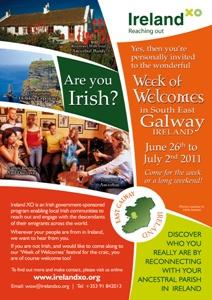
The following is a copy of an email I received from the Ireland Reaching Out program.  Sounds like they are on track for a fantastic “Week of Welcomes” in the parishes of south-east Galway…

Hello from South-East Galway!


We have been receiving an overwhelming amount of email from you over the last weeks and days as we ramp up the project and look forward to our inaugural Week of Welcomes 26th June-2nd July – a week of learning, heritage and fun.


Due to the volume of enquiries, we are not in a position right now to answer every individual query. We are a relatively small team, made up almost entirely of volunteers, and the immediate focus is on a successful pilot and rollout of the project in the South-East Galway area. With this email, we’d like to answer the most frequently asked questions. 


What is the Ireland Reaching Out pilot project and when will it expand to other areas of Ireland?

The Ireland Reaching Out pilot project is primarily focused on making contact with our South-East Galway Diaspora, i.e. global emigrants and/or their descendants who left the area and inviting them to reconnect with their place of origin. Over the past year, over 40 local Irish parish communities have been working hard to find out who left their areas and have been helping us to create an online presence for each parish such that should you believe you are connected to a particular Irish parish, you can introduce yourself directly to the local Ireland Reaching Out team.

Due to the huge popularity of the project, we have experienced a great volume of queries relating to parts of Ireland outside of our initial focus. These are welcome, but right now, we must prioritize those queries which are made in connection to South-East Galway.  You will, however, be pleased to know that it is anticipated that the Ireland XO will expand nationally in the second half of 2011. Should you be interested in becoming involved in a parish anywhere else in Ireland, you will be able to register your specific interest at that time.

How can I keep myself informed about the project and its progress?

How can I help spread the word about the Week of Welcomes June 26th-July2nd?

The Week of Welcomes will become an annual fixture in every parish’s calendar in Ireland – help us to spread the word about the inaugural event in South-East Galway this June. The website is continuously being updated as we confirm more details but one thing is for sure: it will be a visit to remember!


Can I attend the Inaugural Week of Welcomes June 26th-July2nd?

The quick answer is that yes you can! Even if you are not connected to South-East Galway but priority is been given those with local South-East Galway roots and those with surnames such as Kelly, Burke, Fahy and Madden which are native to the area (see the 1855 Griffith’s Valuation list of most common surnames in the pilot area here – scroll to bottom of page: http://www.irelandxo.org/?q=content/about-us). A small number of places in each parish is reserved for people of Irish Heritage who would like to come along and enjoy the local Irish welcome for this very historic event. If you would like to attend but have no specific link to South-East Galway, please let us know. The event will covered by local and international media.
I am interested in tracing my ancestors – can you help me to do this?

If you are trying to trace your ancestors to Ireland, the Ireland Reaching Out Project can certainly help you once it is rolled out Ireland-wide later this year. What we offer is a connection to your parish(es) of origin where local people (possibly relatives!) who have volunteered as part of the project will be keen to assist.  One of the remarkable aspects of this project is that when you have a community of people assisting you to trace your ancestors, the process is way quicker!

If you don’t know your parish of origin, knowing the county of origin will help.  If you don’t know this – but simply know your people are from Ireland – then please have patience, because we are possibly going to get to you from the other direction – all in good time however.  If you have some information about your family, but are unsure of where they come from, we will give you the opportunity to register that information later on this year.  For now, help us to help you by letting people know about this project which in turn will help the project to scale up.  Through your help, we can systematically reunify the entire Irish Diaspora. Even if you are a “John Kelly” of Irish roots, working together, we will one day find out who you really are!

I would like to get involved in the project — how do I volunteer? And what skills are you looking for?
We have had many offers of assistance for which we are very grateful. We are keeping track of every offer of assistance and even if we do not get back to you straight away, please bear with us as our central organization is strengthened in the coming months.  You can sign-up and tell us about your skills and areas of interest here: http://www.irelandxo.org/?q=content/join-our-team.

In the area of Loughrea, Co Galway, we are looking for people with professional IT, web, management, research, strategic development, financial, marketing, PR and event-organization skills.  Further afield, we are looking for volunteers to assist with the online management of local Irish parish websites, something that can be done as easily from Australia, UK or the USA as from the West of Ireland!

Thank you for your continued interest, offers of help, ideas and support!  If you have family and friends with an interest in Ireland, please let them know about the exciting project!

The Ireland XO Team


**********************************
Dolores O’Shea
Project Administrator – Ireland Reaching Out
South-East Galway Diaspora Pilot Project
25, Dunkellin Street, Loughrea, Co. Galway
http://www.irelandxo.org
**********************************

2 Comments

In Loving Memory

On several occasions I have mentioned my great-grandmother Annie Hill Regan and the small collection of photographs and greeting cards she left behind.   Among the mysterious photographs from Manchester England, a photo-pin of a priest, and a charming Christmas card from a sister, are two memorial cards.  Below is the card for her father who passed away the year before Annie came to the United States.

William Hill memorial card, 1898 (click to enlarge)

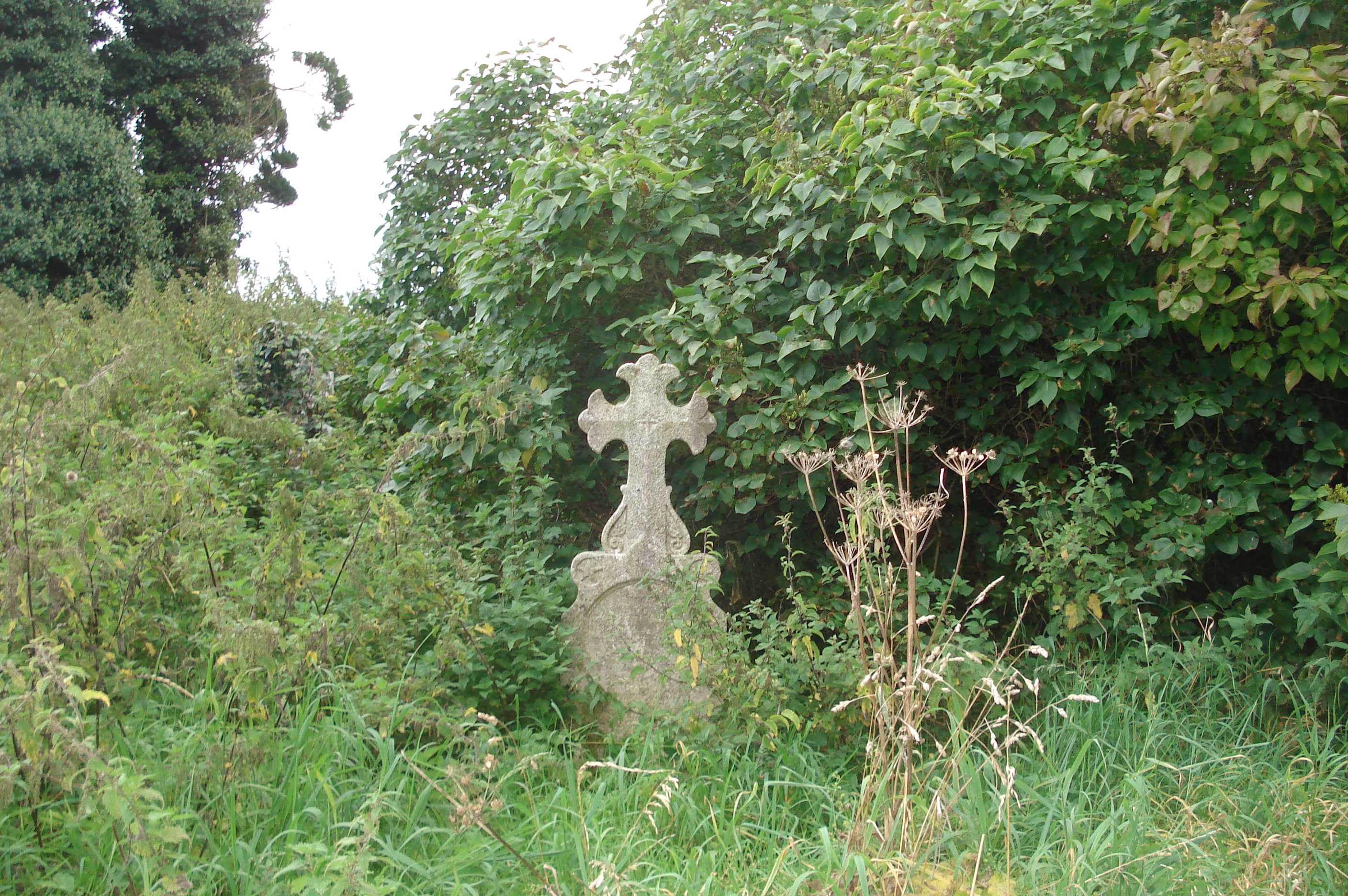
In 2009 I visited Rathmore Churchyard.  I was unable to locate William’s grave, but I suspect it rests hidden in the overgrown grass, somewhere amidst the gravestones of Hill relatives of whom I am not familiar.

Rathmore Churchyard, County Kildare (2009 Regan McCormack)

The other card is for James Hill.  I assume James was a nephew, and one can imagine this loss was felt deeply by the entire family.

James Hill memorial card, 1895 (click to enlarge)

Memorial cards can provide great information to the genealogist or family historian.  In the case of Annie’s father, I knew his name from her birth certificate, but I learned his birth year, date of death, and place of burial only from this memorial card tucked into a stack of old photographs.  But memorial cards can also raise more questions than they answer, and prove to be as frustrating as an album full of unidentified photographs or a postcard with faded text.

Because they are so portable, I am sure a great many memorial cards crossed the Atlantic, mailed to emigrant daughters and sons in America, accompanying letters detailing all the latest news from home.

Share your stories about how items like memorial cards have assisted you in the search for your family history.  Perhaps a memorial card is all that is left to tell of an emigrant relative’s life in America?  I would love to hear your stories, so please, leave a comment!


13 Comments

Oops…was it a mystery or memory block?

Father John J. Molloy

The “mystery” from last time was actually solved a few years back.  My mom reminded me that we confirmed the identity of the priest when we compared the photo-pin to a photograph of Father John J. Molloy that we found in the book Meet Shieldsville, by Mary L. Hagerty.  I spaced this discovery out, and I must admit that this was not entirely an accident.  At times I become overwhelmed with my own family history research, and when a discovery opens up a new can of worms and I don’t have the time or energy to deal with it, I will slip the cover back on and vow to deal with it at a later date.  This is precisely what happened with good old Father Molloy.

Priest Pin

Above is a reproduction of the photo of Father Molloy.  It is not of the highest quality, but I think you can appreciate the resemblance to the photo-pin on the right.  My great-grandmother worked as Father Molloy’s housekeeper (1905-1910) before she was married.  While I was pleased to learn the identity of the priest, it meant that there was even more to learn about Father Molloy.  The first thing I wanted to know was how Annie came to know Father Molloy.

John J. Molloy was born in County Mayo, Ireland and educated at St. Patrick’s College Maynooth, County Kildare.  He was ordained in 1891 and arrived in Minnesota later that year.  Father Molloy served as an assistant pastor for a number of parishes throughout Minnesota before settling at St. Patrick’s in Shieldsville.  He served the community for fifty-two years.

All of that was well and good, but I couldn’t find anything in the biographical information on Father Molloy that could point to a connection to my great-grandmother.  That was until I read in his obituary that he was survived by one sister named Delia in Manchester, England.  Immediately I  thought of the dozen or so photographs taken in the studios of Manchester, England that Annie had saved.  Of course, none of the photographs were identified, but I assumed they were of family members.  Annie had one sister who moved to Manchester and raised a family (Bridget) and another sister who lived there for a few years before returning home to Kildare (Catherine, who I have mentioned before.)  Manchester could be the connection, but it made my head hurt and I told myself I would tackle this another day.

I believe the day has come.  It is time to dust off my Manchester file and see if I can’t figure this one out.  A wonderful book, The Reynolds Letters, provides considerable insight into the lives of Irish emigrants living and working in Manchester during the 19th and early-20th centuries.  I will use the resources available on ancestry.com and elsewhere on the internet to see if I can learn anything more about a possible Molloy-Hill connection in Manchester. 

Here are some of my of mystery Manchester photographs…


Probably one of the Hill girls...

Unknown Couple from Manchester

Perhaps Annie's sister and family?

The Hill sisters that I believe spent time in Manchester are:

Margaret (Maggie)

b. 1866

Catherine (Katie)

b. 1872

m. John Howe

Bridget (Delia)

b. 1876

If anyone has experience researching Irish emigrants in England, specifically Manchester, please let me know.  I will keep you posted…


1 Comment

Mystery Priest

Photograph pin, ca. 1890-1900

This “photo-pin” belonged to my great-grandmother Annie Hill Regan.  Annie passed away in 1937, and this pin was among a small collection of cards, photographs, and memorial cards that made their way to my mom.  Click here to see a 1930s Christmas card from Annie’s sister Katie in Ireland.

I remember seeing this pin as a child and being puzzled as to why my great-grandmother had such a thing.  Who wore a pin with someone’s picture on it, especially a picture of a priest?  I didn’t get it, but I was relieved that the fad of priest-photo-pins didn’t carry over to the 1980s – the thought of wearing a picture of my parish priest Father O’Sullivan stuck to my cardigan gave me goosebumps!

Several years ago I became curious about the identity of the priest in the photo-pin, and I started to ask questions…

  • Could this be Annie’s brother, or maybe an uncle or a nephew?
  • When Annie came to the US, she worked as a housekeeper for Father Molloy.  Maybe this is him?
  • Were pins like this common or did she have this specially made?

I have never been able to answer these questions.  I know Annie had one brother, John, but I know nothing about his life, and I have seen photos of Father Molloy, but only as an older man and there isn’t a strong resemblance.

Maybe you can help me with the third question.  Has anyone come across an item like this, maybe in an old box of your great-grandmother’s treasures or at an antique shop?  The pin measures about two inches in diameter with a coppery, scalloped edge.  Leave me a comment if you have any ideas…

Check out this website for more on photo jewelry.


Leave a comment

Sometimes it just takes a little detective work…

When I first received the following request for assistance, I thought it would be a piece of cake – James provided me with names, some dates, and the family’s home parish.  Here is the comment he left:

I am trying to trace family members on my late Mother’s side who came from Glenamaddy, Galway. There are the McGuire’s who went to Yonkers New York. Brothers James, Micheal and sisters Mary, Cathrine. James married Julia Higgins on 20 Sep 36 and James Jr married 1 Dec 62.

This seemed straight-forward enough, so when an initial search turned up nothing, I was a bit disappointed.  I knew there had to be something out there about James’ family, so I went to an expert.  This was a job for Jim, the head researcher for Archival Solutions.

Genealogy research often requires a good amount of detective work, and this situation was no different.  Jim was up to the task and in no time he told me he had a name of a possible relative of James living in Yonkers, New York.  Researcher Jim was able to trace, not the brother Jim for whom we had a spouse name and marriage date (as well as child’s name and his marriage date), but one of the McGuire sisters.  Catherine married and settled with her husband in Yonkers, New York, where the couple had one son.

I passed the information to James, and I was struck by the appreciation he expressed.  He told me that he telephoned the individual Jim had found, and indeed it was his first cousin.  This was the first time that James had ever spoken to a relative on his mother’s side.  James said they spoke for a “very long time” and his American cousin has filled him in on some family history.

James put together a package of family photographs to send to Yonkers, and has some rather fragile old letters that he will hand-deliver when the cousins meet in New York later this year.

I think I would call that a success!  James, please keep us posted on your future family discoveries!

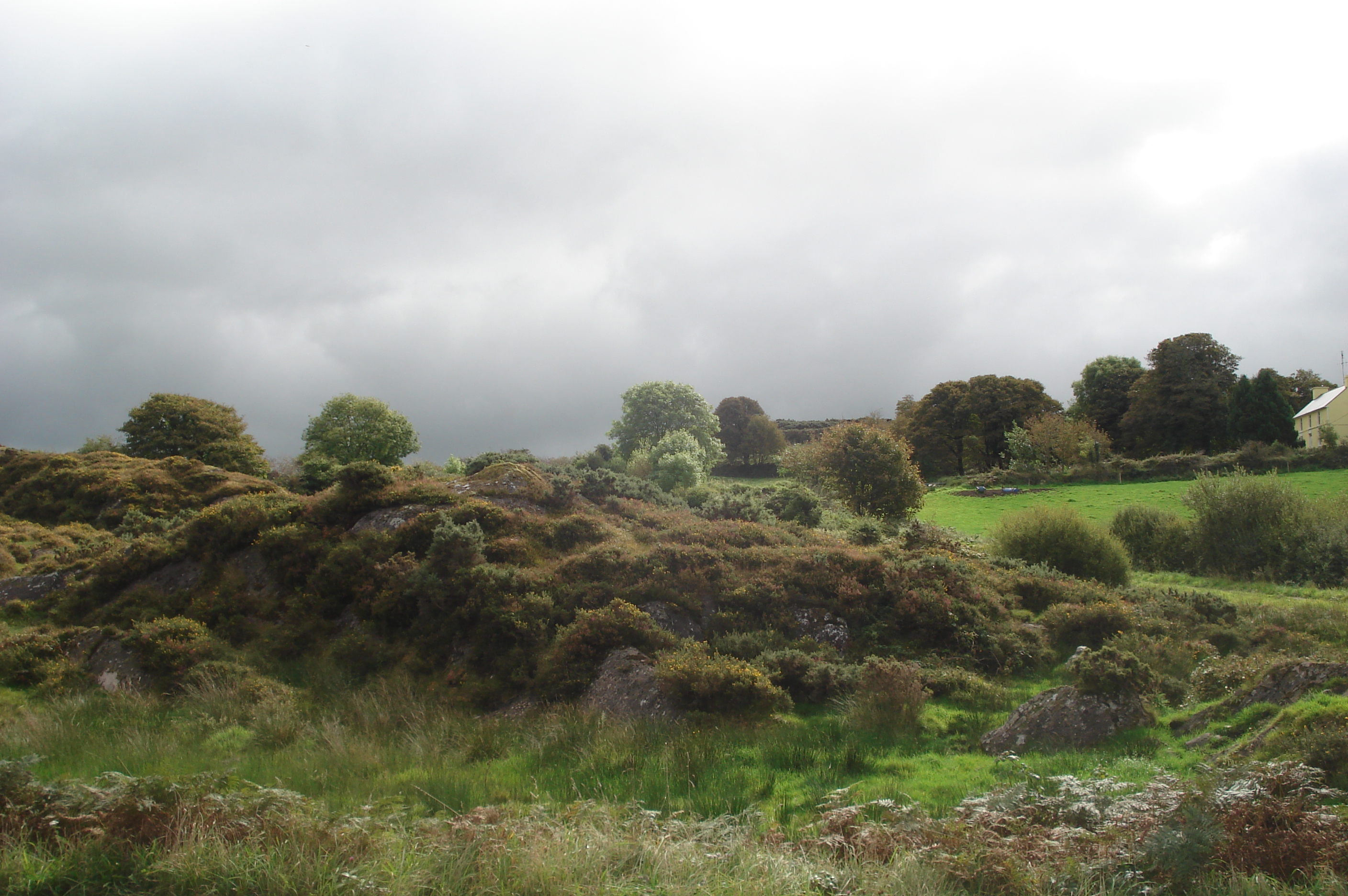
May not be Glenamaddy, but it's a pretty scene from elsewhere in Galway...(2009 Regan McCormack)


14 Comments

Kilmichael Roots

In 2009 I visited with Father Jerry Cremin of Kilmichael Parish in County Cork.  He shared some records he had on my family.  Two of my great-great-grandfathers (John Regan and Patrick Foley) left the parish in 1864 and came to the United States.  Father Cremin’s descriptions of the history and the landscape of Kilmichael were enlightening and entertaining.

View from Kilmichael Ambush memorial, County Cork (2009, Regan McCormack)

When I saw this search topic that brought someone to The Irish in America –  Irish immigrants able to read and write? – I immediately thought of my visit with Father Cremin.  Census data from when John Regan settled in the U.S. shows that he was unable to read or write.  Father Cremin told me that this was not unusual for a man from Kilmichael in the mid-19th century.  He continued to say that John Regan most likely didn’t even speak English, let alone read or write it, when he left Kilmichael.

John Regan

I am a bit embarrassed admit that I had not even considered that any of my ancestors were Irish speakers, but it stands to reason.  Perhaps John Regan never gained command of the English language.  “Old Johnny Regan” is remembered by his grandchildren as a somewhat gruff man, who didn’t seem that interested in young children.

Patrick Foley, who also came from Kilmichael, was literate.  My grandma always told me that her grandfather Foley received his education in a hedge school in County Cork.  In the U.S., Patrick Foley was active in township government and held offices in the Ancient Order of Hibernians and St. Patrick’s Benevolent Society.  My grandma seemed proud of her grandfather, but she would say that the Foleys thought they were better than everyone else.

Patrick Foley

I have a book with Patrick Foley’s  name in gold on the cover, O’Halloran’s History of Ireland.  I am not sure of the exact origin of the book, but I suspect he acquired it while living in New Hampshire, after emigration.  Perhaps it was connected to his participation with the St. Patrick’s Benevolent Society or AOH.  Has anyone else seen this book?  Let me know by leaving a comment!

Last week a couple more search topics appeared on the list:

  • Regan family Kilmichael
  • Foley Macroom

I wish the person who searched for these items would have left a comment…maybe we are talking about the same families!  Click here to read about the first generation of Foleys and Regans born in the United States.

Happy St. Patrick’s Day to you all!


12 Comments

Heaps of Love: A message from home

I am always interested to see what internet searches bring people to The Irish in America.  Here are some of the recent search topics:

  • Irish beginnings in America
  • Irish people searching for American relatives
  • What was the life of an Irish immigrant like in America?
  • Irish emigrant letters
  • Irish immigrants able to read and write?

Emigrant letters can be an important tool for Irish seeking information on relatives who came to America.  Many Irish people who have contacted me for assistance on locating relatives have some memory of letters from these emigrants.  Either the actual letter, or stories of the letters received over the years.  Some people still have the letters and can refer to them for details of the relative’s life in America.

In Irish family history research census data, passenger manifests, and birth and death certificates provide the pertinent information you need to complete a family tree.  If you go a little further, obituaries and newspaper clippings will expand your understanding of the individuals you are researching.  Photographs can put faces to the data, but letters can provide intimate glimpses into the lives of your ancestors.  The emigrant letter is fast becoming a treasured source for information on the experiences of Irish emigrants (see this article on a recent donation to the Cork City and County Archive.)

Of course, for those of us researching in America, we won’t find the emigrant letter, but rather, if we are lucky we might find a response to that letter.  I often day-dream of discovering a dusty box of letters in a long-forgotten attic, letters written to one of my ancestors that would provide some insight into the life they left behind in Ireland.  Alas, I have yet to find such a stash, but I do have a little something.

My great-grandmother Annie Hill Regan would have been my best bet for saving such correspondence.  We have many of her things – china, furniture, and photographs – but no letters, only a tidy envelope containing two Christmas cards and several postcards.

Christmas card, Katie Hill Howe to Annie Hill Regan (front)

Christmas card, Katie Hill Howe to Annie Hill Regan (inside)

The card pictured above was sent to Annie in 1930 by her sister Katie from Ireland.  I can only imagine the cards and letters the two sisters exchanged during the thirty years that passed since Annie left County Kildare to begin a new life in Clontarf, Minnesota.  Because people did not often save their correspondence, that makes this small packet of my great-grandmother’s so important to me.  Obviously the contents were important enough to her that she set them aside and saved them.  This tells me much about my great-grandmother, as well as provides a peak at the family she left behind in Ireland.

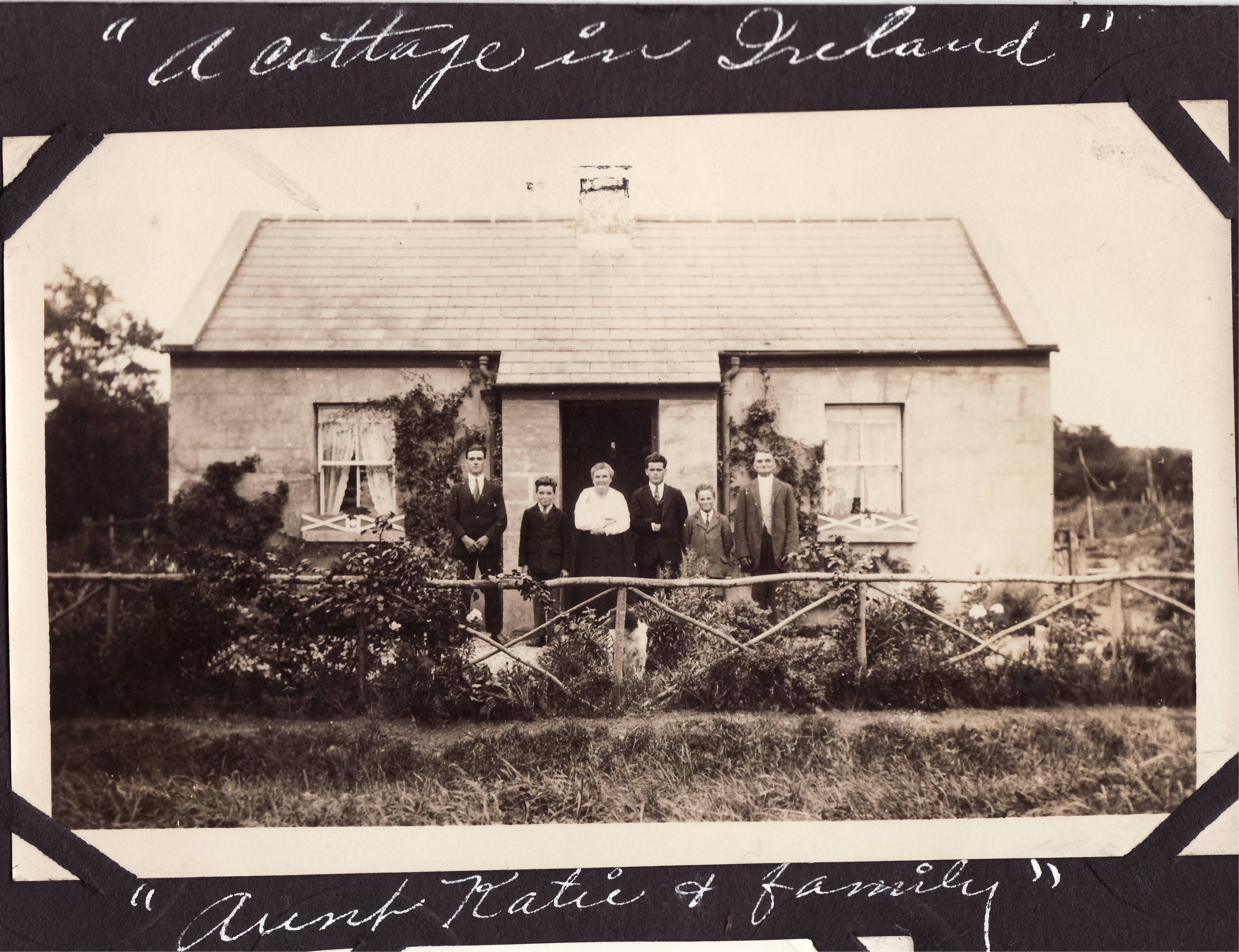
Katie Hill Howe and family, Johnstown, County Kildare (photo from MJ Harshmann)

I wanted to mention a great little book, The Reynolds Letters: An Irish Emigrant Family in Late Victorian Manchester.  This collection provides a glimpse into an Irish family’s emigration experience – from County Leitrim to Manchester, England and on to Chicago, Illinois.  Great read for anyone interested in the Irish who emigrated to England and America.

Next time I will address another item on the most common searches and how that may contribute to an absence of letters.


3 Comments

Belle of the Ball

Guest contributor Jim McCormack shows us how family history research can lead us in unexpected directions.  Jim’s research has extended from his direct lineage to learning about the earlier wave of McCorma(i)cks who came to America – the families of his grandfather’s uncles.

One of the fun aspects of family history research is you often get sidetracked by interesting stories or people. A good example involves my study of the family of Patrick McCormick. Patrick was one of my grandfather’s uncles and an early settler in Camden Township, Carver County, Minnesota. Patrick and his wife Catherine Glendon had a total of fourteen children. My search for Andrew Francis, the couple’s sixth child took me from Carver county Minnesota to the mountains of Tuolumne California where he died in 1911.

Andrew McCormick was born in 1864 and was a graduate of the State University Law Department. The promising young attorney was tall, handsome, and athletic.  On July 10th, 1894 Andy was married to the lovely Belle Hagen, the best known and popular young lady in Camden.  Within three years Andrew had uprooted his young family and taken them to the gold fields of California. By Jan 1st 1911 Andrew was dead and Belle was responsible for raising their five children. My search for Andrew (which I will discuss in a later post)and the California branch of the family introduced me to a cousin in California Rosemary Arca. Besides sharing many stories of the family, she graciously shared treasured family photos. Among those were photos of Belle Hagen McCormick, Belle’s mother Ellen Sweeney Hagen and a photo that I think is of Isabella Sweeney Ellen’s mother. Whether it was the similarity with my own mother who was left a widow with young children to rear or all of the feminists in my family or seeing these photos, I began to dig into the Belle Hagen McCormick story.

Ellen Sweeney Hagan - Belle's mother

Isabelle (Belle) was born in 1870 to Ellen Sweeney and Peter Hagen. She was the second of three children born to the couple. According to Peter’s obituary Ellen died in 1874. In the state Census of 1875 Peter and the three girls were living as a family in Carver. By 1880 the three Hagen girls were living with their Grandmother Isabella Sweeney and their father Peter had been committed to the State Hospital in St. Peter, Minnesota. Luckily for Belle she had a loving grandmother to raise her after the two terrible losses of her youth.  One can only speculate on how she was affected by her mother’s death and father’s mental problems. In 1885 Isabelle Hagan was living with Grandma Sweeney with no sign of the other two girls.

Belle Hagen McCormick

Despite these early setbacks Belle apparently adjusted quite well. Prior to her marriage to Andrew, Belle was known as one of the most popular young ladies in the County.  Newspaper accounts of the time described the wedding as almost fairy tale like.  The Norwood Times described “a very impressive ceremony complete with flowers and wreaths decorating the church in Norwood.  The Times reported that the bridesmaids were Misses Margaret McCormick, sister of the groom and Mary E. Hagen of Ft. Snelling, sister of the bride. The groomsmen were Philip McCormick, brother of the groom and Daniel Sharon, a cousin of the groom (and boyhood friend).  After the ceremony a sumptuous repast was served to the family and relatives at the home of Senator Craven.  After their wedding tour the prominent young Chaska attorney and his beautiful wife took rooms in a trendy new addition in Chaska.”The honeymoon apparently did not last long. Within three years Andrew Belle and Lenore their first child had moved to California. By the time Andrew died Jan 1st 1911 the family had grown to five children. Sometime that same year Belle married Lott Walker Savage in Tuolumne. In Oct 1912 their daughter Francis Ellen was born. At some point after 1920 the blended family moved to Oakland where the family remains today.


Ellen Sweeney Hagen grave marker

Peter Hagen grave marker

Grave markers for Belle’s parents, Ellen Sweeney and Peter Hagen.

Please leave a comment if you would like to ask Jim a question.  He will share a bit more about Andrew McCormick in a future post…make sure you check back!


Leave a comment

Happy Anniversary

To one of my favorite Irish American couples…my great-grandparents Annie Hill and Cornelius Regan.  They were married 100 years ago today, February 21st, at St. Malachy Catholic Church in Clontarf, Minnesota.  Annie came from Kill Parish in County Kildare in 1899 and settled in Clontarf, Minnesota.  Neil was born in Fisherville, New Hampshire, his parents were Mary Quinn from County Clare and John Regan of Kilmichael, County Cork.

Annie Hill and Cornelius Regan - February 21, 1911

Happy Anniversary Annie and Neil!


4 Comments

Ireland Reaching Out: Parish List

Mike Feerick of Ireland Reaching Out left a comment a couple of days ago and provided a complete list of the Galway parishes involved in the program:

The Full List of South-East Galway Parishes….. It’s a big part of County Galway!

Abbey and Duniry
Tynagh
Aughrim & Kilconnell
Ardrahan / Labane
Ballinakill & Derrybrien
Gort (Kilbeacanty & Beagh)
Kilconieran & Clostoken
Clonfert, Meelick and Eyrecourt
Clontuskert
Fohenagh and Killure
Peterswell
Kilchreest & Castledaly
Leitrim & Killeenadeema
Killimor
Tiranascragh
Fahy and Quansborough
Kiltullagh & Killimordaly
Laurencetown
Kiltormer
Loughrea
Mullagh, Killoran, Kilrickle, Cappataggle
New Inn & Bullaun
Portumna, Boula, Gortanumera
Woodford
Ballymacward & Gurteen

Do you trace your ancestry to one of the south-east Galway counties? If you can, you must visit the Ireland Reaching Out website!