The Irish in America


2 Comments

Letters from North America

The New Brunswick Archive in Canada has a great collection of letters to and from Irish emigrants to the area.  You can read the actual hand-written letters, or if you prefer not to struggle with nineteenth century script, transcriptions are available for download. The collection contains items from the nineteenth century, as well as some from the early twentieth century.  Also included are a diary, family histories, and other documents.  Take a look around the site…fascinating stuff!

An example of what the New Brunswick archive has to offer…

The Laurence Hughes collection (MC2618 :: Laurence Hughes fonds) contains several letters written to Laurence Hughes of Fredricton, New Brunswick from relatives in Ireland and elsewhere in North America.  I think these letters are particularly interesting for they demonstrate the networks of Irish emigration and how that support facilitated further migration from Ireland and within North America. The letters span seventeen years (1837-1854) and see several relatives in Ireland considering emigration and dealing with the decision to stay.

In 1837 Laurence’s brother Thomas writes from Newry sharing the news from home.  Thomas encourages Laurence to move to Boston and gives him advice on how to be successful there:

Now before you go to Boston enquire of every respectable person that knows you if
they can give you a line or two of recommendations to any person they may be acquainted with…[damage]…the Catholic Priest of Fredericton…

Good advice, I would say.  Thomas provides his brother with options, outlining a plan for Laurence’s return to Ireland since, “It is only natural to expect you would prefer living in Ireland.”   Laurence stayed put in Fredricton, at least until 1854.  Thomas mentions that he had four children and was looking forward to more…”We calculate on having one every 13 or 14 months that’s not bad trade thank God.”

In the 1837 letter, Thomas mentions another brother, Edward, who had also gone to New Brunswick.  By 1852 he was living in Pennsylvania with a large family and looking to move west to Iowa:

I some times think of selling it to go live in the west. There is a fine
colony of settlers from Carlow in loway State sent out by Rev. James Heigher and they have fine schools there now for boys and girls. I think dear Lawrence if we would go there it would be a fine chance for our children but I am afraid it is not healthy there.

Read Edward’s full letter here.  I wonder if Edward ever made his way to Iowa?  Establishing Catholic colonies in the midwestern United States was popular during this time (until the mid-1880s.)  The goal of such projects was two-fold: provide opportunities for Irish immigrants to escape congested Eastern conditions and own land, farm, and raise families in a Catholic community, and to strengthen the American Catholic Church by populating the West with Catholic settlers.

These letters are full of interesting observations.  Edward comments on his fellow Irishmen who work on the railroad, a job many felt lucky to get:

There is a great deal of railroads making here but the most degrading characters work on them now. Some of this is a disgrace to the land that gave them birth.

This comment is important because it reminds us that all Irish immigrants were not treated equally in America, even by their fellow countrymen.  Clearly Edward was educated to some degree, and from his letter it is apparent he was a religious man who did not approve of drink.  Irish in America like him would have had little time for the poor, uneducated, Famine-era emigrants.  Edward and his brothers made the decision to come to North America before the worst years of the Famine hit Ireland while for many of the million who came during the Famine, the alternative was starvation.  This is not to say that conditions in Ireland were favorable at the time of the Hughes brothers emigration, but judging from the letters, it was not a case of emigrate or starve.

Research Help Requested…

Edward mentions a “Catholic Almanac” in his letter to Lawrence.  Has anyone ever heard of that before?  I would love to know where I could find 19th century copies!


2 Comments

The Famine: Views from Ireland and Abroad

“The Coffin trade is the most flourishing one at present here.”

This quote appeared in the January 8, 1847 edition of the Cork Examiner.  Steve Taylor of Vassar College has compiled a fascinating collection of newspapers, illustrations, and other items from Irish and British sources pertaining to the Great Famine.  The collection, Views of the Famine, is available online and provides a glimpse into how the press was reporting the crisis, and what people were doing (or not doing) to cope with the disaster.

"The causes of emigration in Ireland." 13 January 1849 (from Views of the Famine)

The collection includes excerpts from the Cork Examiner during 1846-47.  The weekly reports of death by starvation and disease and a pervasive sense of hopelessness can be difficult to read.  Entire families perished, their lifeless bodies found on the dirt floors of make-shift huts, post-mortem exams showing not even a trace of food in their stomachs and intestines.  Columns reporting over-capacity in the workhouses appear alongside advertisements for steerage passage to North America costing more than most Irish could ever afford.

On September 1, 1847, a column Emigrant Disasters ran in the Cork Examiner.  The column explains why the journeys of emigrants bound for the United States were more “successful” than those destined for Canada.  The major difference was the ships used to transport emigrants to Canada were timber ships, vessels utterly unsuitable for passengers.  The Examiner explains: “…less attention to be paid to their [ship’s] sea-worthiness, since they are laden half the way with what can’t sink, and the other with a freight, which is thought no loss if it do.”

The passage to Canada (British America) was cheaper and the preferred route for much of the “assisted emigration” that took place during the Famine years.  Owners of the large estates in Ireland who favored a more “humane” method of getting rid of tenants, chose to send them to Canada rather than merely evict them from the land.

The destination for many of these emigrant ships was New Brunswick, Canada.  The New Brunswick Archive offers a collection of online databases pertaining to the Irish who came to Canada.  Specifically, there are some useful resources related to assisted emigration.

The Fitzwilliam Estate Emigration Books 1848-1856 lists the tenants evicted from the Coolattin estate of Lord Fitzwilliam in County Wicklow, Ireland.  The archive provides an informative introduction, a narrative by Jim Rees providing context, a finding aid, and a transcript, complete with genealogical information.  Quite an interesting and useful tool.

The New Brunswick Archive also has a collection of letters, transcribed and available online.  I will address some of these letters in my next post, but I would like to turn your attention to a group of letters, Letters from Irish Emigrants and others, put in by Sir Robert Gore Booth Bart: [1846-1849].  Click here and scroll to the last group to read these letters.  Sir Robert owned an estate in Sligo.  These letters speak to the conditions and challenges faced by the Irish in the New World.

For more information on the Famine Irish in New Brunswick, read this essay by Dr. Stewart Donovan of St. Thomas University, In the Wake of Dark Passage: Irish Famine Migration to New Brunswick.

Just a couple more examples of the resources available online to help us better understand the Irish experience in America (and Canada, too!)

Resources:

Views of the Famine

New Brunswick Irish Portal

Irish Canadian Cultural Association


1 Comment

Missing Friends, Missing Links

I bet that almost every person engaged in family history and genealogy research  has lost track of someone – at some point compared census records and wondered, “Now, where did he (or she) go?”  And of course there are always those pesky unidentified mystery photographs that make their way into family collections.

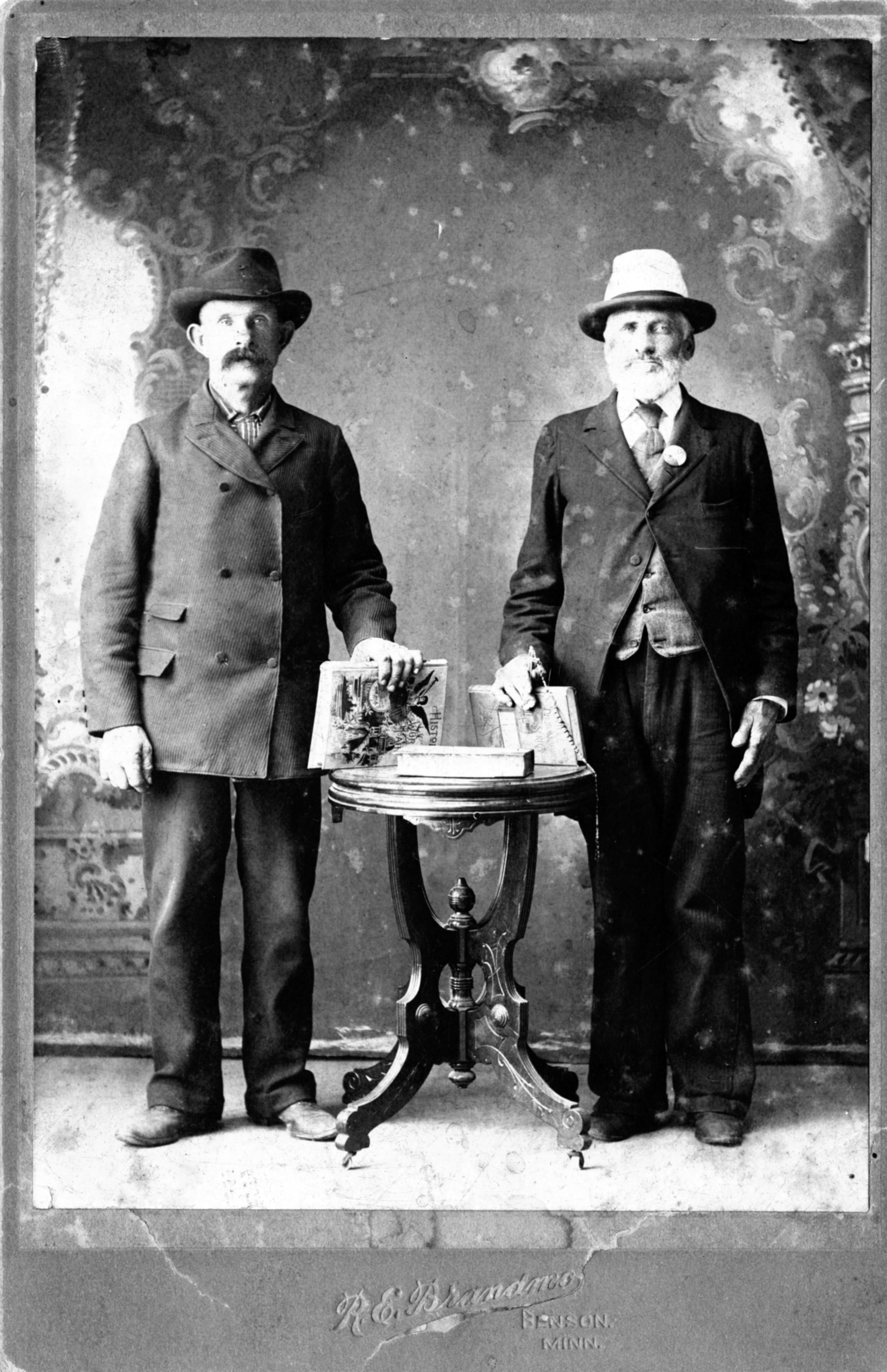
No clue who these two guys are...

Often when compiling a family history relatives will drift in and out of the picture, sometimes disappearing forever.  This can be especially true if you are Irish, attempting to make sense of a family history full of the gaps left by emigration, or American with Irish roots, sorting through migration throughout the entire United States (it is a big country!)

It may be frustrating for genealogists tracing relatives who appear to be missing with no paper trail to follow, but imagine what it was like for the mother who had gone ten years without hearing from her emigrant son, or the brother who was separated from his siblings in the confusion of arriving in America?

I was thinking about some of the mysteries in my own research when I remembered a database put together by the Irish Studies program at Boston College several years ago – Missing Friends: Ads for missing Irish immigrants from the Boston Pilot

The database consists of text entries for 38.701 ads placed by individuals looking for lost friends and relatives from the “Missing Friends” column which appeared in the Boston Pilot from October 1831 through October 1921.  The amount of information contained in the entries varies, but can include specifics about birthplace, dates of immigration, locations, relatives, and occupations.

To test the database, I searched for my great-great-grandfather Francis McMahon’s sister who, according to family folklore, was lost once the family arrived in America.  No records matched for that search, but I quickly transitioned into general browse mode of the database.  It is possible through an Advanced Search to search by words you enter in any of the fields contained in the entry.  This way, if you are unable to locate a specific name, you might luck out and find someone from the same townland or parish as your relative, with whom there may be a connection.  Search by relationship to find all the grandmothers who placed ads for missing grandchildren, or ads for missing farmers, railroad workers, or miners.

This database is definitely worth a look.  Let me know if you find anything interesting!  Leave a comment or send me an email – aine@archival-solutions.com.  I came across something interesting when I was browsing the database…well, interesting to me at least!

I did an Advanced with Fisherville, NH in the “Location after arrival” field.  Fisherville, NH was where some of my relatives first settled after arriving in the US.  Two ads resulted from the search, both for Thomas Keenan.  One ad was placed February 11, 1865 by his brother Peter, and the other March 11, 1865 by his mother Ann.  Thomas was my great-great-grandfather Patrick Foley’s brother-in-law (sort of convoluted relationship, I know!)  At any rate Thomas had left Fisherville for Australia in 1857 and the family lost touch with him at some point.  The ad placed by his mother says, “Afflicted mother Ann Keenan wants information.”  This makes me wonder…was it simply that they had not heard from Thomas that prompted two ads in two months, or was there something else going on in the family in Fisherville that made them want to find him?

This great database is just another way we can get closer to the stories of the Irish in America…


4 Comments

What’s Whit Week?

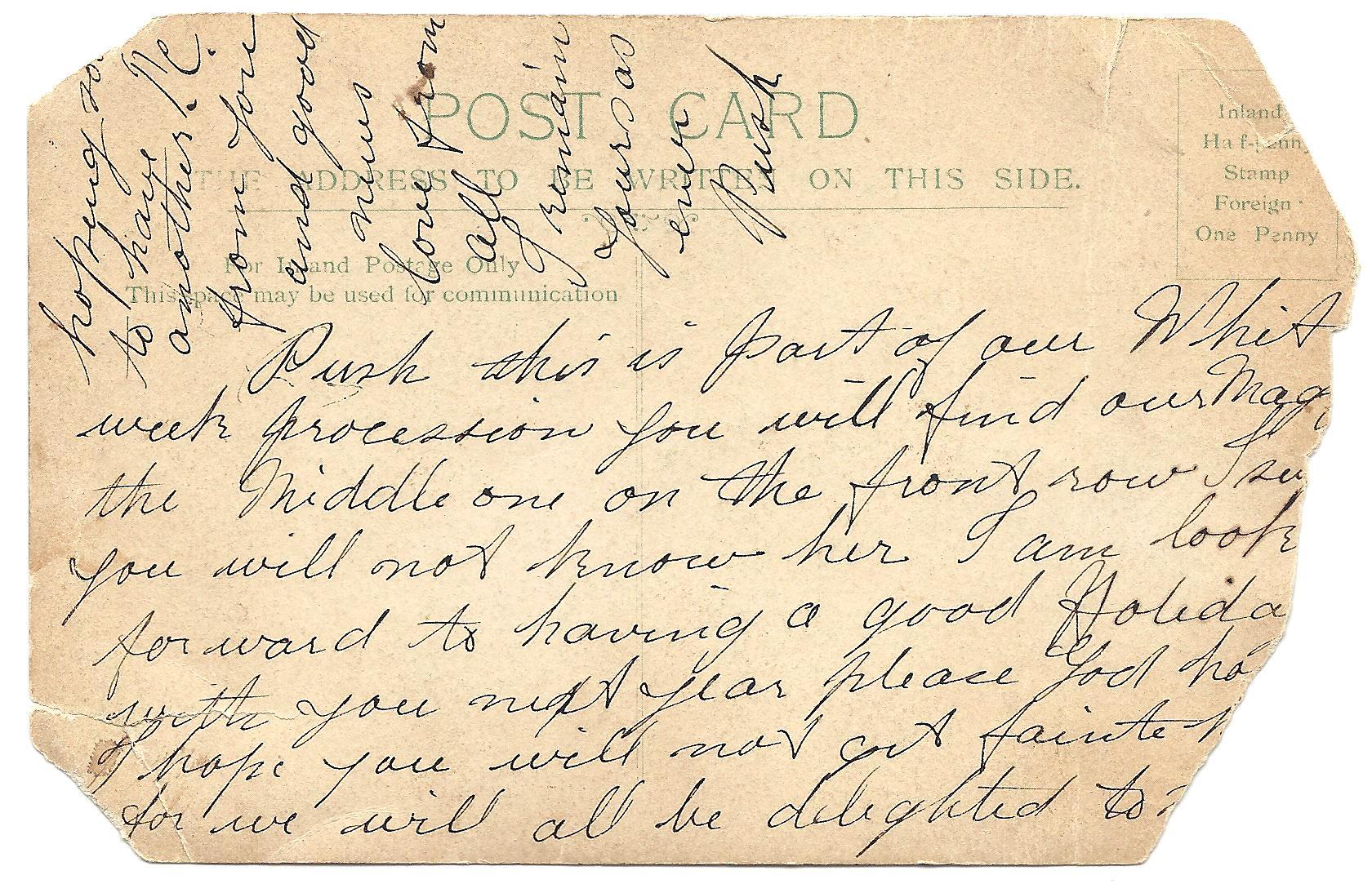
Whit Week Procession (postcard sent to Annie Hill Regan)

Whit Week is here and that can mean only one thing…hmmmm…I wonder what that could be?  If this was the early twentieth-century in Manchester, England, odds are it would mean donning a new white dress and marching in a Whit week procession like the ladies pictured above.

Since the demise of the Whit Monday bank holiday in the UK in 1967 and Ireland in 1973, I am not sure how much attention is  paid to the week following Pentecost (read more about Whitsun by clicking here.)

This photo of a Whit Week parade appears on a postcard from the early twentieth century, and survives in a small collection of photos and cards that belonged to my great-grandmother Annie Hill Regan (born in Kildare, emigrated to Minnesota 1899.)  With no postmark, no address, and rather ambiguous greeting and signature (both are Push), this little card is a bit puzzling.  My best guess is that the card came to Annie from her younger sister Bridget Hill Reynolds of Manchester, England.  From what I have read, processions like this were more popular in England, and the postcard mentions “our Maggie” – Bridget had a daughter named Maggie, who eventually emigrated to America joining her Aunt Annie in Minnesota.

The card mentions looking forward to a visit “next year.”  I wonder if Annie ever did travel from Minnesota to Manchester, England to visit her sister’s family?  Did she return home to Ireland on this visit?  I have searched for possible documentation of such a journey, but so far have come up empty.  I will have to keep at it and see what I can find.

Reverse of postcard

Maybe you can help me figure this photo out…

  • Have you seen Push as a nickname or slang in correspondence from the early 20th century?
  • Do the dresses provide a more concrete date to this photo?
  • Is Whitsun or Whit Week still observed in Ireland and England?

Any ideas?  Please leave a comment!

Have a good week!


1 Comment

Family Ties

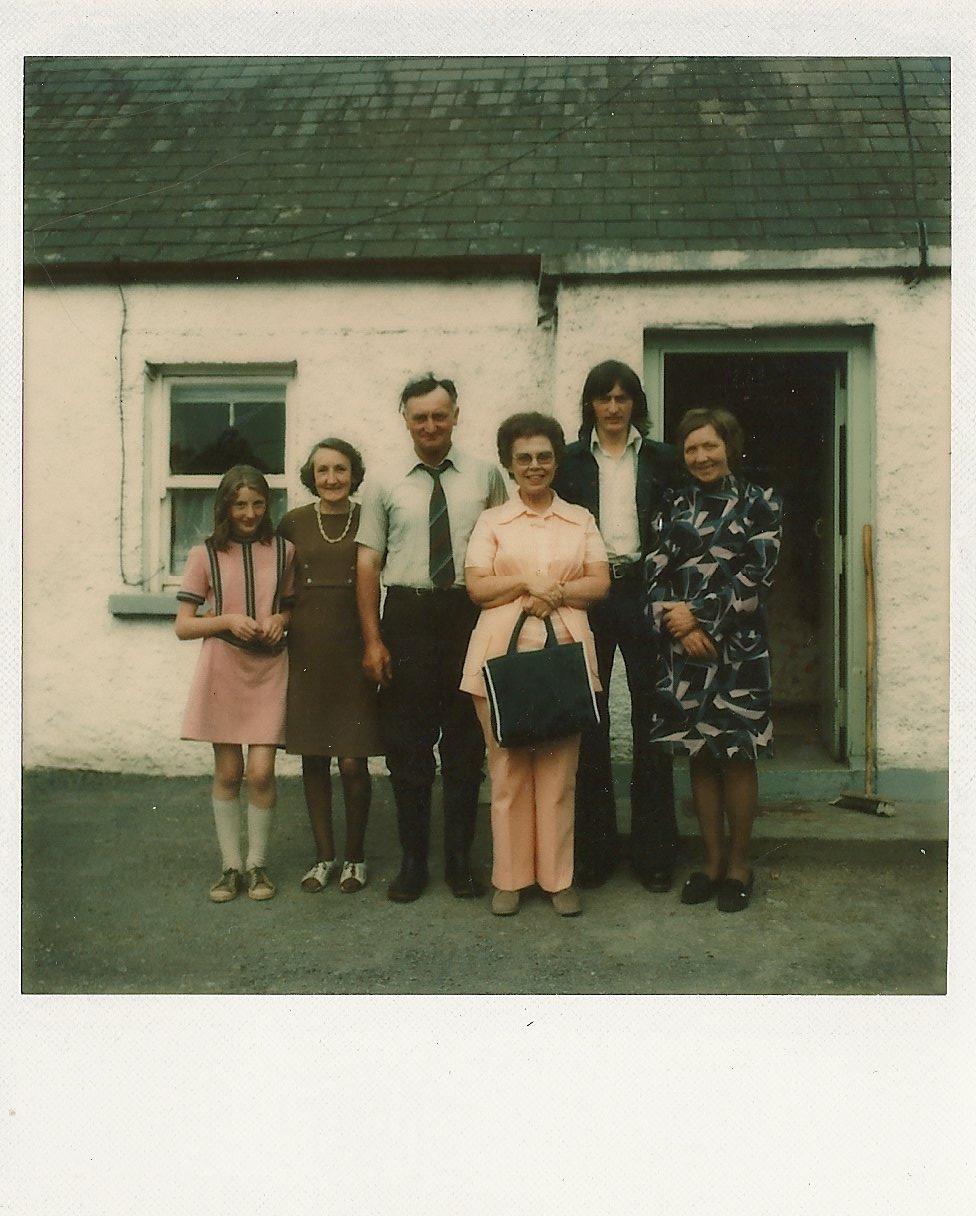
Can you identify the American in this photo?

Long before our 2009 visit with our McCormack cousins in Ballyedmond, County Laois, the family was welcoming American relatives back to the farm and home place.  We were not the first McCormack Yanks to make contact with our Irish cousins, but it seemed our family suffered from a bit of historical amnesia.  Much the same way that people don’t keep in mind the lessons learned by their parents and grandparents and proceed to make the same mistakes (war, high heels, trusting that a boom economy will last) my family lost touch with its history for a generation or so.

In 1934 my grandfather Bill McCormack, first generation Irish-American, visited Ireland with his Uncle Pat who had emigrated to the United States in the 1890s, and had designs on moving back to Ireland.  Poor health ultimately prevented Pat from returning to stay, but at least he was able to have one last visit home.  My grandfather’s cousin Paddy McCormack of Rathdowney, County Laois was a young man at the time and remembers this visit.

Paddy and Maura McCormack, far left.

My grandfather passed away in 1958, and while his sister Nellie stayed in touch with the family in Ireland, this connection was lost for my father and his sisters.  Also lost were the stories my grandfather could have shared about his trip to Ballyedmond and our Irish relatives.  I can think of one inquisitive granddaughter who would have relished these stories!  My father became interested in genealogy in the 1990s and after much research, new generations of the American branch of the family connected with the Ballyedmond McCormacks.  Initially I had the sense that my father had “discovered” our family roots, but of course they were always there, it just took a little digging.

I would love to see a snapshot from the 1934 visit, but to my knowledge there is no photographic evidence.  Instead, I share a photo from 1975 when another McCormack relative visited Ballyedmond (see top of post.)  The American I challenged you to identify is Eileen Garding, a first cousin to my grandfather Bill.  Andy McCormack is the gentleman in the shirt and tie – my grandfather’s first cousin who lived in the house in the background, the house in which my great-grandfather was born.

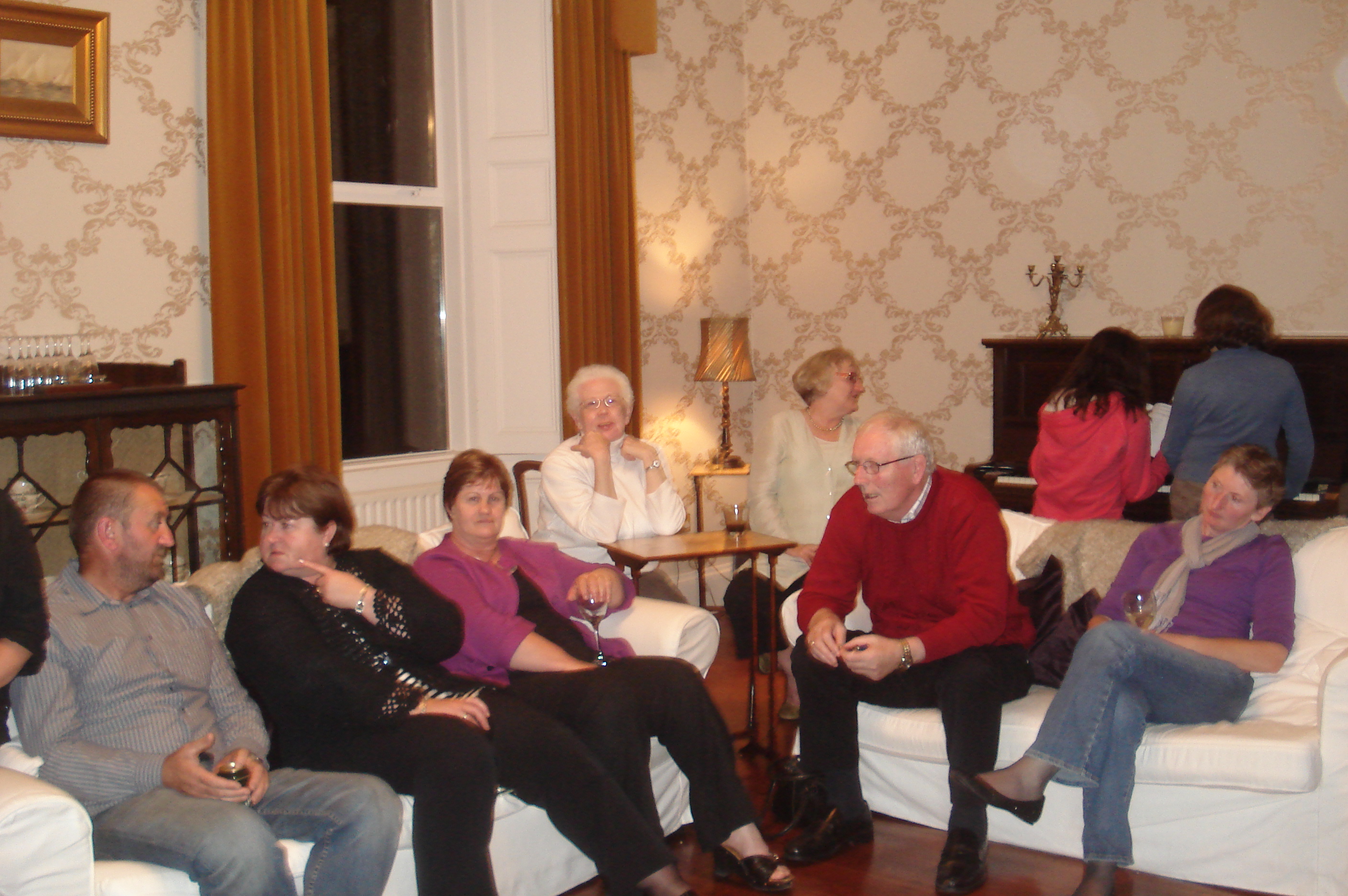
McCormacks -- 2009 (Ellen McCormack from first photo is seated at far right)

The 1975 photo provides a bridge from my grandfather’s visit in 1933 to my own family’s visits to Ireland. In 2000 when I first met my Irish relatives, I met Tess McCormack (pictured next to her husband Andy) and her daughter Ellen (next to Tess, at left end.)  I have not yet had the pleasure of meeting Ellen’s brother Martin pictured next to Andy in the blazer, but her other brother Jimmy and his wife Helen have graciously welcomed us back to Ballyedmond.

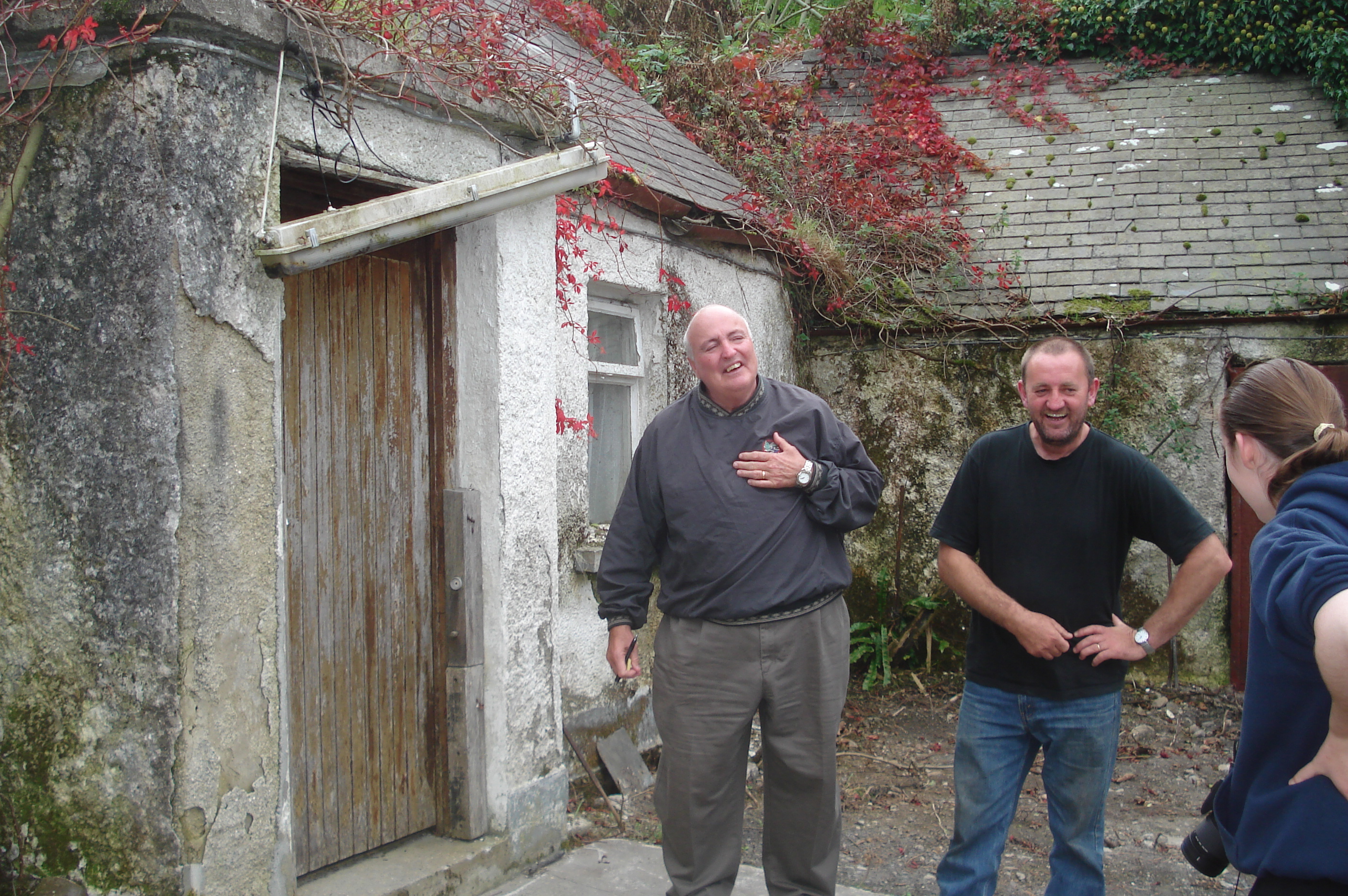
Two Jimmys by old house (same house in 1975 photo)

My sister remarked to me after the 2009 party in Ballyedmond that she felt like she had known our Irish relatives her entire life, not simply met them once or twice.  I felt the same way.  I guess that is what can be great about family, when you can pick up where you (or your grandparents) left off and move forward.  Hopefully my nieces will not need to recreate the family tree forty years from now.  I think the internet and computer files may have solved that problem!

Jimmy and Martin McCormack -- couldn't resist including this slice from the seventies...

Check out related posts…

Week of Welcomes: McCormack Style (Part I)

Week of Welcomes: McCormack Style (Part II)

Read my story that appeared on IrishFireside.com about our 2009 parties with the McCormacks — click here.


Leave a comment

A Photo of the Irish Diaspora in Minnesota

Jim, senior researcher for Archival Solution, writes about how his quest to identify all of the individuals in this photograph has resulted in new discoveries about his family research and new family connections.  He shows how photographs can often serve as catalysts in our research, leading us to dig deeper and develop a richer, more comprehensive understanding of our family’s history.

McCormi(a)ck Family Unites

Aine’s stories on her blog The Irish in America always motivate me to keep working on my own family project. For the past twelve years I have been researching the family of John Cormack who was born at Lochmoe in County Tipperary, Ireland in the last decade of the eighteenth century. According to family tradition he drifted up to Ballyedmond in Queen’s County (now Laois) where he married Catherine Purcell and started a family that would give several sons and daughters to the United States. My study has raised and answered many questions.  Among those was: “What is the reason for the multiple spellings of the family name? Why are there some “McCormicks” and some “McCormacks”? That answer is for another day however.

One of the other long-standing questions involves a picture given to me by a cousin about seven years ago. I knew it was a photo of a family function and there were 107 people in it. Of those I knew the identities of five individuals, including my Grandfather Andrew McCormack and his brother Mike McCormack, always known as our Uncle Mike. Uncle Mike’s wife, Katie Hannon and two of their first cousins were the others that I recognized. Being rather new to family history at that point I set a rather lofty goal for myself.  I decided I would identify all 107 people in the photo.

The picture was taken in July 1946 at the celebration of the 50th wedding anniversary of Phillip J.K. McCormick and his wife Ellen, nee Craven. Phillip was my 1st cousin two times removed.  My Cousin Zack Krueger, Phillip and Ellen’s grandson was very helpful in providing names for many of the faces. Every time I meet or correspond with a relative I pull out my photo and try to jar their memories. As of May 25, 2011 my goal is in sight.  I have identified all but eleven of those pictured. Complicating the process is that there are both McCormick and Craven relatives as well as many friends and neighbors of the family. Another problem is that there are people in the photo that are related to some of my relatives but not related to me. For example out of the fifteen Dalys shown in the photo I am related by blood to about half of them.

A recent meeting with some of my Nugent cousins provided the identity of several more of the celebrants. Researching the faces in the photo has been very rewarding for me. By putting faces on the names many of the McCormicks, Dalys, McDonalds, Burns, Nugents, Peteks, and Kruegers, have become real people and not just names found on old census and church records, as well as birth and death certificates


1 Comment

Glenamaddy Update

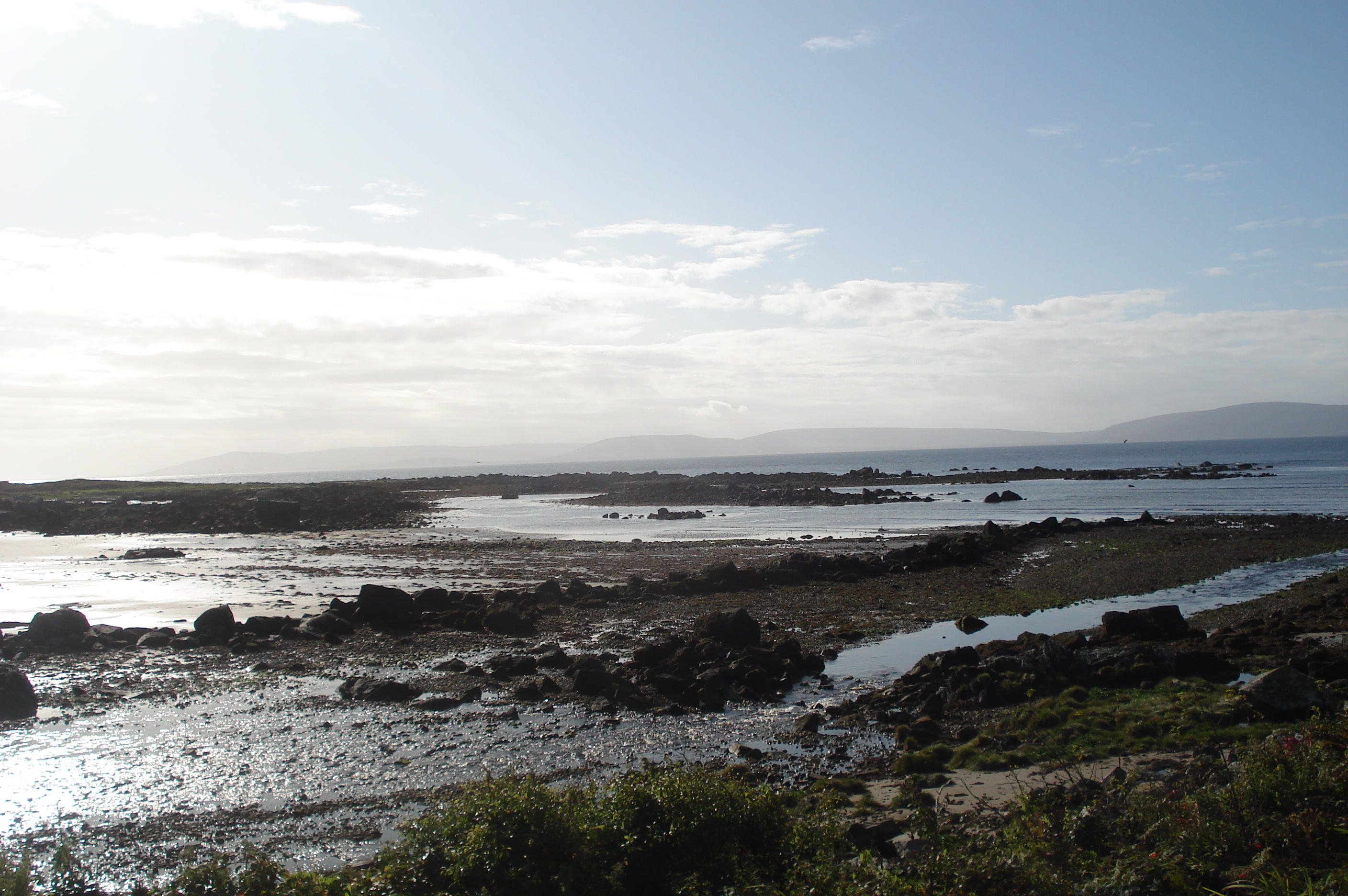
Galway -- not Glenamaddy, but a pretty shot from near Spiddal (2009, RBM)

Remember James who was looking for descendants of relatives who emigrated to the US from Glenamaddy, County Galway?

Jim, the head researcher with Archival Solutions, tracked down several leads for James based on the information he provided.  James was trying to locate his mother’s brothers and sisters in the historic records, with the ultimate goal of finding living relations.  Only one of his uncles remained in Ireland, and when he died his widow sold the farm in Glenamaddy and moved to Scotland.  James’ mother was the youngest sibling, and she moved from Glenamaddy as a young woman.  The five remaining McGuire siblings emigrated to America.

Before he contacted us, James had never spoken to a cousin on his mother’s side, least of all met one face-to-face.  This has all changed for James.  I would like to share his email:

Dear Aine,
Just to keep you up to speed – I have now had several emails (along with photos) from two of George and Arlene’s daughters.   One lot of photos showed the old farm buildings in Glenamaddy, along with one the people who remember the family.  He lived on the farm just below the McGuire family.
The sons of their daughter Linda, like my sons have red hair and her two boys would pass as brothers to my two sons!   They have also been in touch with other member of the family throughout the States.
My wife and I will finally meet Henry & Susan in September when our cruise ship docks in NY and we are staying over for a few days before flying back to the UK.
So you see you and your Dad’s work paid outstanding results for me – I will be forever grateful.  God bless you and yours.
Warm regards

How fantastic that the children and grandchildren of the McGuire sisters are able to compare notes on family history, photographs, and memories!  James had photographs belonging to his mother of American relatives that he is now able to identify.  I can’t wait for an update later this year, and am delighted we were able to help James find the American branch of his family tree.  Emigration tore so many Irish families apart over the years; it is nice to know that it is never really too late for family to come together again.

If you are interested in learning about what happened to Irish relatives who emigrated to the US, or would like to connect with your long-lost cousins, please visit our Find Your Cousins page for information on how we can help you like we helped James.  And do not hesitate to contact us — we would love to hear your stories!


1 Comment

Mystery Priest

Photograph pin, ca. 1890-1900

This “photo-pin” belonged to my great-grandmother Annie Hill Regan.  Annie passed away in 1937, and this pin was among a small collection of cards, photographs, and memorial cards that made their way to my mom.  Click here to see a 1930s Christmas card from Annie’s sister Katie in Ireland.

I remember seeing this pin as a child and being puzzled as to why my great-grandmother had such a thing.  Who wore a pin with someone’s picture on it, especially a picture of a priest?  I didn’t get it, but I was relieved that the fad of priest-photo-pins didn’t carry over to the 1980s – the thought of wearing a picture of my parish priest Father O’Sullivan stuck to my cardigan gave me goosebumps!

Several years ago I became curious about the identity of the priest in the photo-pin, and I started to ask questions…

  • Could this be Annie’s brother, or maybe an uncle or a nephew?
  • When Annie came to the US, she worked as a housekeeper for Father Molloy.  Maybe this is him?
  • Were pins like this common or did she have this specially made?

I have never been able to answer these questions.  I know Annie had one brother, John, but I know nothing about his life, and I have seen photos of Father Molloy, but only as an older man and there isn’t a strong resemblance.

Maybe you can help me with the third question.  Has anyone come across an item like this, maybe in an old box of your great-grandmother’s treasures or at an antique shop?  The pin measures about two inches in diameter with a coppery, scalloped edge.  Leave me a comment if you have any ideas…

Check out this website for more on photo jewelry.


14 Comments

Kilmichael Roots

In 2009 I visited with Father Jerry Cremin of Kilmichael Parish in County Cork.  He shared some records he had on my family.  Two of my great-great-grandfathers (John Regan and Patrick Foley) left the parish in 1864 and came to the United States.  Father Cremin’s descriptions of the history and the landscape of Kilmichael were enlightening and entertaining.

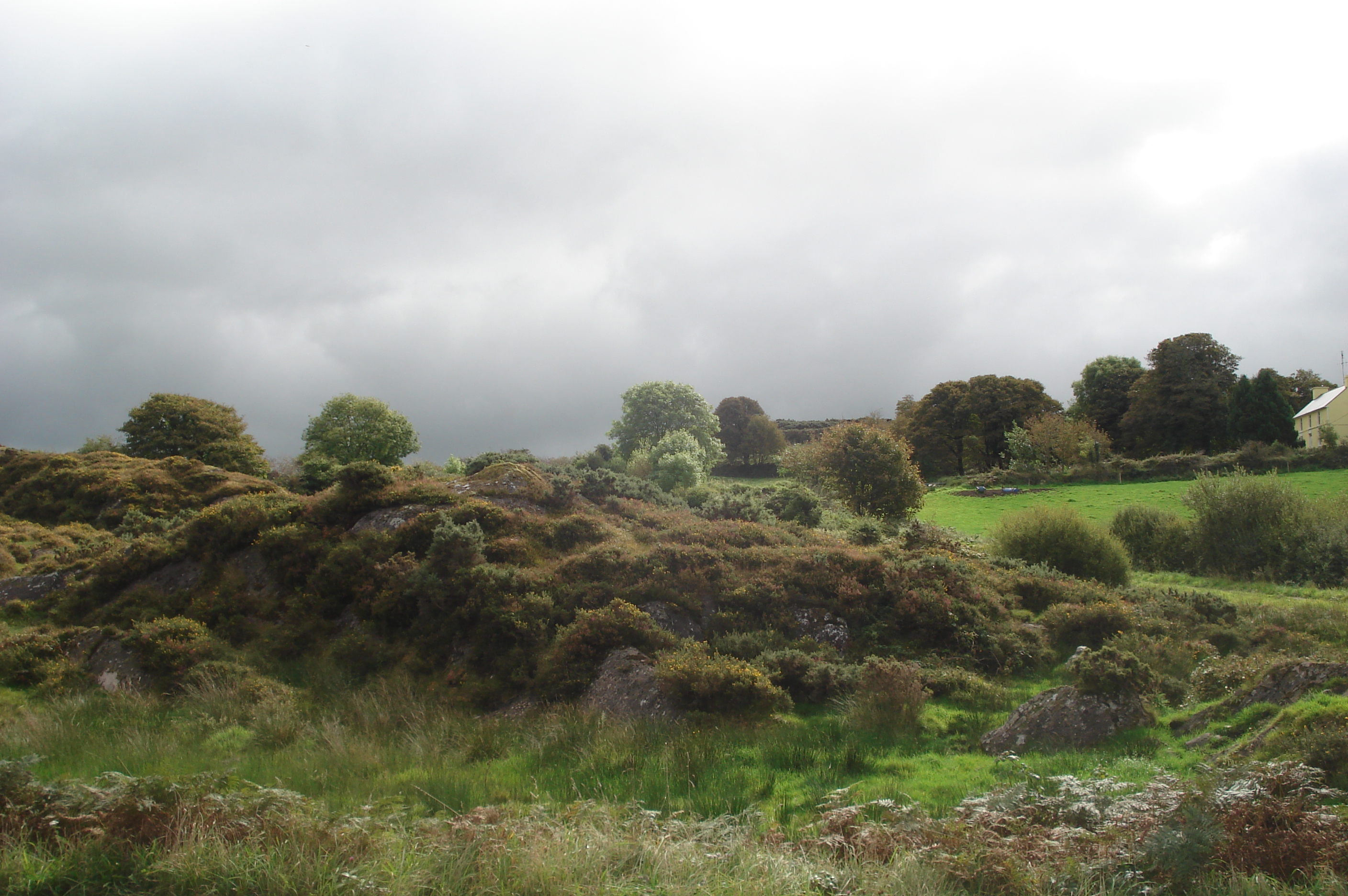
View from Kilmichael Ambush memorial, County Cork (2009, Regan McCormack)

When I saw this search topic that brought someone to The Irish in America –  Irish immigrants able to read and write? – I immediately thought of my visit with Father Cremin.  Census data from when John Regan settled in the U.S. shows that he was unable to read or write.  Father Cremin told me that this was not unusual for a man from Kilmichael in the mid-19th century.  He continued to say that John Regan most likely didn’t even speak English, let alone read or write it, when he left Kilmichael.

John Regan

I am a bit embarrassed admit that I had not even considered that any of my ancestors were Irish speakers, but it stands to reason.  Perhaps John Regan never gained command of the English language.  “Old Johnny Regan” is remembered by his grandchildren as a somewhat gruff man, who didn’t seem that interested in young children.

Patrick Foley, who also came from Kilmichael, was literate.  My grandma always told me that her grandfather Foley received his education in a hedge school in County Cork.  In the U.S., Patrick Foley was active in township government and held offices in the Ancient Order of Hibernians and St. Patrick’s Benevolent Society.  My grandma seemed proud of her grandfather, but she would say that the Foleys thought they were better than everyone else.

Patrick Foley

I have a book with Patrick Foley’s  name in gold on the cover, O’Halloran’s History of Ireland.  I am not sure of the exact origin of the book, but I suspect he acquired it while living in New Hampshire, after emigration.  Perhaps it was connected to his participation with the St. Patrick’s Benevolent Society or AOH.  Has anyone else seen this book?  Let me know by leaving a comment!

Last week a couple more search topics appeared on the list:

  • Regan family Kilmichael
  • Foley Macroom

I wish the person who searched for these items would have left a comment…maybe we are talking about the same families!  Click here to read about the first generation of Foleys and Regans born in the United States.

Happy St. Patrick’s Day to you all!


12 Comments

Heaps of Love: A message from home

I am always interested to see what internet searches bring people to The Irish in America.  Here are some of the recent search topics:

  • Irish beginnings in America
  • Irish people searching for American relatives
  • What was the life of an Irish immigrant like in America?
  • Irish emigrant letters
  • Irish immigrants able to read and write?

Emigrant letters can be an important tool for Irish seeking information on relatives who came to America.  Many Irish people who have contacted me for assistance on locating relatives have some memory of letters from these emigrants.  Either the actual letter, or stories of the letters received over the years.  Some people still have the letters and can refer to them for details of the relative’s life in America.

In Irish family history research census data, passenger manifests, and birth and death certificates provide the pertinent information you need to complete a family tree.  If you go a little further, obituaries and newspaper clippings will expand your understanding of the individuals you are researching.  Photographs can put faces to the data, but letters can provide intimate glimpses into the lives of your ancestors.  The emigrant letter is fast becoming a treasured source for information on the experiences of Irish emigrants (see this article on a recent donation to the Cork City and County Archive.)

Of course, for those of us researching in America, we won’t find the emigrant letter, but rather, if we are lucky we might find a response to that letter.  I often day-dream of discovering a dusty box of letters in a long-forgotten attic, letters written to one of my ancestors that would provide some insight into the life they left behind in Ireland.  Alas, I have yet to find such a stash, but I do have a little something.

My great-grandmother Annie Hill Regan would have been my best bet for saving such correspondence.  We have many of her things – china, furniture, and photographs – but no letters, only a tidy envelope containing two Christmas cards and several postcards.

Christmas card, Katie Hill Howe to Annie Hill Regan (front)

Christmas card, Katie Hill Howe to Annie Hill Regan (inside)

The card pictured above was sent to Annie in 1930 by her sister Katie from Ireland.  I can only imagine the cards and letters the two sisters exchanged during the thirty years that passed since Annie left County Kildare to begin a new life in Clontarf, Minnesota.  Because people did not often save their correspondence, that makes this small packet of my great-grandmother’s so important to me.  Obviously the contents were important enough to her that she set them aside and saved them.  This tells me much about my great-grandmother, as well as provides a peak at the family she left behind in Ireland.

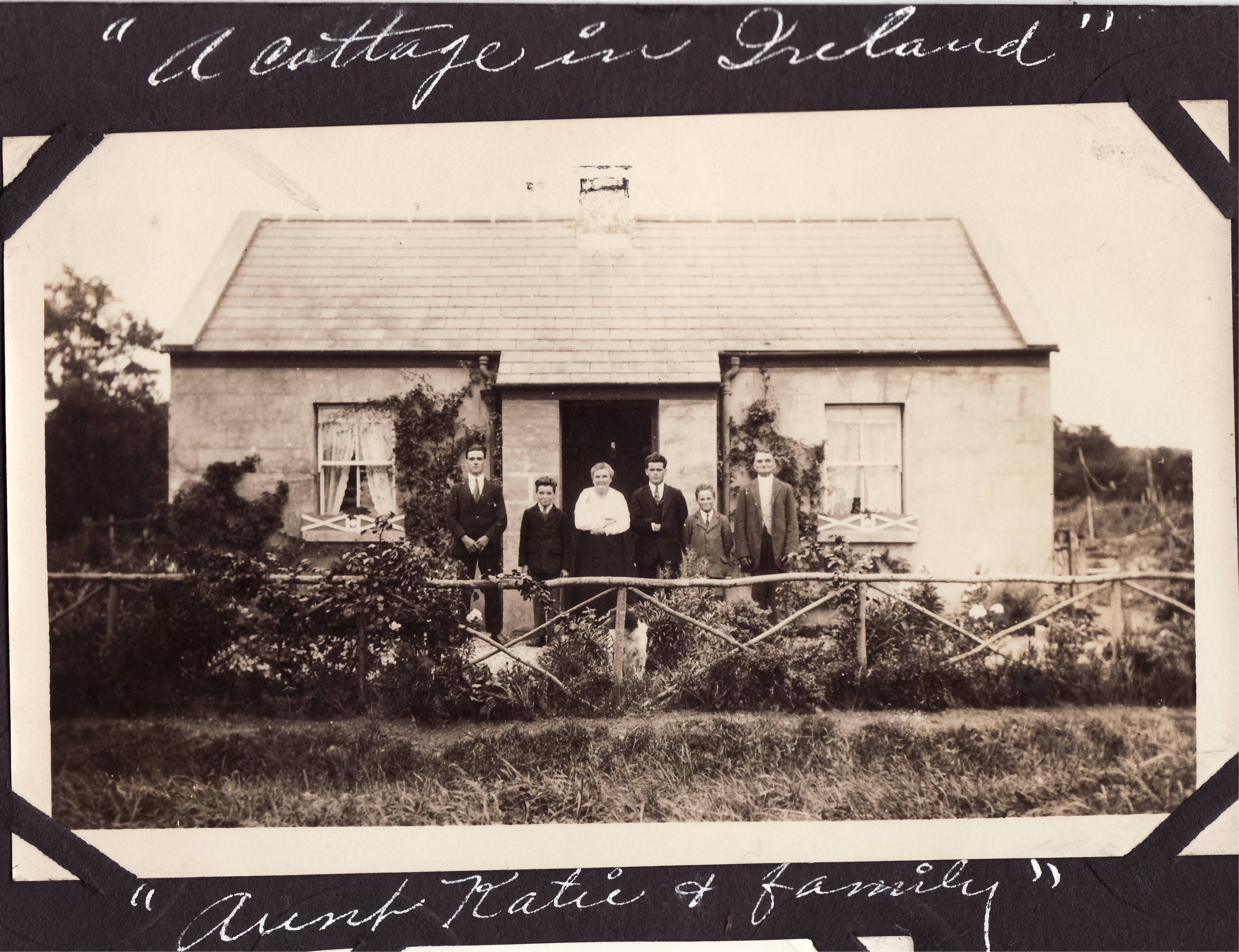
Katie Hill Howe and family, Johnstown, County Kildare (photo from MJ Harshmann)

I wanted to mention a great little book, The Reynolds Letters: An Irish Emigrant Family in Late Victorian Manchester.  This collection provides a glimpse into an Irish family’s emigration experience – from County Leitrim to Manchester, England and on to Chicago, Illinois.  Great read for anyone interested in the Irish who emigrated to England and America.

Next time I will address another item on the most common searches and how that may contribute to an absence of letters.