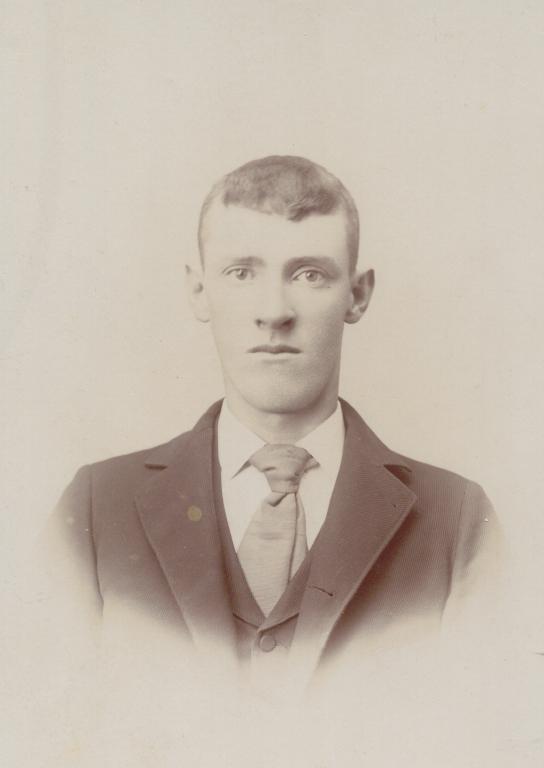
Cornelius John Regan was born one-hundred-fifty years ago in Fisherville, New Hampshire. He was the second child and first son of Irish immigrants John Regan and Mary Quinn. Following traditional Irish naming practices, the first-born son was named after the paternal grandfather. The American Cornelius would be known as Neil; his grandfather in Kilmichael, County Cork was called Conn (Cornelius is the English equivalent of the Irish name Conchobar).
This is the youngest Neil we have in a photo. (Private Family Collection)
I have previously written about Neil on his birthday. I shared how his Irish Republican tendencies emerged at the sight of a certain flower and how he got a kick out of sharing his birthday with Flag Day. Today, I will share a quick memory from Neil’s granddaughter (and my mom), Eileen Regan McCormack.
Neil was the only grandparent Eileen knew. Neil moved in with his son, John, and John’s wife, Agnes, shortly after they married in 1941. So, Grandpa was in place by the time Mom came along a few years later, and he would be a presence in the home for the next seven years.
Eileen remembers her grandpa always reading while sitting in his chair by the dining room window. He read books and the newspapers, and when she was around, he often read aloud to her. Eileen specifically recalls him reading the “Little Lulu” comic books to her. While not part of his usual literary repetoire, he enjoyed the mischievous antics of the silly little girl as much as Eileen.
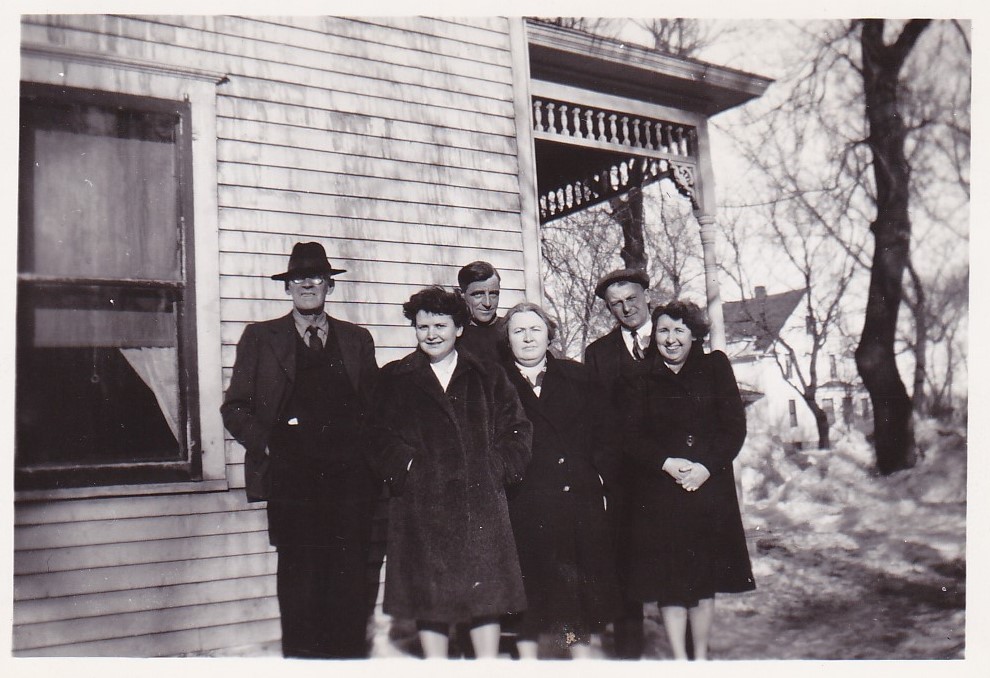
Neil, Agnes (McMahon) Regan, Otto and Mary (McMahon) Fuchs, Edgar and Margaret (McMahon) Nelson, 1944. (Private Family Collection)
Eileen and her grandpa were a good pair, both of them quiet, easy-going, and shy. Neil also fit in perfectly with the McMahon clan his son married into (see photo above).
Neil passed away on June 30, 1951. He was waked at the Regan home in Minneapolis and brought back to Clontarf for the funeral Mass at St. Malachy Catholic Church and burial.
Mom and I began sorting through the research we had compiled on the 300 Cashel Street house in Clontarf, Minnesota. It has been fun looking through the folders and making sense of the floor plans Mom drew up nearly twenty years ago!
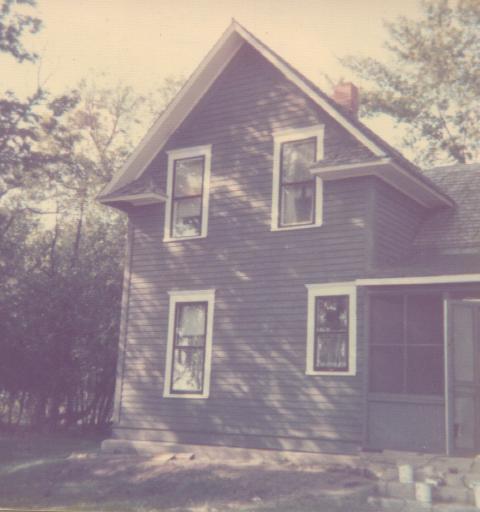
It is challenging to write about a house that no longer stands. It would be wonderful to walk around the house to see how it fits into the environment. But that’s OK…at least we have some photos of the place before it was dismantled.
300 Cashel Street, north side (Private Family Collection)
We realized we didn’t know when the house was built, and then we realized we only had property deeds for 1906-1934.
I called Carla Roberts, the department head of the Swift County Land Records Office, and asked if they could tell from their records when a house was built. Carla said to me that information is not usually included in the records held by their office since they are concerned with the transfer of land titles and deeds. She suggested we visit the Assesor’s Office (just across the hall from her at the Swift County Courthouse in Benson, Minnesota). We may see a change in taxes assessed, indicating new construction took place.
Too bad there were no building permit requirements. Mom and I wonder if there might be any building information in the Clontarf Township Records. I believe those are located at Swift County Historical Museum. We, of course, made tons of photocopies.
We are planning a trip to Clontarf in July, so we will visit the Land Records Office and the Assessor’s to see if we can find records before 1906 and ascertain when the house was built. We can’t remember if we looked at any earlier deeds and didn’t make copies of them. This is why it is essential to always keep good notes with your research!
We also need more details on what happened after 1934. In 1934, a foreclosure involved the Home Owners’ Loan Corporation (HOLC), a government program established to offer homeowners in default options for refinancing to avoid foreclosure. Obviously, the program was not successful in the case of the Regan family. We are looking into HOLC for further information. HOLC was a New Deal program during the Great Depression – check out this great site for tons on the New Deal.
Up next…a former resident of 300 Cashel Street has a landmark anniversary of their birth on Wednesday, so check back for a special tribute.
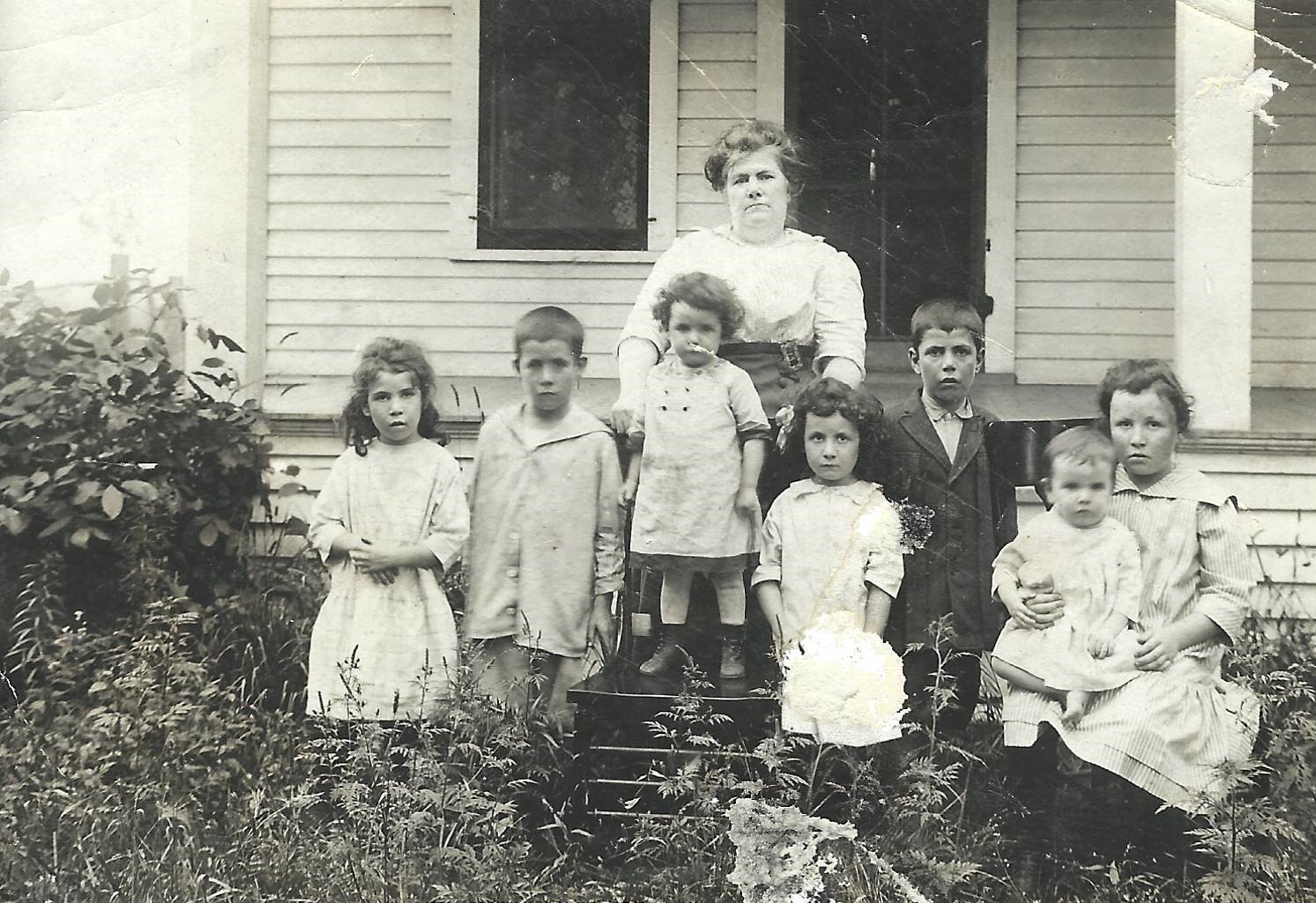
I posted this photo last Sunday for Mother’s Day because it features two special moms in my family (my great-grandma and grandma). I am sharing it again today because of what is behind them: the house.
McMahon Family, 1914 Clontarf, MN (Private Family Collection)
This photo hung on the wall above my grandma’s kitchen table for years. Grandma would often glance at the picture and smile while we chatted, played cards, or had something to eat. The photo sparked Grandma’s memory, and a family story or tidbit from her past, relatable to the current activity or conversation, would follow. Regardless of what the memory was, Grandma would always have this to say in conclusion: “You know, your grandpa’s family moved into that house several years after this photo was taken, and that is where he grew up.” Grandma loved making that connection.
Recently my mom and I came across a folder in our Clontarf archive labeled 300 Cashel Street, the address of the house in the photo. The folder includes notes, hand-drawn house plans, photographs, and copies of property deeds. Nearly twenty years ago, we began looking into our Clontarf, Minnesota roots with the ultimate goal of writing a book. We love to research and have done tons of it throughout those years but have not yet written the book. There are many explanations (excuses?) for this, but the scale of the project is somewhat overwhelming.
So, we decided to start small. We will use the house on Cashel Street to tell part of the story. We are not sure what this project will look like, but we are motivated to take the excellent research we have done out of the archive and shine a light on it. What can this little house on Cashel Street tell us about early twentieth-century life in a Minnesota railroad community? Stay tuned to find out!
In the 1970s or 1980s, my mom embroidered the saying, “Mother is another name for love,” and placed it in a green-painted frame as a Mother’s Day gift for her mom. I can see it hanging on grandma’s wall, and I remember when I was young, considering the idea that my mom could possibly love her mom as much as I loved both of them.
I have shared this photo several times, but it is my favorite for Mother’s Day.
McMahon Family – 1914 (Private Family Collection)
My great-grandmother Mary Foley McMahon is with her seven children outside of their Clontarf, Minnesota, home. My grandma(Agnes) is standing on the chair before her mother.
“All that I am, or hope to be, I owe to my angel mother.” — Abraham Lincoln
I am getting old. I’m not saying this because I am over fifty and my hair is gray, but because I said this to friends last weekend when we were planning a night out:
“Let’s go somewhere quiet…so we can chat.”
Turns out my friends had the same idea and the four of us spent a lovely Saturday evening gathered around Ace’s dining room table, catching up, laughing, and snacking on chips and guacamole, chocolate-covered pretzels, and brownies. The evening was low-key and comfortable and felt old-fashioned (the Hamm’s may have added to the nostalgia).
My mom often reminisces about the regular family dinners, get-togethers, and card parties of her youth. Often hosted by her parents, John and Agnes (McMahon) Regan at their South Minneapolis home, the evenings and Sunday afternoons were sometimes held at McMahon and Regan cousins’ homes peppered throughout the city.
Here are a few snapshots of my Irish American family around the table. The common denominator of these photos is the McMahon family – three generations of descendants of Francis and Catherine (McAndrew) McMahon. Once the McMahons moved to Minneapolis from the Clontarf area in western Minnesota, they branched out making matches with those of non-Irish heritage. Names like Fuchs, Freitag, Nelson, Oien, and Bebus joined the McMahon family tree. My grandma Agnes was the only of her siblings to marry fellow Irish American (and Clontarf native) John Regan.
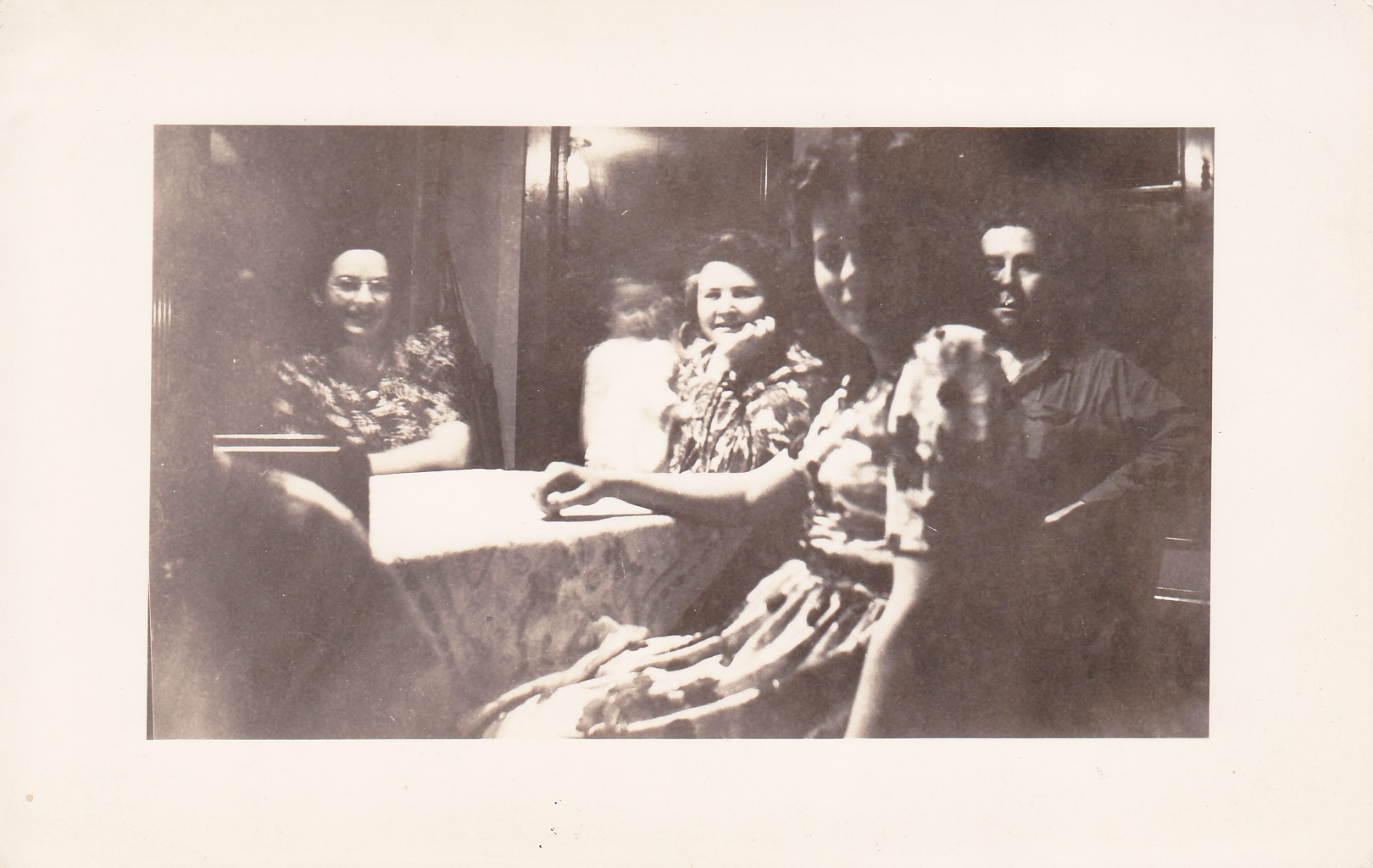
Minneapolis, 1943 (Private Family Collection)
My grandma Agnes McMahon Regan is on the right, resting her head in her hand, next to my grandpa John Regan. The others are identified only as, “Foley girls – Aunt Bid and Uncle Tim’s.” Aunt Bid was Bridget McMahon. Mom says this is most likely is at Aunt Bid’s kitchen table. Maybe the others are Kit, Cecilia, or Loretta Foley?
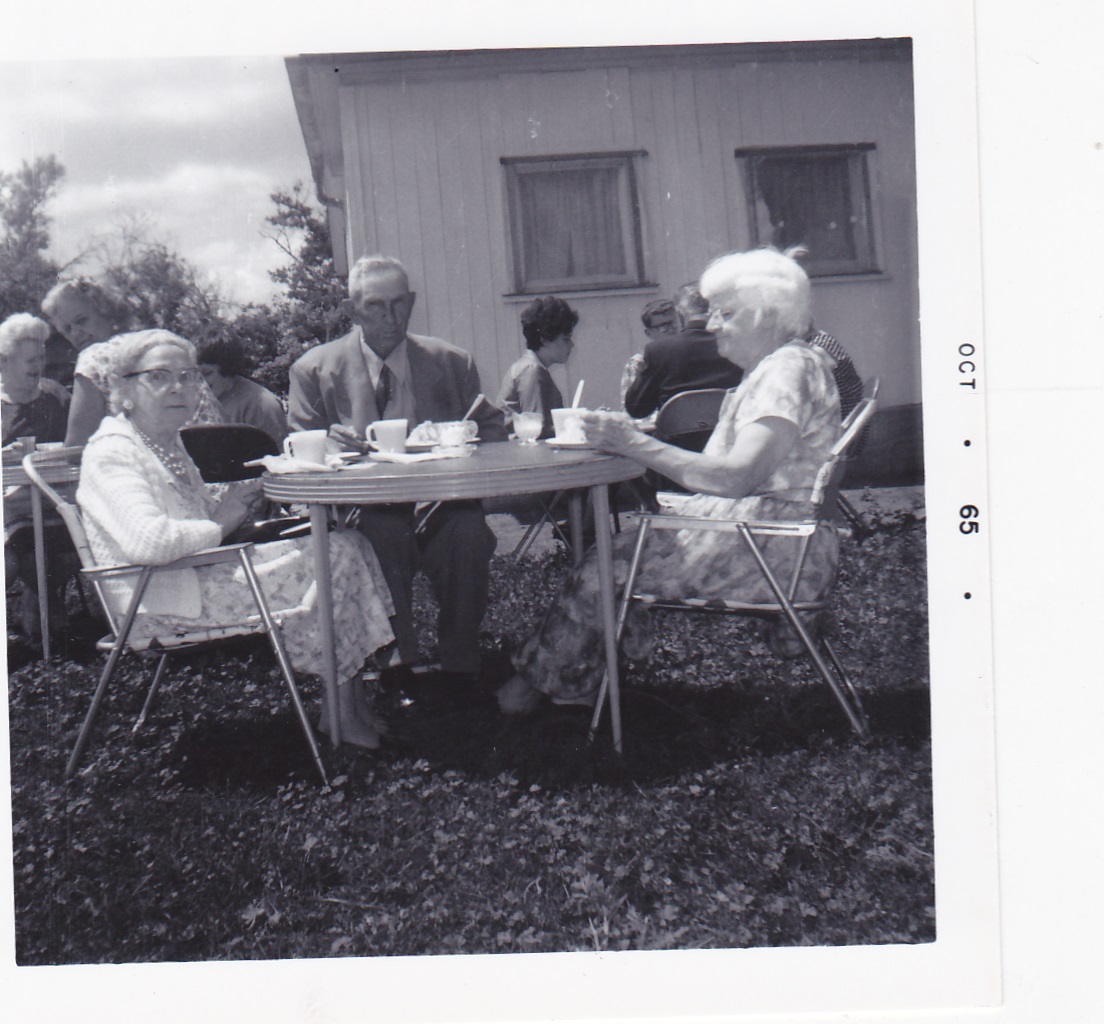
McMahons al fresco, 1965 (Private Family Collection)
Rose McMahon is on the left, with her sister Mary McMahon and husband Will Herr. Could this be at Mary and Will’s fiftieth wedding anniversary celebration in Bristol, South Dakota? Written on the back is, “Eileen and John Regan may be at next table.” Mom can help me out with this.
Benson, Minnesota, about 1963 (Private Family Collection)
From left: Fran Fuchs Lainsbury, Dody Fuchs Abbott, and their mother, Mary McMahon Fuchs at the table in the Foley house in Benson. That’s my Aunt Mary (actually a great aunt, but always just Aunt Mary to us). I think Aunt Mary looks so cute here. I only remember her when she was twenty years older.
Wedding, about 1963 (Private Family Collection)
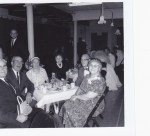
Some members of the McMahon family gathered at the wedding of Mary Fuchs (possibly). From the bottom left: Frank, John, Aunt Rose McMahon, Ella (John’s wife), Benie Oien, Rose “Dodo” McMahon Oien. I bet Frank’s wife Bertha took the photo unless Frank had a penchant for handbags (“Frank, hold my purse for a minute while I take a picture.”) I wonder where John and Agnes are sitting? And who is that guy standing on the left, behind the table, like he is in the picture?
Does anyone else wish we could step into old snapshots like these and stay for a moment, just long enough to catch Bertha asking the table for a smile and to hear John laughing? And maybe even long enough to pull Dodo aside and ask her why old Aunt Rose is sitting between John and Ella.
Note: Mom told me that the guy at the left behind the table is her cousin Jim Nelson. So, if this was a modern photo, he would have squeezed himself in somewhere to be part of the shot! Also, mom thinks this may have been Dodo and Bernie’s wedding (that would explain Bernie’s natty ensemble.
Mary Foley was born on this day, January 2nd, in 1875, in Fisherville, New Hampshire.
Mary Foley (later McMahon) about 1876 (Private Family Collection)
Mary was my great-grandmother. When she was young, she was known as Minnie, and some of her friends called her Bones. Mary’s daughter, and my grandma, said she only ever heard her called Mom or Ma.
Nellie and Minnie, about 1900 (Private Family Collection)
When we moved my grandma from her apartment, there were dresser drawers full of neat little bundles of fabric, remnants from decades of sewing projects. Tucked into one of the drawers was an embroidery hoop holding a once-taut piece of muslin. Work had begun on the piece but was interrupted.
Mom could tell by the signature brown stitches that this was Minnie’s handiwork. Was it abandoned when she had to go to the hospital in October of 1945, where she would pass away? It is likely that is why my grandma would hold onto an unfinished embroidery project for nearly sixty years. That’s why Mom and I have kept it for twenty more years. I can picture Minnie smoothing the fabric and tightening the hoop, threading the needle, and eventually slipping the needle through the cotton and setting the work down for the last time.
This is an embroidery pattern that was also floating around in Grandma’s things:
Now, I am off to bake a spice cake. For me, molasses, nutmeg, and cloves combine to create an olfactory time machine. In a couple of hours I will be enjoying an afternoon cup of coffee and a slice of spice cake with Minnie.
Minnie and her children – Clontarf, MN about 1915 (Private Family Collection)
My mom and I have this photo labeled “Old Foley,” but that was just a guess. I think it is time to revisit this lady in her pretty cloak.
If she is an “Old Foley” could she be related to this guy?
Patrick Foley, circa 1865 (Private Family Collection)
Or maybe she’s an “Old Crowley” and related to Patrick’s wife, Mary Crowley. I made a case for this some years ago…
Mary Crowley Foley, circa 1865 (Private Family Collection)
The photo appears to have been taken at a studio in San Francisco. I don’t know of any Foley or Crowley connections to California. My family’s westward journey ended in Tara Township, Minnesota (at least for a couple of generations). But then there is so much we don’t know…
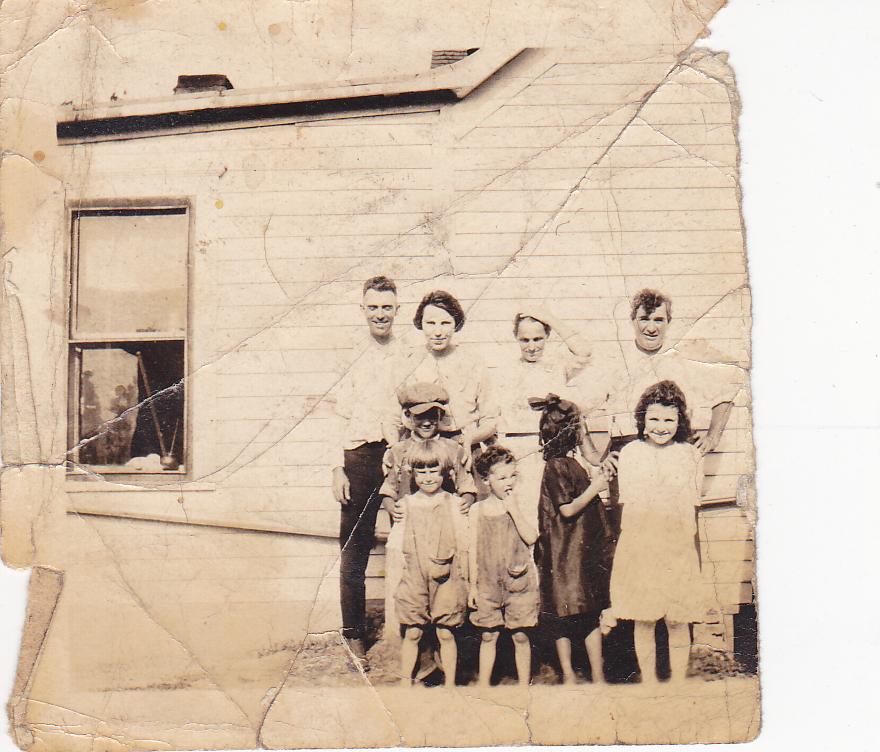
I need some help from my mom on this one. I know that is my great-grandpa Tom McMahon on the right, with his daughter Agnes (my grandma) standing in front of him. Who are the rest? Could they be Tom’s brother Frank (left), his wife Agnes McGraw McMahon and their children? Their oldest, Richard, was the same age as my grandma. That could be him in the cap by his dad. Three girls followed him in age: Florence, Eileen, and Gertrude, but I can’t quite tell.
And then there is the lady next to Tom. Could it be his sister Kate? She may have still been in Clontarf.
McMahons in Clontarf, Minnesota, ca. 1921 (Private Family Collection)
Subtract about seventeen years from the gentleman standing on the left above and do you get the one standing on the left below?
Tom and Mary Foley McMahon wedding (seated), with Frank McMahon and Margaret Foley (standing), 1904 (Private Family Collection)
I believe this one is from the 1930s. My grandma on the left with her sister Rose and Eileen McMahon, possibly one of the little ones in the first photo.
McMahon Cousins (Private Family Collection)
One more, just because I noticed how my grandma was holding two fingers on her right hand with her left hand and it reminded me of this cute photo.
Agnes and her brother Frank McMahon, 1919 (Private Family Collection)
Mom – please set me straight on dates, identifications, etc.
On Saturday, they are holding an auction at the former St. Malachy Catholic Church building in Clontarf, Minnesota. They are selling pews, windows, plant stands, and anything else that lacks “religious significance.”
I was interested in the half of the old confessional that was stored in the sacristy. They removed it from near the entrance when more room was needed to accommodate the new, larger caskets. I am out of luck; they aren’t selling it. Not sure how it is more religiously significant than the pews which held the devout parishioners week in and week out for over a century…
A report of the Dedication of the “new” St. Malachy’s Church appeared in the December 15, 1896, edition of the Benson Times. The event was a big deal, not just for Clontarf Catholics, but the pomp and ceremony must have intrigued everyone in the area. I wonder if it is the most people who have ever been in Clontarf at the same time? I’ve included a copy of the newspaper article, but it’s not great, so I also added a transcription below.
According to the article, the builders left the plaster ready for fresco painting. I wonder if it was ever done? Did Tim Reardon tell us that there was some painting on the ceiling that was covered up by the 1960s remodeling? My memory fails at the moment. Does anyone know if they ever got a bell?
The Beautiful and Impressive Ceremonies Witnessed by a Large Crowd Tuesday Morning.
Tuesday was a gala day for the Catholics of Clontarf in particular, and of Swift County in general. It brings the occasion of the dedication of the new church at that place. For a number of years the members of St. Malachi’s [sic] parish have had in contemplation the erection of a new edifice of worship, but owing to the stringency of the times, it has yearly been deferred, until early last spring when the contract was let and the work pushed until there now stands in the little town a church which is a credit to the congregation and a standing monument to the untiring efforts of its beloved and respected pastor, Rev. Father Oster.
The building is a substantial frame one, 40×100 in the main with a 20 foot ceiling, with a large and well-arranged sanctuary and sacristy in the rear end. There is a seven foot basement under the entire building, in which is located the heating plant, which is of the latest improved pattern. A very noticeable feature in the church is an alcove just back and above the main altar, in which are placed the statues of the Sacred Heart and adoring angels, the opening being beautifully draped with rich curtains. The roof of the alcove is of colored glass which throws mellow light upon the figures, giving the whole a beautiful appearance. In the front end of the building is located a gallery, which reaches across the entire width, and about 20 feet deep. This will be for the use of the choir and is reached by a winding staircase from the front entry. The plastering has been left in what is known as the “floated” condition, so that at some future time it may be frescoed. Besides the main altar, there are two side ones, which stand on either side of the building inside of the communion railing. The windows are of beautiful colored leaded glass and are the fights of individuals or societies, the names of the donator appearing on each window. Taken as a whole the interior presents a pleasing appearance. On the exterior rises a gracefully modeled steeple, the top of which towers high above the building. In this, provisions have been made for a large bell, which no doubt, will be placed therein at no great distant day. The accompanying cut gives a much better idea of the appearance of the building than words could convey. The church will comfortably seat 500 persons, and will accommodate this congregation for years to come.
The Dedication
The day of the dedication of this building to the purposes for which it was erected was an ideal one, and an early hour delegations from Murdock, DeGraff, Benson, Danvers, Hancock, and in fact from the entire surrounding country, began arriving, and by 10:30 fully 1,000 persons were gathered in and about the building. At the time stated the dedication procession started from the main altar, headed by Father O’Connor of DeGraff who acted as master of ceremonies for the day, followed by six altar boys, Bishop Cotter, of Winona, and a number of priests coming next. A tour of the outside of the church was made and the regular ritual work of the church for such occasions gone through with. On returning, the litany was recited and the interior of the building blessed.
After the dedication ceremonies had finished, the Blessed Sacrament was brought from the old church to its new abode in solemn procession. This was one of the most imposing events of the day: the bishop clad in his purple robes, the priest in vestments, surrounded by altar boys in bright gowns carrying colored lanterns and candles, made a scene which will not soon be forgotten by those who witnessed it.
After this came the solemn high mass, which was celebrated by Rev. Oster, Father Kane acting as deacon, Father Egan as subdeacon and Father O’Connor as master of ceremonies. The music was furnished by the combined choirs of Clontarf, Benson and Murdock; Chas. Maginnis presiding at the organ, and assisted by a string orchestra. The fact that the day was the 40th anniversary of the ordination of Father Oster made this mass the more impressive, and many a silent prayer was offered, asking that the life of the “grand old man” might be yet spared for many years. The following priests, in addition to those mentioned above, assisted at the mass: Rev. Gauvreau, of Beardsley; Rev. McDavitt, of Mannanah; Rev. Boland, of Litchfield; and Rev. O’Brien, of Graceville.
At the close of the mass Bishop Cotter took the pulpit and read the 83rd Psalm, which he used as his text. On opening, he paid a glowing tribute to the life and work of Father Oster. He told of his work in the pioneer days of Minnesota, how he had visited and ministered to the sick and those in want when such services called for long tiresome rides over unsettled country, and that he had never been wanting where duty called. The bishop congratulated the members
Of the parish in their good fortune of having such a man as Father Oster to lead and teach them. Assuring them that if they would but follow his counsel they would certainly reach the goal for which all christians are striving. After further congratulating the congregation on the completion of their beautiful house of worship, he proceeded with his sermon, and for over an hour held the vast audience spell-bound and all were loath to have the discourse come to a close. Bishop Cotter is a sound reasoner, a profound scholar and a finished orator, and it is indeed a treat to hear him. At the close of the sermon he gave a few words of advice in regard to the financial management of the church affairs. The services of the day then closed with a solemn benediction.
While the bishop and priests were administering to the spiritual needs of the congregation, the ladies were busy preparing for their temporal needs, and by the time services were over, they had a bountiful dinner in readiness in the old church, and to this place a grand rush was made. The sum of 25 cents was charged and it is needless to say that the ladies realized a neat sum for their efforts.
It was expected that Arch-bishop Ireland would be present, but just at the last moment he was called to Chicago.
Sketch of Rev. Oster.
This article would be incomplete without giving something of the life and work of the pastor who has spent so many years in building up the Clontarf parish.
Rev. Anatole Oster, the senior pastor in charge of the Clontarf parish and also the Benson Catholic church is very favorably known to most of our readers. He is highly esteemed, not only by the members of his several parishes, but by all who know him regardless of religious affiliations, for his many estimable qualities and deep religious convictions, He was born in Alsace Lorraine about 63 years ago. He spent his early childhood in France, where he commenced his studies for the priesthood. He came to this country in early manhood and finished his studies under the venerable Bishop Creaton [sic], the first Catholic bishop of St. Paul, by whom he was ordained to the priesthood 40 years ago; the festivities of the dedication of this new church being the 40th anniversary of the celebration of this first mass. He has spent all the years of his ministry in Minnesota and was identified with the growth and development of the early settlement of the territory as well as the state since its organization. He shared in the privations of the early settlers and missionaries, and has seen and rejoiced at the development and growth of the state as well as the church of which he is a conspicuous member. He has seen the latter institution grow from a society of only three priests to minister the religious wants of its members in Minnesota and the Dakotas, to the proportions it now assumes, viz: An archbishopric at St. Paul, with five suffragan bishoprics located at Duluth, Winona, St. Cloud, Sioux Falls and Jamestown, N.D., respectively, and a working corps of nearly 500 priests, besides numerous hospitals, houses of refuge, and institutions of learning, two of which latter institutions are located at St. Paul, being St. Thomas college and the HIll seminary, which ranks with the best in the country.
In all of the work incident to this tremendous growth and development, Rev. Oster has taken a very conspicuous part, and always with great credit to himself and his church. He is a man of deep and scholarly attainments, and an exemplary citizen as well as a model minister of the gospel. He has been located at several different points in this state during his ministry, and has built a number of other churches as well as the dedicated one on Tuesday. He came to Swift county in the early part of 1878 and has since resided at Clontarf, also having charge of the Catholic Church in Benson, and those at Danvers and Hegbert.
The inscriptions on two of the windows at St. Malachy’s were a mystery to my mom and me. We wondered about Axier and Milmoe. We know so many of the old Irish family names from our research into Tara Township, the village of Clontarf, and the railroad, but are much less familiar with the non-Irish families and those from Hoff Township.
Following are short profiles on the Axier and Milmoe families, based on some general Ancestry.com info and the St. Malachy’s account books. If anyone has anything to add to this, or has information on any of the other window donors, please leave a comment and let me know!
Photo by Anne Schirmer, 2021
THE FAMILIES BEHIND THE WINDOWS
Charles Axier Family
The Axier family called the Clontarf, Minnesota area home for less than twenty years, but, like so many families, they made their mark on the town, the Church, and the community. The most visible contribution is the stained glass window at the “new” St. Malachy Catholic Church (1896).
BRIEF HISTORY OF THE AXIER FAMILY IN THE UNITED STATES
Charles and Marie Axier were born in France in about 1830 and 1836 respectively. They came to the United States around 1849 and were married in 1856. In 1865, Charles is in the Illinois State Census living in Prairie du Rocher in Randolph County. Information is limited from this census, but the Axier family consists of three people and their livestock has a value of $25. Swift County records indicate that Charles Axier was a veteran of the U.S. Civil War.
In the 1880 U.S. Federal Census, the Axier family lives in Hoff Township, Pope County, Minnesota. Charles is 51 years old and Marie is listed at 35 years old. Their daughter, Julia (21) is listed in the household of Father Oster in Clontarf working as a domestic servant. The 1885 Minnesota State Census list Charles (age 55) and Marie (age 40) still in Hoff Township in Pope County
Charles and Marie moved to town, appearing in Clontarf in the 1895 Minnesota State Census living near the Church and rectory. Charles (64) and Marie (55) are employed as gardeners (due to their location and close association, likely for St. Malachy’s).
By 1900, like Father Oster, the Axiers are no longer living in the Clontarf area. Julia married August Boucher on May 8, 1900, in Swift County and the couple shows up in the 1900 Census in Otsego Township in Wright County. Julia is the stepmother to August’s two children – Emma (7) and Arthur (18). Charles (70) and Marie (60) live with the Boucher family in Otsego.
In 1905, Charles 64) and Marie (55) have relocated to Anoka in Anoka County (per Minnesota State Census). Charles is employed as a laborer and Marie has no occupation listed. Charles dies in 1909 and is buried at Calvary Cemetery in Anoka, Minnesota. His gravestone states that Charles was born in 1835. (Note on the accuracy of ages: Census data is sometimes unreliable due to family members reporting information who don’t know the correct age, language barriers, mistrust of the census-taker, and simply individuals not wishing to reveal their age.)
Marie moves back to Julia’s home in Otsego. Julia’s husband, August, passes away on September 13, 1916 and by the 1920 Census, Marie (84) and Julia (64) are living alone at the house. Marie died on January 31, 1927, and is buried next to her husband in Anoka’s Calvary Cemetery. The date of birth given on her stone is January 13, 1936.
STAINED GLASS WINDOW
8/8/1896 – Charles Axier partial due to window fund $10.00
10/12/1896 – $5.00
SAMPLES OF OTHER AXIER FAMILY CONTRIBUTIONS
10/25/1879 – Grave Yard Fund C. Axier $1.00
6/15/1886 – Peter Pence collection Mrs. Axier $.15
6/16/1886 – Charles Axier Church dues $29.00
7/3/1887 – Dues Charles Axier $5.00
6/2/1896 – To friend’s (Mrs. Axier) offering $.50
Milmoe and Mockler Families
John MIlmoe was born in Ireland about 1830. In 1870, he appears in the US Federal Census living in ward two of Oshkosh, Wisconsin with his wife Anna and family. John is employed as a blacksmith. Anna Angel was also born in Ireland around 1828 and after coming to the US, married Daniel McCarthy in Milwaukee, Wisconsin in 1845. McCarthy passed away in 1851. John and Anna married about 1855, creating a family of children from Anna’s first marriage and children of their own.
By 1880, the family has relocated to Hoff Township in Pope County near the village of Clontarf, where John is now a farmer. Anna Milmoe passed away in 1890 at the age of 62. Her death may have inspired the lovely stained-glass window at St. Malachy simply inscribed, Milmoe.
John and Anna’s daughter Mary married William Mockler of Hoff Township in 1886. The couple lived near the Milmoe farm, as well as other active St. Malachy’s parishioners – Goulets, Chamberlains, Chevaliers, Daniels, Axiers, and Milmoes. The ladies of these families are among those responsible for a second window donated by the Ladies of Pope County. Mary Milmoe Mockler was mentioned a number of times in the financial records of the church. She organized her friends and family in raising funds for multiple windows at Saint Malachy’s Church.
In 1900, John Milmoe is living with his daughter Mary Mockler, who is widowed with three small children aged 8-13. John Milmoe died in 1911. He is buried at Greenwood Cemetery in Hayward, Sawyer County, Wisconsin amongst Mockler family members.
MILMOE IN THE EARLY ACCOUNTS BOOK
9/17/1878 – Collection/pew rent – $5 James
MOCKLER IN THE ACCOUNTS BOOKS
10/6/1878 – Collection/pew rent – $2.00 John
4/13/1886 – C/P – $5.00 Edward
7/9/1887 – C/P – $15.00 Edward (T. Goulet and Isidore Daniel each gave $5.00)
Note:
Information in this article is from census data from Ancestry.com and the St. Malachy Financial Records, copies in Eileen McCormack’s files. These copies and the information contained here do not represent the complete financial record. Eileen McCormack made the copies when the books were at the parish house in Clontarf, 2004-2005. The books are now located at St. Francis Catholic Church in Benson, Minnesota.
Eileen R. McCormack and Aine C. McCormack, March 9, 2022
Anne Schirmer, the local Clontarf historian, has put together a book of St. Malachy’s photos and Clontarf history. Let me know if you would like to purchase a copy! Last time I checked, they were $15 – shipping may be extra. Anne organized a “History Open House” in Clontarf in March and is planning on hosting another event soon. Leave a comment and I will get in touch. Thank you!






 The Irish in America