The Irish in America


Leave a comment

The Windows of St. Malachy’s

When sunlight streams through the muted colored panes of glass, the church is filled with subtle warmth, comfort, and beauty. It is all about the windows at St. Malachy’s Catholic Church in Clontarf, Minnesota.
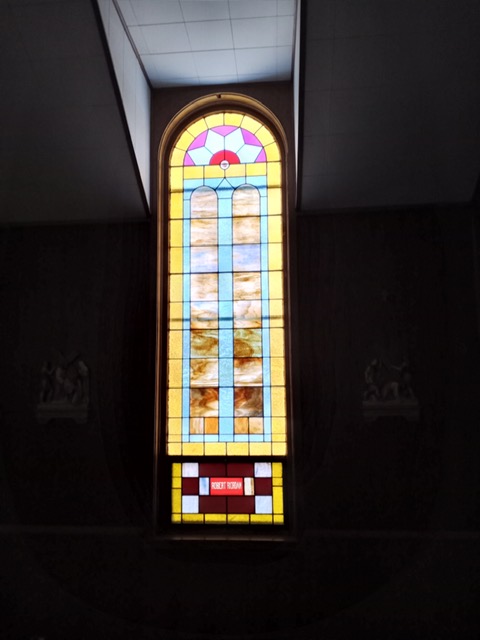
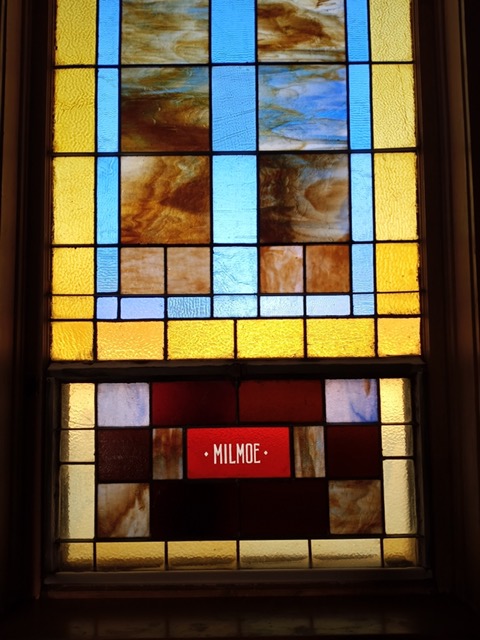
Window donated by Robert Riordan – inscription is in the center of the “ventilator” section near the bottom of the window. (Photo by Anne Schirmer, 2021)

The following is an informational listing on the windows of St. Malachy’s. The details are there: size, cost, payment, dates, and donors. If you are interested in any of these windows, go to Clontarf, Minnesota this Saturday, May 21st at 9am for the auction!

THE WINDOWS OF ST. MALACHY’S

The most striking feature of the 1896 St. Malachy Catholic Church building is the beautiful stained glass. The windows give character and a sense of elegance to the simple frame church. Father Oster wanted to put Clontarf and St. Malachy’s on the map, to represent the thriving, prosperous community it had become in less than twenty years. A St. Malachy parishioner (or group of parishioners) paid for each stained-glass window. Inscriptions of the donor’s name(s) appear on most of the windows.

Who made the windows?

Father Oster hired Brown & Haywood of St. Paul, Minnesota to design and manufacture all the stained-glass windows in the church. In the 1890s, Brown & Haywood was one of the most sought-after stained-glass studios in Minnesota, employing some of the top artists in the region. Many civic buildings and churches throughout Minnesota featured their stained glass, including St. Mary’s in Waverly, Minnesota. The company moved from St. Paul in 1898, shifted its focus, and was later sold to the Pittsburgh Plate Glass Company.
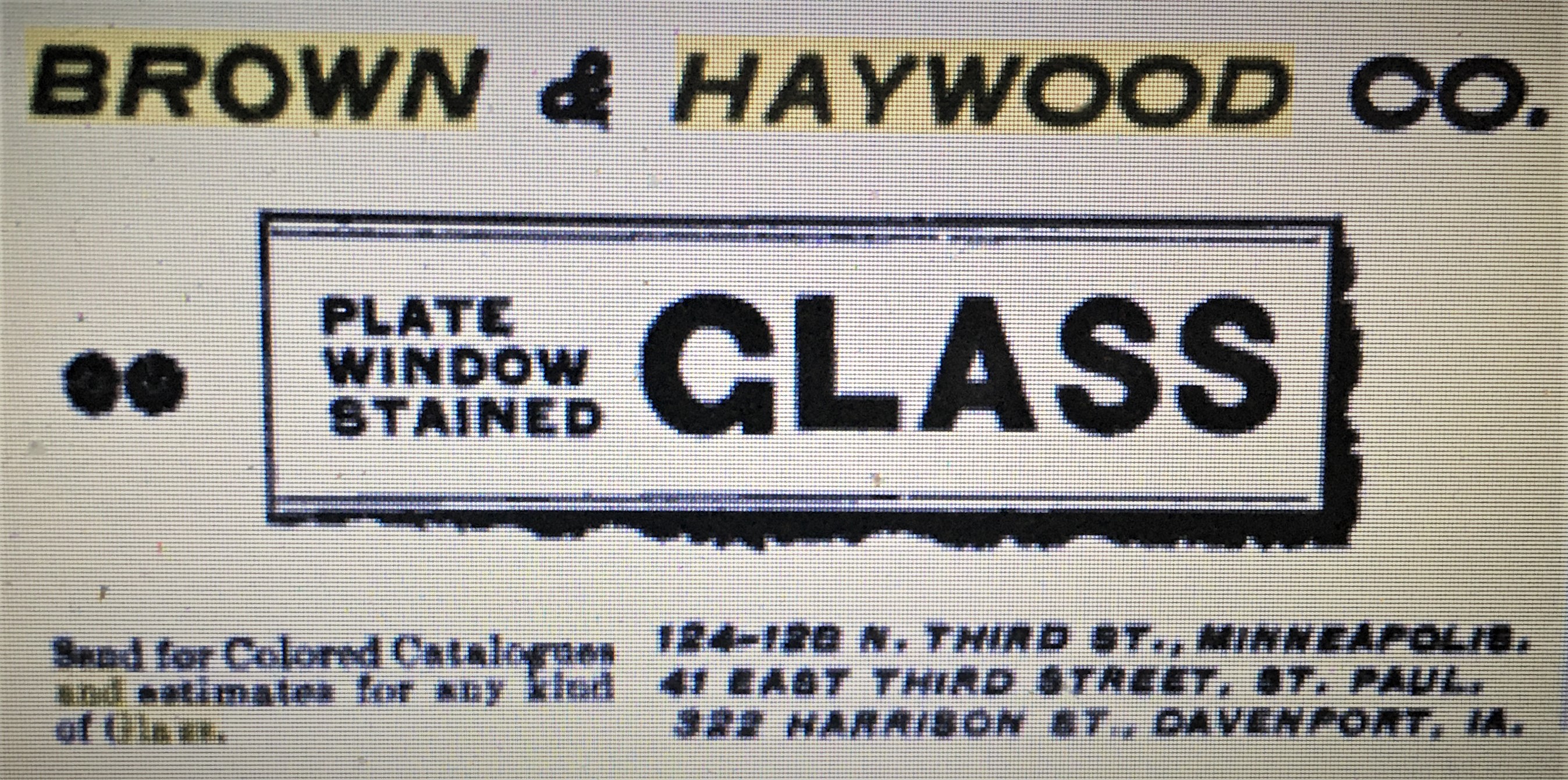
Advertisement in the “Improvement Bulletin” Vol. XV. No 9. January 30, 1897.

How much did they cost?

An account of the full window charges from Brown & Haywood from November 13, 1896, appears in the financial book on the date of payment, December 27, 1896. The amounts listed represent windows and installation.

10     36×130 leaded     $325.00                (five on each side)

  2      36×70 leaded          $35.00               (left side “duplex” on front)

  2     36×70 leaded           $35.00               (right side “duplex” on front)

  1     56×56 leaded           $21.00               (“Rose” window)

  1     57×28 leaded           $11.00               (transept above door)

16     20X26 CATH            $  9.00               

12     Ventilators @2.50    $30.00

14     Inscriptions @.50   $  7.00

TOTAL CHARGES (including approx. 60% discount on two small windows): $454.20

When did St. Malachy’s pay?

December 5, 1896       $150.00

December 27, 1896     $256.70

January 15, 1897          $ 93.80

TOTAL PAYMENTS: $500.50 (missing pages might account for this perceived over-payment)

Who were the donors?

(Note: The following figures from 12/8/1896 differ slightly from earlier entries due to shipping or installation charges.)

TEN Main Windows (five on each side along length of building, all inscribed)

     -Ladies of Pope County – 3 windows – paid $60.90 (December 8-9, 1896)

36×130 leaded window (each)

Account entry for July 14, 1895, states that the July Fourth Fair raised $41.48 for stained glass windows.

This included proceeds from Mrs. Mockler’s fancy table ($21.18) and quilt raffle ($11.75).

     -Young Folks – 2 windows – paid $40.60 (December 8-9, 1896)

36×130 leaded glass (each)

Entry from July 10, 1896, lists $30.00, proceeds from “play by Clontarf Troop for windows.”

     -Ancient Order of Hibernians (AOH) – paid $20.30 (December 27, 1896 via J. O’Donnell)

36×130 leaded glass

Breakdown of Charges for 36×130 windows (listed under AOH):

32 ½ leaded glass              $16.25

Ventilator                           2.50

Inscription                           .50

Transportation                1.05

       TOTAL                             $20.30

     -Charles Axier – paid $20.30 (December 8-9, 1896)

36×130 leaded glass

     -John Milmoe – paid $20.30 (December 8-9, 1896)

36×130 leaded glass

     -Isidore Daniel – paid $20.30 (December 8-9, 1896)

36×130 leaded glass

     -Robert Riordon – paid $20.30 (December 8-9, 1896)

36×130 leaded glass

FOUR Front Windows (“Duplex” style on either side of façade)

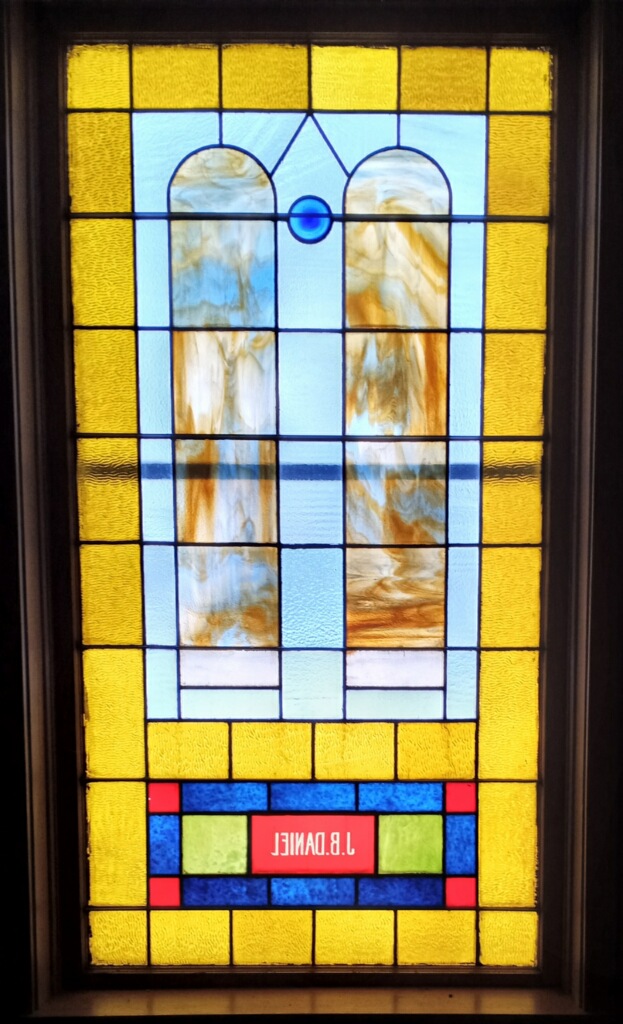
     -Jos. Daniel – paid $21.60 (December 8-9, 1896)

     -J.B. Daniel – paid $21.60 (December 8-9, 1896)

ROSE Window (on front of building)

     -Eugene Daniel       $9.50   56×56  12/9/1896 (no inscription)

TRANSOM Window (above front door)              

     -Simon Conaty – Contractor/builder on project              $5.20   57×28  12/9/1896 (inscription)    

AGONY IN THE GARDEN (above and behind placement of the original altar)

     -The only window depicting a scene at St. Malachy’s

     -No specific information was found in the account books for this window  

Note:

Information in this article is from copied pages from the St. Malachy Financial Records from Eileen McCormack’s files. These copies and the information contained here do not represent the complete financial record. The excerpts were copied by Eileen McCormack when the books were at the parish house in Clontarf, 2004-2005. Record books are presently at St. Francis Catholic Church in Benson, Minnesota.

Eileen R. McCormack and Aine C. McCormack, March 9, 2022


1 Comment

If You Build It…

Actually, they were already in Clontarf, they just needed a better church. Parishioners were filling up the small 1878 church building every Sunday and Holy Day, and for baptisms, weddings, and funerals in between. Clontarf needed a church to reflect the success of the growing community that began as a small colony just twenty years earlier.

Clontarf is an Irish place name and St. Malachy is the first Irish-born saint to be formally canonized, but the parish was built by Irish and French-Canadian residents. The two groups did not always get along, but they were united in faith by Father Anatole Oster, a native of France.

There are LOTS of names listed below…if you see one you recognize, let me know about your connection to Clontarf, Minnesota.

Wouldn’t you love to know who those people are on the front steps of St. Malachy Catholic Church?

PLEDGES AND PAYMENTS: CONSTRUCTION OF THE NEW ST. MALACHY CHURCH

So much can be learned from looking through the account books. Sure, we see how much folks contributed to the construction, but we also gain an understanding of how important the church was to the residents of Clontarf and the surrounding townships. They were invested in the church and the community, they had a stake in its success. This can be seen in the money pledged and the hours of donated labor.

Letting Go of the Old

Part of the preparations for the new church was dealing with the old one. They would need the old church for mass while the new one was constructed and they wanted the new building in the same spot, so…move the church!

 On July 3, 1893, Nels Erickson was paid $82.00 for “moving the church 117 feet east @ 70 cents per foot…” Later that year on October 14th, Erickson was paid $26.00 for “wages at mason work.” An entry dated November 2, 1895, reads: “On Nov. 2 the following men worked banking old church 3 hrs: Wm. Shinnick Jr., Rich. Bulger, Wm. Purcell.”

Pledged Donations (noted in account book)

1892 – D. F. McDermott $100, H. Ernst $20, Edward Mockler $20, J.W. Flynn $25

1893 – Charles Axier $25, J. O’Donnell $50, R. O’Brian $5, John Kent $10, Father Oster $345 (“to bldg. fund”),  Louis Chamberlain $5

1894 – Michael Donovan $100

1895 – Frank Casey $10, Andrew Riordon $20, Thomas O’Brian $10, Michael Halloran $5, Sam Daugherty $20, John Gosson $25, Joseph Daugherty $5, Henry Riorden Jr. $10, P.A. McCarthy $5, John Hanlon $5, Richard McGraw $60

1896 – James Kent $10, Patrick Chenery $50, Mrs. Reen $25, Jane Kenna $25., John Sullivan $25, Edward McGinley $20

1897 – Ernest Goulet $20, Napoleon Camiri $20, William Kenna $10., Patrick Foley $25, Martin McAndrew $10, James McDonald $5, John McDonald $5, Patrick Langan $10

(See below for a list of pledges recorded June 8 – 10, 1896 as received and recorded at the Bank of Benson.)

Everyone Pitched In

Much of the construction was completed by the men of Clontarf. They helped with digging foundations, hauling, framing, and finishing. Although they were not paid, the labor is accounted for in the financial records. Various individuals appear throughout the records listed by name, date, hours worked, and type of work they contributed.

 Payments to Contractor

  • 7/10/1896 – Simon Conaty payment $100 (Contractor/builder on the project)
  • 8/7/1896 – L. F. Young for drawing contract and bond $5.00
  • 8/7/1896 – Simon Conaty payment 1st part of contract $400
  • 8/29/1896 – Simon Conaty Part payment on $500.00 (from D. F. McDermott note to St Malachy?) $300
  • 9/24/1896 – Simon Conaty payment $294
  • 10/5/1896 – Simon Conaty payment $206
  • 12/10/1896 – Simon Conaty payment of $220 “For rails and wainscoting”
  • 1/18/1897 – Simon Conaty payment of $600
  • 6/28/1897 – Simon Conaty payment of $876.01

Specialist Work

  • Thomas Beagan – foundation/concrete & mason work, in 7/10/1896 entry is a listing of work in the basement with measurements
  • Prendergast Bros. – 12/30/1896: furnace & delivery payment $223.26

The following list of pledged donations to the building fund may show some duplicates from the above list. Beware of spelling inconsistencies – all names are transcribed directly from account book.

  • Wm Duggan $60
  • James Kent $50
  • Jer Riordon $20
  • Roger O’Brien $10
  • Thomas Sullivan $25
  • Peter Harrison $35
  • M J Connolly $10
  • John Hughes $50
  • Thomas Shea $40
  • Robert Riorden $20
  • John Riorden $20
  • Henry Riorden Jr. $35
  • John Regan $60
  • Timothy Galvin $60
  • John Gosson $50
  • John Gaughan $15
  • Laurence Daugherty $30
  • M. H. Mear $15
  • John Mear $15
  • P.H. Mear $15
  • James McGowan $10
  • H.W.Daley $15
  • W.H.Daley $5
  • Thomas O’Brien $35
  • M.E.Conlogue $25
  • John Gallagher $20
  • James Fleming $20
  • M. Fenton $25
  • J. Conroy $25
  • L. Doran $20
  • H. Riordan $40
  • T, Riordan$20
  • A. Maguire $10
  • J. Chevalier $25
  • George Goulet $15
  • ? Callaghan $35
  • Andrew Riordan $20
  • P. H. McCarthy $15
  • John McDonough $15
  • T.J. Purcell $15
  • J.M. McDonnell $10
  • V. Riley $10
  • John McDonnell $10
  • Dan E. McDonald $10
  • Maurice Galvin $15
  • Joseph Thornton $24.62
  • Frank Faneufsen $25

Note:

Information in this article is from copied pages from the St. Malachy Financial Records from Eileen McCormack’s files. These copies and the information contained here do not represent the complete financial record. The excerpts were copied by Eileen McCormack when the books were at the parish house in Clontarf, 2004-2005. The record books are located at Saint Francis Church in Benson, Minnesota.

Eileen R. McCormack and Aine C. McCormack, March 9, 2022

1 Comment

Does History Go to the Highest Bidder?

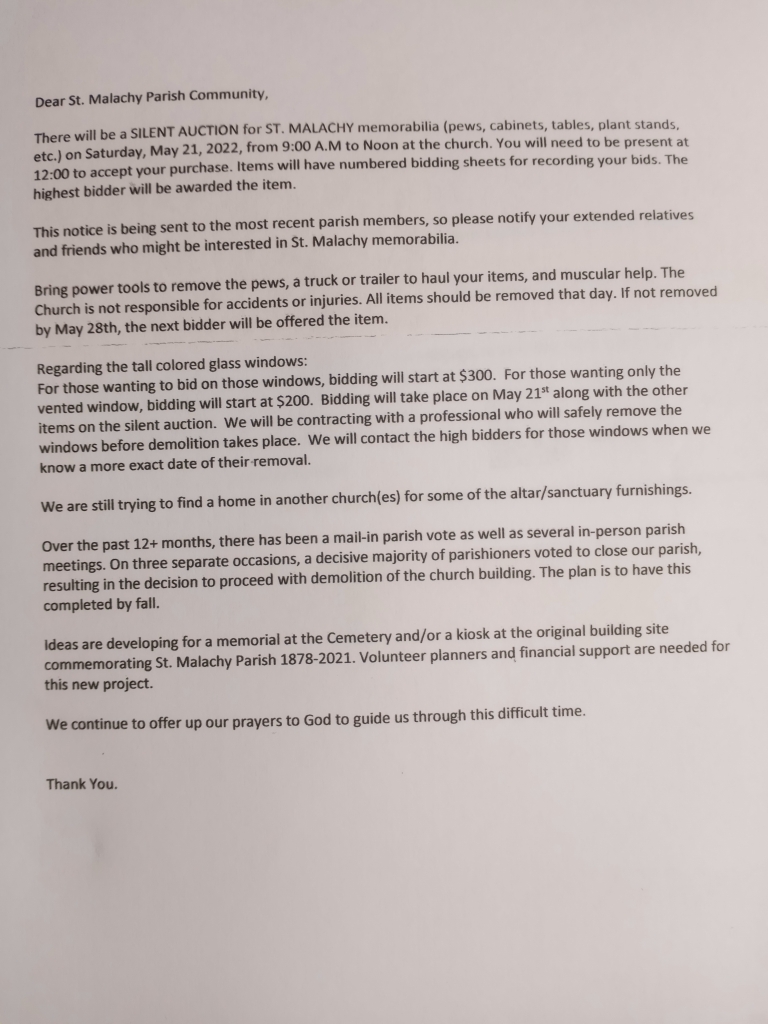
Letter from late April 2022

The Catholic Diocese of New Ulm, Minnesota plans to demolish the recently deconsecrated St. Malachy Church building, but not before they auction off “St. Malachy’s Memorabilia.”

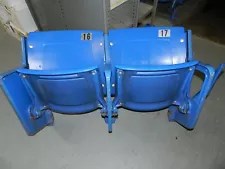
Memorabilia makes me think of my brother’s Don Mattingly baseball cards or a jersey worn by Joe Mauer. Remember how people bought sets of the iconic blue plastic seats from the Hubert H. Humphrey Metrodome when it was taken down? They put them in their “man caves,” ice houses, and basements all over Minnesota. Will the St. Malachy’s church pews have the same appeal? Maybe, but the word memorabilia seems to cheapen what the pews and stained glass windows of St. Malachy’s represent.

Years ago when my mother, Eileen, and I began looking into family history in the Clontarf area, she had copies made of pages from the St. Malachy’s account books. Pages were chosen because they pertained to our families – the Regans, the Foleys, and the McMahons – as well as known neighbors and associates. The copies by no means represent the full fiscal picture of the building of St. Malachy’s, but they clearly shows how the people of Clontarf paid for the building, a building whose elements will be auctioned off as memorabilia and will soon be demolished by the Diocese of New Ulm.

The following narrative is the first installment on the building of St. Malachy Catholic Church in Clontarf, based on the original financial records.

FUNDRAISING AND THE BUILDING OF THE NEW ST. MALACHY CHURCH

By 1896, it was clear to most that the parish of St. Malachy’s had outgrown the original building constructed in 1878. Children of the original settlers were marrying and starting families of their own as new residents joined the community and the town grew. The financial record books indicate that raising money for the new St. Malachy Church was every bit a community effort – “all hands on deck!”

March 17, 1896 – ST. PATRICK’S DAY EVENT

The parishioners of St. Malachy’s assembled an event to raise money for the new church building while celebrating St. Patrick’s Day. With attractions that included a watch drawing, Pidgeon target shooting, a cigar and candy stand, play performance, dinner, and fireworks, the fundraiser would certainly have been popular with the wider community.

Margaret Duggan of Tara Township and Mary Purcell of Clontarf donated the watch and the drawing raised $256.50, over half of the total funds raised at the event ($470.05). Expenses for the festivities were listed as $52.00, but most were covered by donations.

November 1896 – FALL FAIR

Later in the year, once the crops were in, Clontarf area residents held a Fall Fair to celebrate and raise more funds for the building of the new church. Records provide no final numbers for funds raised by organizers, but it appears to have been quite an affair.

Spanning two days, with dinner served on both Saturday and Sunday, Fair events included a horse raffle, another watch drawing, a fishpond, a play, and a cigar and candy stand. There were raffles for a kettle and a cigar box, as well as three “Fancy Tables” organized by Mrs. Moore, Mary Hurley, Miss Riley, and Mary Purcell.

The records note that Patrick Freeman of Clontarf donated the horse for the raffle and Frank McMahon of Tara and Eugene Daniel of Hoff went out ahead of the raffle to sell tickets to area residents.

Examples of funds raised:

  • Fancy Tables – $50.00
  • Play tickets – $14.35 (95 tickets sold @ 15 cents each)
  • Dinners – $68.00 (“at least”)
  • Watch Drawing – $92.00

March 17, 1897 – ST. PATRICK’S DAY EVENT

Limited information exists in the record books for this event, but undoubtedly there were the usual nineteenth-century fundraiser staples: raffles, cigars, candy, dinner, and a play.

Included in the March 17, 1897, financial records entry are a few details on the Dramatic Club of Clontarf. Sixty-four tickets were sold to the performance for total sales of $16.00. The ticket prices rose to 25 cents a seat. After renting wigs ($1.85) and purchasing a “tableau fire” and “sundries” ($2.15) and paying printing costs ($4.36), the records indicate they contributed $10.60 toward the window fund. They must have received a discount on some of their props.

Note:

Information in this article is from copied pages from the St. Malachy Financial Records and copies are located in Eileen McCormack’s files. These copies and the information contained here do not represent the complete financial record. Eileen McCormack copied specific pages when the books were at the parish house in Clontarf, 2004-2005. The record books are located at Saint Francis Church in Benson, Minnesota.

Eileen R. McCormack and Aine C. McCormack, March 9, 2022
For more information on Clontarf history, please visit here and here.


2 Comments

Family Album: Mother and Son

Catherine McAndrew McMahon sent this postcard to Tom, her oldest son, in early April 1908. She was in Rochester being treated at the Mayo Clinic for cancer, and Tom was at home in Tara Township. Catherine died on April 18th following surgery to remove a tumor.

Tom kept his mother’s obituary folded up in his wallet. His rosary, the postcard, and the obituary are the only things left behind by my great-grandfather.

Frank and Catherine McMahon Family ca. 1895 (Private Family Collection)

Tom is standing, second from the left, and Catherine is seated in front, next to her eldest daughter and namesake. The McMahon family would lose its youngest son, Johnny (standing, at far right), to tuberculosis about three years after this photograph was taken.


Leave a comment

Family Album: Brothers-in-Law

We have many of this style of photo in our family collection: studio portraits of people in their twenties and early thirties, taken circa 1900. This is a favorite because it reminds me of one of our first meetings with my grandpa’s cousins Donald and Gerald Regan.

I remember showing them this photo and Donald saying, “Ah, yes, that is Pat on the left and that would be Uncle Jim on the right. Isn’t that right, Gerald?”

Gerald nodded in agreement.

You could just about see the memory wheels turning in the brothers’ heads as the smiles crept across their faces. Chatting with Donald and Gerald about the old days was always a treat.

“Pat” was their father, Patrick Regan, and “Uncle Jim” was James Duggan, their mom Julia’s oldest brother.

Patrick Regan (left) and James Duggan, about 1900 (Private Family Collection)


Leave a comment

Family Album: Your Grandpa’s People

My grandma kept a cardboard box of family photos on the closet shelf under the Monopoly game. Every once in a while I pulled the box down and we’d go through the photos. I marveled at Grandma’s ability to not only identify the people in the pictures but to recall dates and outline connections.

Once we had gone through the old photographs of her parents, aunts and uncles, and grandparents, we’d move on to the “modern” snapshots of Grandma and her friends in the 1930s, weddings, and outdoor groups. Finally, we’d come to the bottom of the box and a cache of unidentified photos.

“Those would be your grandpa’s people.”

My grandpa was an only child and died the year before I was born. It has taken a bit of research (and a dose of serendipity) for us to identify “Grandpa’s people” and it is definitely a work in progress!

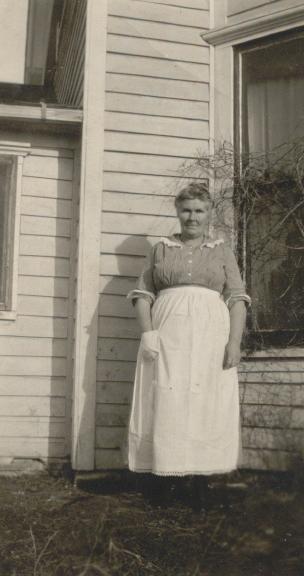
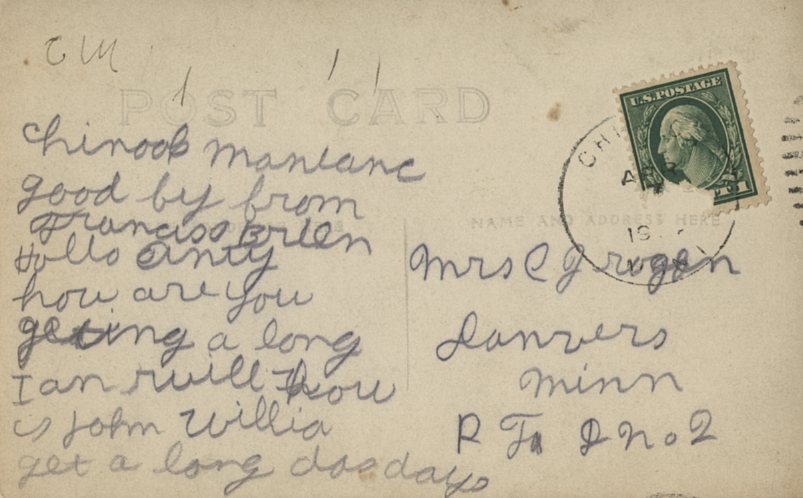
It turned out “Grandpa’s People” referred to my grandpa’s mother’s people. Like this photo of Mary Hill O’Brien, one of my great-grandmother Annie Hill Regan’s four sisters. Mary came to the United States from Kill, County Kildare, Ireland in 1892. She married a widowed farmer (Thomas O’Brien) in Tara Township, Minnesota in 1894. Annie joined her sister in Minnesota in 1899. Mary and the O’Brien family moved to Montana in 1914.

Mary Hill O’Brien – Chinook, Montana 1920 (Private Family Collection)

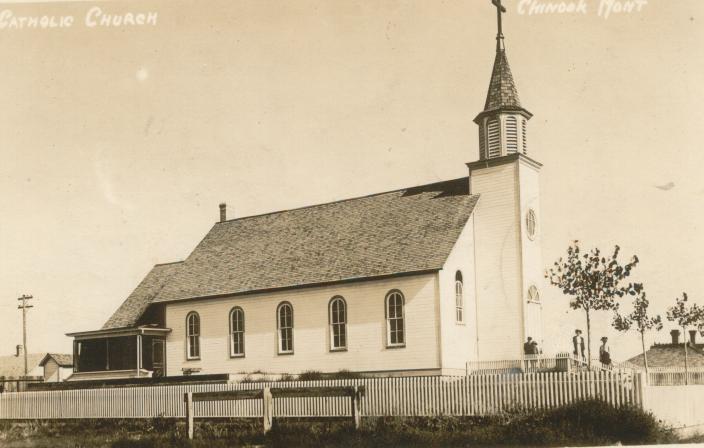
There were a couple of postcards in the bottom of that old box, too. Here’s one from Chinook to “Anty” Annie in Tara Township…


2 Comments

Anyone up for a game of checkers?

It might not look like much to you, but this somewhat crudely fashioned checkerboard has always been a treasured relic of my family history.

Patrick Foley’s checkerboard, circa 1870. Fisherville, NH.

I grew up in a house full of family heirlooms. My mom liked to incorporate them into her overall decorative scheme. She framed her grandparents’ wedding certificate and put it on the wall amongst old family photographs and used her great-grandmother’s china pitcher as a vase for lilacs and lilies of the valley in the springtime. Mom also lulled us to sleep in the same rocking chair her grandmother once rocked my grandpa. Old stuff and family history were all around the place.

But the checkerboard always intrigued me. It was tucked discretely in the space between a tall radiator and the dining room wall. When I was young I assumed that my mom intentionally put it there to hide it from potential thieves and jealous relatives. In my mind, the checkerboard was an extremely valuable antique.

The checkerboard (we always called it “the checkerboard” but I suppose it could be a chessboard) belonged to my great-great-grandfather, Patrick Foley. Patrick died the year my grandma was born (1913), but she shared what she had heard about her grandpa.

Grandma didn’t have stories about her grandpa, as much as she recounted some random details of a man’s life that survived the generations. My grandma was proud to say that Patrick was able to read and write (a rarity among her grandparents). Patrick was educated in a hedge school in County Cork, Ireland. He came to the United States as a young man with his friend John Regan and settled in Fisherville, NH. When Bishop Ireland started his colonies in Minnesota, Patrick moved west, bought a farm, and raised his family in Tara Township. Patrick was known as “Grandpa Petey” (or P.T. for his initials). He was a prosperous farmer in Tara and eventually moved into a nice house in the nearby larger town of Benson, Minnesota.

Patrick Foley, circa 1867, tintype (Private Family Collection)

I grew up in the 1970s, before the genealogy craze, Ancestry.com, and DNA matches, and was grateful for my grandma’s information, but I did want to learn more about Patrick. What did he do in Fisherville and where did he come from in Ireland? The checkerboard stirred my imagination and inspired me to learn more about my family history. I’ve visited Fisherville (Concord), New Hampshire and Kilmichael, County Cork and I have learned many more random details of Patrick Foley’s life. I guess it is my job to piece it all together and tell the story.

In case you are interested, here are the details of the checkerboard. Maybe you’ve seen something similar hidden in the nooks and crannies of your family home? Let me know!

The checkerboard measures about 20.5 inches (wide) by 19.5 inches (deep) and is about 3 inches thick. This is a substantial piece, I’d say it weighs nearly four pounds. Alternating stained and dark green painted squares create the playing surface (squares range in size 1.5 to 2 inches). In spite of these irregularities, I thought it was quite fancy because it was personalized. “Patrick Foley” is stenciled on one end and “Fisherville” on the other.

Happy St. Patrick’s Day!


Leave a comment

Family Album: Aunt Kate

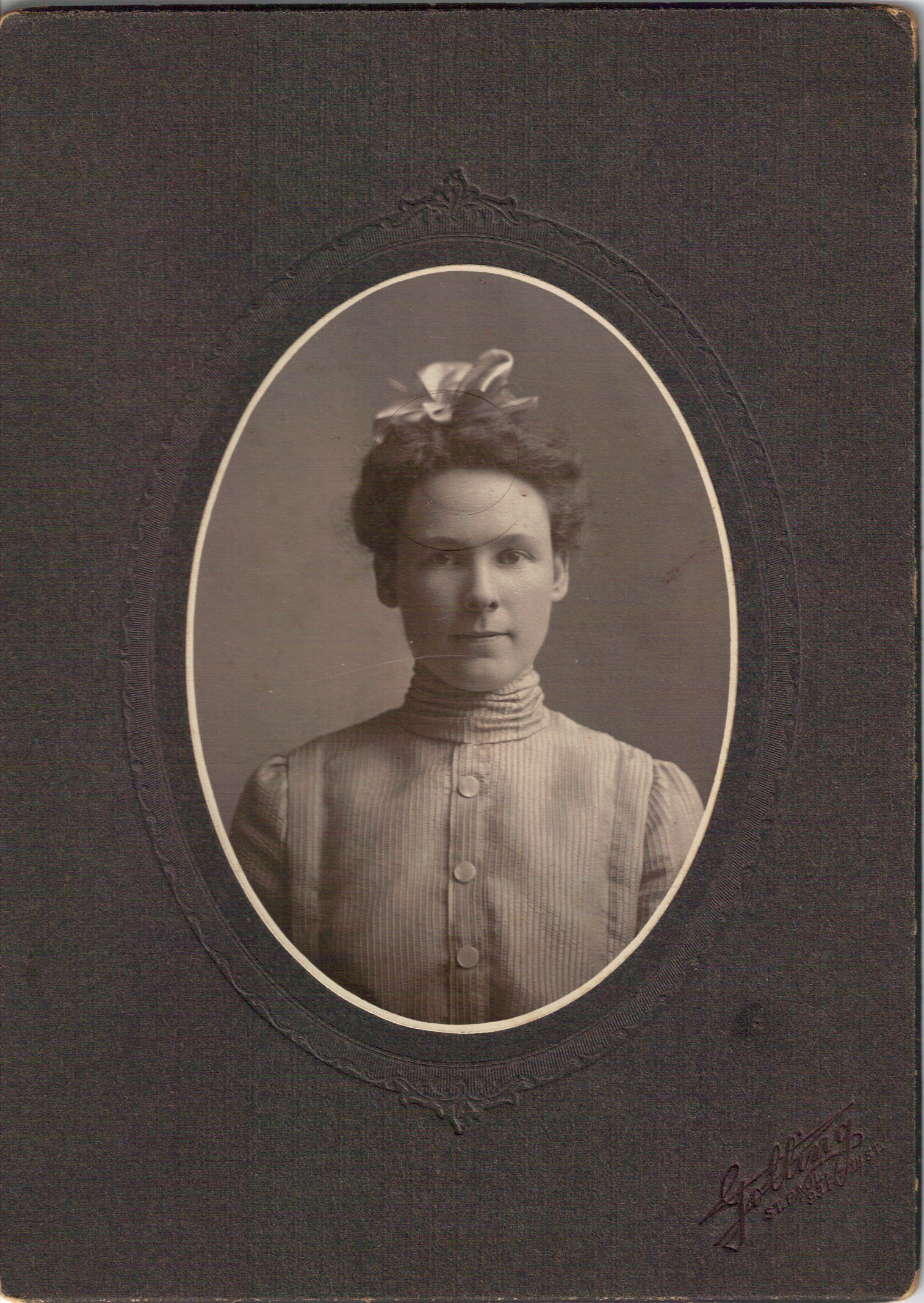
Catherine McMahon was the oldest daughter of Frank and Catherine (McAndrew) McMahon, born in Tara Township, Minnesota on October 17, 1877.

Catherine McMahon, circa 1900 (Private Family Collection)

I know very little about Catherine, except to call her Aunt Kate like my grandma and mom would. My mom remembers her as one of the old aunts. She married Jack Mears and the couple had no children. They lived in South Minneapolis, near downtown, and Jack was employed as a laborer. Before she was married, she lived in Clontarf with her family. The 1900 census says she was employed as a teacher. By the 1910 census she is “keeping house” – her mother passed away in 1908, so she was taking care of the house and her dad.

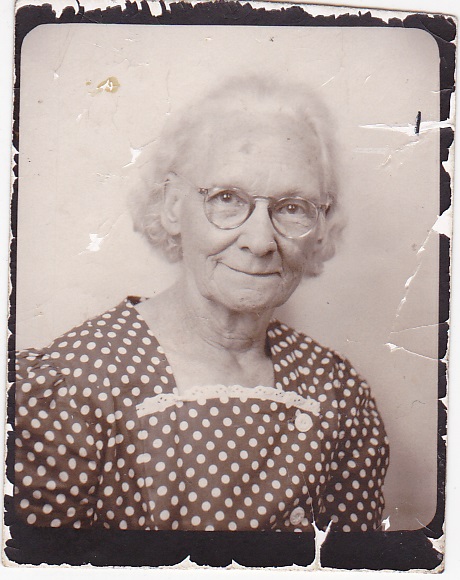
Aunt Kate, circa 1950 (Private Family Collection)

This is probably how my mom remembers Aunt Kate. She’ll let us know! I’m looking forward to learning a bit more about Aunt Kate. I am working on finding a marriage record and I want to take a look at her death certificate.


7 Comments

Jumping In: Irish in Minnesota

We will be known forever by the tracks we leave.

Dakota Tribe (from Xavier University’s Quote Archive

As I started work on the Irish in Minnesota project this month, I had some trouble settling in with the research and getting organized. I’ve come to the conclusion that while I am familiar with a wide range of Minnesota history topics, I need to do some reading to get up to speed on the larger picture of nineteenth century Minnesota. That being said, I would like to get the ball rolling with a bit of background information and an introduction to a Minnesota “First.”

Irish immigration had a tremendous impact on the development of nineteenth century America. Migrating to nearly every region of the country, the Irish carved out lives in eastern cities and states, as well as established new communities throughout the West. The Irish came to America because of famine, oppression, and the lack of opportunity at home. Some were forced to emigrate, but others acted with agency and chose to come to America. Ann Regan writes in Irish in Minnesota that the experience of Irish immigrants in Minnesota “defies generalization….they have created stereotypes and broken them, held to traditions and made new ones.” This is a good point to keep in mind as we sift through the history of the Irish in Minnesota.

Irish immigrants began coming to the Minnesota region in the 1820s as soldiers at Fort Snelling and lumberjacks from Canada. Because of its location on the east bank of the Mississippi River, St. Paul grew quickly through the 1840s and 1850s. The future capital city of Minnesota, St. Paul was a town where anything seemed possible and it attracted ambitious Americans and immigrants alike. St. Paul served as a launching point for westward migration, first via steamboat and later the railroad. (More on the Irish in St. Paul to come.)

Why did the Irish come to Minnesota? The simple answer is land. The United States government signed the Treaty of Traverse des Sioux with the Dakota in 1851, which opened the territory west of the Mississippi River. This included the Minnesota River Valley, a timber-rich region accessed with relative ease from St. Paul by steamboat. With the Treaty of Mendota later in 1851, a total of 24 million acres of land became available for new settlement. (Wikipedia)

For Americans and immigrants feeling the effects of “Western Fever” the treaties came at the right time and represented opportunities for new lives. It is important to keep in mind, however, that for the Dakota, “these treaties marked another step in a process that increasingly marginalized them and dismissed them from the land that had been—and remained—their home.” (Eric W. Weber, MNopedia, Minnesota Historical Society)

The U.S. government furthered its agenda of expansion with the treaties. (Did you know that the term Manifest Destiny was coined by Irish American editor John O’Sullivan in 1845?) According to the Wikipedia entry on the Treaty of Traverse des Sioux, the U.S. government agreed to pay annuities to the Dakota equal to about 7.5 cents per acre. New settlers would pay about $1.25 per acre. Not a bad deal for the government, especially considering the Dakota were never fully compensated. (Wikipedia)

Patricia Johnston mentions in Minnesota’s Irish that many of the Irish in Minnesota were “two boat” migrants: One boat brought them across the Atlantic from Ireland, and a second to Minnesota. The second leg of the journey would often involve several modes of transportation, but the steamboat was important for the early arrivals in Minnesota. It wouldn’t be until later in the nineteenth century that more Irish would come directly to Minnesota from Ireland, typically joining family already established in the area. (p. 23)

McMahon Family of Tara Township, Swift County, Minnesota — Ireland, New York, Wisconsin, Civil War, love, loss…a “typical” 19th century Irish American family. (photo from private family collection)

The stages of Irish migration can be clearly seen in census data from the1850s-1890s. Patterns emerge with parents who were born in Ireland, they arrived in the U.S. and married in eastern states such as New York, Massachusetts, or Pennsylvania where their oldest children were born. Migration west resulted in middle children born in Ohio, Illinois, or Wisconsin, with the youngest born in Minnesota. Extended families, in-laws, and friends moved across the country together and in phases. As the railroad extended from Minnesota to Montana, Washington, and California, the younger generation of Irish and Irish American migrants often followed.

Claims to the “First” anything are typically controversial, especially when those claims are made at a time when events were happening quickly and record-keeping was hit-or-miss. The township of Jessenland, on the Minnesota River in present-day Sibley County, is widely accepted as the “First Irish Settlement in Minnesota.” The story goes that the Doheny Brothers (Thomas, Walter, and Dennis) took the steamboat “Black Oaks” up the Minnesota River from St. Paul and spotting a beautiful site fifty miles into the richly wooded region (part of the “Big Woods”), stopped the steamboat and made their claims. This spot would be known as Doheny’s Landing and marks the first permanent Irish farming community in Minnesota. Doheny’s Landing grew into Jessenland.

Jessenland’s “origin story” is described by John Gerald Berger in the 1965 book, A History of St. Brendan’s Parish, The Village of Green Isle, and Minnesota’s First Irish Settlement:

We might imagine that it was a beautiful spring morning when the three brothers got off the boat, and that the lush green valley with its wooded bluffs and glens reminded them of their homeland. They had left the Emerald Isle, some years before, like so many others, because of the potato famine…All they carried with them, besides the clothes on their backs, were shovels, axes, and grub-hoes. That first summer they managed to clear enough land to plant a few potatoes, but they were frozen by an early frost.

(Berger, p.2)

A few pages later, Berger proposes that the “traditional” story of the Doheny Brothers may not be absolutely accurate but he asserts that, although there were concurrent arrivals to the area, a Doheny brother made the earliest claim by an Irishman, establishing the first Irish community. Edward Neill, writing in 1882, offers some clarification:

Thomas Doheny, the Irishman who came up on the Black Oak in July, 1852, and located his own and other claims, returned in the spring of 1853, bringing with him several others, who formed the nucleus of the Irish settlement. Doheny planted a few potatoes and then returned to St. Paul while Michael Grimes, Sr., remained and built himself a house, and became the first Irish settler.

(Neill, History of the Minnesota Valley, 1882 – excerpt on GenealogyTrails.com)


I was curious about Michael Grimes, Sr. since he was not mentioned by name in Berger’s account. If he was the first Irishman to build a house and spend the winter at the site, he deserves further attention. I will have access to a reprint of Neill’s book soon and will check on the Grimes story. A quick search provided that the Doheny and Grimes families both lived in Middletown in Susquehanna County in northeastern Pennsylvania prior to coming to Minnesota (more next time). Over the next few years, the Irish would fill Jessenland and spill over to Washington Lake, Faxon, and Green Isle townships: Boland, Bray, Carlin, Dunne, Egan, Mullen, Mulligan, Shaughnessy, Wilson, and Young are some of the families who joined Doheny and Grimes.

Next time I want to take a closer look at some of the individuals who established Jessenland and see how the Irish community grew from its humble beginnings at Doheny’s Landing to include four townships. If anyone out there is a descendant of (or has a connection to) the early Irish in Sibley County, please leave a comment!

Township map of Sibley County. Irish established Jessenland, Fazon, Washington Lake, and Green Isle in the northeast corner of Sibley County along the Minnesota River.

Notes and More Information:


3 Comments

Gimme the Butter

A version of the following article first appeared in Irish Lives Remembered Genealogy Magazine (July 2013 issue).

Tom McMahon, 1895

Tom McMahon, 1895

“I’ve never heard that! Why didn’t grandma ever tell me that story?”

I have to admit, when my older sister Regan says this, as she does from time-to-time, I feel a tinge of satisfaction. Younger sisters will understand how years of childhood rivalry can spill over into adulthood and we briefly allow ourselves to revel in the tiniest of victories. A card game won, a promotion at work, or in my case, a story my grandma told me.

But, as the ever-modest younger sibling, I shrug and tell Regan it’s simple. She never heard the story because she never asked. I was constantly asking my grandma to tell me all about the “old days”, and a question like, “What was your dad like?” (and a few key follow-ups) often lead to an afternoon of unearthing memories and revealing truths. Like this…

Thomas Edward McMahon, my great-grandfather, was born on June 13, 1879, in Tara Township, Minnesota. Tom was the second child and eldest son of Francis and Catherine (McAndrew) McMahon. His father was a native of County Fermanagh and his mother was born in New York – her parents came from County Mayo in the 1850s.

1904

1904

My grandma was Agnes McMahon Regan, Tom’s youngest daughter. Grandma said her dad was warm and generous. His family and friends could depend on Tom to be there when they needed him. No one was better in a crisis. Grandma smiled when she said that in the end, her dad was at heart, a big kid. He loved to play with his children and his easy manner lead to lots of jokes and laughter. Tom enjoyed nothing more than sitting in his chair in the evening, surrounded by his family as his wife, Mary, read aloud from Treasure Island or Little Women or whatever novel the mobile library offered that month.

Tom wed Mary Foley on June 9, 1904, at St. Malachy Catholic Church in Clontarf, Minnesota. The couple grew up a mile apart on farms in Tara Township and were childhood friends. Tom’s nickname was “Hoosie” and Mary was “Minnie”. They had seven children – four girls and three boys.

Grandma said her dad was so good-natured, he never raised his voice.

“Never?” I asked. A natural question.

“Well…there was one time…” And we’re off.

The family was at the table for dinner when my grandma (who was about four-years-old at the time) said to her dad, seated next to her, “Gimme the butter!”

Tom was startled by his daughter’s demand. “Pardon me?”

Grandma said it again, this time louder, since he obviously didn’t hear her, “GIMME THE BUTTER!”

Tom was taken aback. None of his children behaved so rudely, not even his spirited middle child, Rose. But he was especially surprised by the outburst from Agnes. Tom told her she could have the butter if she asked for it nicely.

Grandma thought about it for a moment and said, “Gimme the butter!”

Tom had heard enough. He stood up and ordered Agnes to leave the table immediately. Grandma stormed out of the kitchen and threw herself on the seat of the buggy outside. She cried like she had never cried before. A short time later, Tom came out to Grandma. He set her dinner on her lap and placed his arm around her shoulders. Grandma said she apologized profusely. Her dad brushed the black curls from her forehead and dried her tears with his handkerchief. “There, now, that’s the girl. You’re alright…”

The two of them sat on the buggy while Grandma ate her dinner. She still felt terrible, but she had learned her lesson. Looking back, Grandma thought her dad felt as bad as she did that he raised his voice. He never did it again. And Grandma learned some table manners.

More I learned about Tom McMahon…

1921

1921

According to Grandma, her dad was a true farmer. He loved everything about the process – preparing the soil, planting, growing crops, harvesting them, and sharing the fruits of his labor. Unfortunately, the 1910s and 1920s were tough on many farmers on the prairie of Western Minnesota. Tom tried to make a go of it several times. He sold the homestead and moved to rented land, farming until 1926 when he gave it up for the last time. The McMahon family moved to Minneapolis to begin life anew.

In the city, Tom worked at the pole yard, treating and preparing new telephone poles.  When he retired, a neighbor allowed Tom to use a nearby vacant lot for a garden. Tom returned to what he loved. He grew enough produce to trade with the local shop for groceries and feed his family and neighbors. He had never been happier.

Tom McMahon died on May 6, 1937. His wife, Mary, came home after a rare afternoon away from home to find him peacefully in his chair, rosary entwined in his fingers. A heart attack took him quickly.

Listening to Grandma’s memories of her loved ones brought them to life for me, and at the same time allowed me a glimpse at my grandma. I never had the privilege to meet my great-grandfather, but I feel like I know him. I was lucky to know my grandma. Now it’s my job to keep and share my grandma’s memories and her stories for the rest of the family. You just have to ask.


If you aren’t by nature as nosy as I am, these sites might help you think of what questions to ask…