The Irish in America


4 Comments

Life is a Game of Cards

Agnes, with her younger brother, Frank McMahon -- ca 1920

Agnes, with her younger brother, Frank McMahon , about 1920.

This is my favorite photograph of my all-time favorite person – my maternal grandmother, Agnes McMahon Regan.

Today is the 100th anniversary of my grandma’s birth. Agnes  was born in Tara Township near Clontarf, Minnesota on January 12, 1913 on the farm her Fermanagh-born, American Civil War veteran grandfather, Francis McMahon, homesteaded in 1876. Agnes was the sixth child and fourth daughter of Thomas and Mary “Minnie” (Foley) McMahon.

McMahon Family ca.1914

Grandma is standing on the chair, surrounded by her siblings and her mom in 1914.

One of my grandma’s favorite pastimes was playing cards. From Bridge and 500 with her card clubs, to Crazy Eights and Go Fish with her grandchildren, and everything in between, Grandma loved a game of cards. No visit to Grandma’s was complete without at least one game. Not sure if it was an addiction or not, but we can safely blame/credit her Irish Grandpa McMahon, or Grandpa Bushy, as he was known, for her life-long love of cards.

Grandpa Bushy, years before he would teach little Agnes to play cards.

Grandpa Bushy, years before he would teach little Agnes to play cards. Does it look like he is twiddling his thumbs? Something else my grandma got from him!

Grandpa Bushy lived with grandma’s family for a couple of years when she was small. While her older brothers and sisters were at school, Grandpa Bushy taught Grandma the finer points of rummy. She was just four-years-old, but Grandma caught on right away and  never looked back.

Grandma lived her life much like she played cards. Grandma always played the cards that were dealt her. She never complained, really never. Grandma handled tragedy, heart-break, illness, and pain with grace. She believed that her problems were no more devastating than those of the next person.

The coolest thing about Grandma was that she rarely gave her opinion unsolicited, and when it was asked for, she was very careful in what she said. Grandma never gossiped. All that being said, Grandma did not hesitate to stand up for the underdog, or seek justice when someone was treated badly or unfairly. Grandma was very competitive, but she figured out how to win by following the rules.

Grandma didn’t need to tell everyone, everything. She kept things to herself. Odds are if someone told Grandma a secret, she took it to the grave. I managed to get a couple of minor secrets about people long dead out of her over the years, but I gave her my word that I wouldn’t tell a soul. Grandma never showed her hand, and she was the most widely liked person I have ever known.

I know it wasn’t just cards. Life experience is a great teacher. But I can’t help but think that her sweet little Grandpa Bushy, with his big beard and a gleam in his eye, knew that he was instructing his granddaughter on more than just rummy.

Grandma was always teaching us – her children, grandchildren, nieces, and nephews – just by living her life and asking us to stay for a game of cards. Much more effective than lectures! And by most accounts, we all picked up on these more subtle life lessons.

I remember asking Grandma (when she was the advanced age of about sixty-six) to what age she hoped to live. She never gave me a number, instead she said, “I want to live as long as I have my wits about me.” When she died in 2004, she definitely still had her wits about her, it was her heart that didn’t cooperate. She passed away just like she lived: quietly, on her own terms, with dignity and class.

We miss you a lot, Grandma, and we are sure that at the “big card game in the sky” (as my sister,Regan, and I like to think about it) you are taking all the tricks.

Grandma's on the left. Does she look like a card shark?

Grandma’s on the left. Does she look like a card shark?

Throughout the year I will revisit my grandma’s life as a second-generation Irish American, growing up in Minnesota.


5 Comments

A Candle for Louie

Waterford's Gold Coast (photo Regan McCormack)

Waterford’s Gold Coast (photo Regan McCormack)

Regan and I looked forward to our visit to County Waterford last September. On previous trips to Ireland we had visited Lismore and Ardmore in Waterford, but didn’t tour the rest of the county. Our real introduction to Waterford came during the past year through the entertaining tweets from Dungarvan’s Waterford County Museum. The museum shares beautiful photographs and historical items from their collection on Twitter. Regan and I were eager to see Dungarvan and the museum in person and explore more of County Waterford.

But when we arrived in Dungarvan, the sightseeing would have to wait. Regan and I had to attend to some business.

Our dad’s good friend Lou Bader passed away on June 27, 2012. Louie and Dad played a lot of golf together, which probably says it all about their relationship. Louie shared my dad’s competitive streak and sense of humor, as well as his love for a few hours spent on the golf course. But there was something else the two men shared.

About fifteen years ago, my dad began to explore his family history. He traced his roots back to Ballyedmond, County Laois, and found cousins living on the farm his grandfather left in the late 1880s. Louie had also been researching his family tree and had learned about his Irish grandfather through his mother’s stories.

Dungarvan (2)

Dungarvan Street (photo by Regan McCormack)

I wish I could say that Louie and my dad discovered they shared a grandfather –  that would make a great story! No, Louie and my dad only shared similar questions about their family history and the wish to find out where they came from. Both men researched their family trees, traveled to their grandfathers’ birthplaces in Ireland, and made lasting connections with their Irish cousins. Several trips followed for Louie, my dad, and their families.

In light of our autumn trip to Ireland, Dad asked Regan and I to do him a favor and deliver Louie’s memorial card to his cousin in Dungarvan. This was an “old-school” request and my dad’s directions (“Stop in at the cleaners in town and ask for Anne-Marie”) only added to the feeling that we were characters in a Victorian novel. But, of course, anything for Louie. He was a good man and a great friend to my dad.

Louie’s maternal grandfather, Matthew O’Rourke, was born in 1869, the youngest son of Patrick and Margaret. The O’Rourke family lived in the townland of Carrigcastle, near the village of Ballylaneen, about five miles from Dungarvan, County Waterford. In her delightful memoir, Love and Oatmeal (2006), Louie’s mother, Madeline O’Rourke Bader, lovingly recounts when she would ask her father why he left Ireland and moved to Saint Paul, Minnesota. A smile came over his face when he told her his sister-in-law encouraged him to go to America. Madeline writes in the memoir:

The way he smiled when he said that, though, always made me think there was something more to the story. A few years ago when I visited Ireland for the first time and saw how beautiful the land he left behind is, I understood a little better that his smile must have covered up a lot of pain and longing. (Love and Oatmeal, p.4)

Anne-Marie wasn’t in at the cleaners, but Mary told us how sad they all were when they heard of Louie’s passing this summer. She said how much they enjoyed his frequent telephone calls (just to check in with his Irish cousins) and his visits to Dungarvan. In a few short years, Louie had made an impact on his Irish relatives. They really missed him.

Regan and I decided we needed to do something special for Louie, so we found the little church in Ballylaneen where his grandfather was baptized, lit a candle, and said a prayer. We thought of Louie and all the O’Rourkes – the ones who stayed in Ireland, those who emigrated, and the few who made it back.

St. Anne's Church - Ballylaneen, Waterford

St. Anne’s Church – Ballylaneen, Waterford (photo Regan McCormack)

For more information about Dungarvan and Waterford County history, please visit Waterford County Museum. Click here to read about the new Dungarvan guide book.


7 Comments

Happy Birthday Minnie!

Can’t believe an entire year has passed since I posted this in honor of my great-grandmother’s birthday last year. Hope your 2013 is off to a good start — thanks so much for reading. Now, better get to baking that spice cake… Continue reading


11 Comments

Maureen’s Memories: Nono Goes to the Circus

Maureen takes us back to 1930s Milltown, County Kerry, when the circus came to town. She recalls the excitement surrounding the circus, as well as the kindness of her neighbors.

Nono Goes to the Circus

To give you an idea of how small the children were, here is a photo of Maureen's sister Helen (blond, third from left on bottom) and the infants' class in the early 1940s. (You must receive author's written permission to reproduce photo.)

To give you an idea of how small the children were, here is a photo of Maureen’s sister Helen (blond, third from left on bottom) and the infants’ class in the early 1940s. (You must receive author’s written permission to reproduce photo.)

Duffy & Sons Circus was coming to Milltown! I knew I would be going as grandfather (who lived with us) would always take my sisters, Joan and Kitty, and me. We were all very young—toddlers, six and under. This was in the early 1930s. In those days, if you could walk, you were encouraged to attend school.  Any student below first class attended the infant’s room (kindergarten) in our school, Presentation Convent. Our whole class was abuzz. More importantly, the nuns approved. When they asked, “Hands-up, who is going to the circus?” the only child who didn’t raise their hand was little Nora, who was called “ Nono”. Our Sister asked, “Why not?” and she replied childishly, “Me no tickee”. Children’s tickets cost about four old pence. The following day the Doctor’s daughter announced that her mother would buy Nono’s ticket. The Nun gushed to all of us what a great act of Christian charity the Doctor’s wife had performed.

Nono was asked the next day, “Was your mother delighted that you are going to the circus”? She replied in her usual manner, “Me no coatee”. The following day Nono was given a coat from a schoolmate’s mother. She may not have been well spoken, yet she was going to the circus in a nice, new coat.

I’ll always remember that each afternoon before going to the circus my Mammy cooked home fries. She had the knack for making the simplest dishes delicious. After relishing the tasty meal, we were off to see the many exciting acts. Grandfather always dressed in his best blue serge suit. I no longer recalled if the great circus tent was set up in town, or in a field. I do recall the pungent smells, a mix of sawdust and animals, the colorful costumes and the bright fabric of the ring around which we sat, my little sisters and Nono.  My favorite entertainers were the barebacked riders. Out they rode in their shimmering pink outfits, and I decided right then and there what I wanted to be when I grew up! Luckily, I didn’t run away with the circus, and I’m content with the way my life turned out.

I have fond memories of Nora and her baby brother, Patrick Joseph (called “Packy Joe”), always walking hand-in-hand. Not long afterward Nora and Patrick Joseph, along with their entire family, who lived by the river, left County Kerry. The father had a hard time finding work, and was forced to do odd jobs. Their mother took in washing and cared for the ill in their homes. Talk was that they left to find better work in England, and we hoped they did well and could go on to afford to buy Nono and Packy Joe many fine things in life.

About the author…

Maureen, 1953

Maureen, 1953

Maureen Angela Teahan was born in September 1928, Milltown, County Kerry, Ireland. She was the firstborn of a large family. The household included a maternal grandfather and an older cousin, all living in a small thatched home. Maureen was educated at Presentation School and received her Leaving Certification from Presentation Secondary School, Milltown, 1944. She emigrated from Ireland in 1947 and lived in Lawrence, Mass.  Maureen worked at the Wood Worsted Mills for two years until they closed and moved their operations south. After that she was employed as a nanny for a year, also in Lawrence. Then she moved to Boston and worked for the First National Stores (FINAST) in the meat department. During that time she met her future husband and left FINAST when she married Patrick Murray in 1952. Maureen raised three children and was active with volunteer work, the church and community. Her hobbies included reading, sewing, cooking and gardening for as long as she was able.


Did you know that Duffy&Sons Circus is still in operation? Now it is Tom Duffy’s Circus, but it is the same family who put on the circus that came to Milltown. Click here to visit the website and read about the history of the circus.


Leave a comment

Merry Christmas (Happy Birthday)

The story goes that my great-grandmother, Margaret Mary Flannery, put the Christmas goose in the oven, then stepped into the side room and delivered her own special Christmas present. My grandmother Agnes Anastasia Celestine Flannery was born on December 25, 1915 in the house on Bayless in Saint Paul, Minnesota.

Agnes Flannery, 1942

Agnes Flannery, 1942

Grandma’s father, James Patrick Flannery, was born in Providence, Rhode Island, the son of Irish immigrants. Her mother, Margaret Mary Flannery, was born in County Sligo.

James Patrick and Margaret Mary Flannery (also known as "Pa and Ma")

James Patrick and Margaret Mary Flannery (also known as “Pa and Ma”)

I always felt sorry for Grandma. Of all the days to be born, she had to share a birthday with Jesus. I loved my birthday because in my family it is something that is all mine. It is the one day where I get all the attention – all the presents, a cake with candles, and a special song sung just for me. (Is it obvious that I am a middle child?)

There are some people for whom a Christmas birthday would be a problem, but my grandma didn’t seem to mind a bit. She loved everything to do with Christmas — the music, the parties, the pageantry. She felt honored to share her day with Jesus, and enjoyed the special attention her December 25th birthday garnered for her.

I remember my aunts would make a birthday cake and we would light candles and sing “Happy Birthday” after Christmas dinner. We even gave Grandma a special present wrapped in birthday paper. But you know, even without theses special efforts, I think Grandma carved out a tiny bit of the Christmas festivities her personal birthday celebration.

On the last Christmas/Birthday we celebrated in 2004, I asked Grandma to tell me her favorite Christmas carol. I knew the answer, and it was difficult for Grandma to speak because of a stroke, but I just wanted to see the twinkle in her beautiful blue eyes when she said it.

“O Holy Night.”

Happy Birthday, Grandma. This one is for you…

.


6 Comments

Calling all Sullivans from Baurgorm!

A Baurgorm farmhouse in ruins -- photo courtesy of Donal Collins

A Baurgorm farmhouse in ruins — photo courtesy of Donal Collins

Although I have yet to receive a Gathering postcard from Ireland, I have been graciously invited to a gathering event next year. The invitation did not come from my family in Ireland, but rather from a client.

Shortly after Regan and I returned from Ireland in October, Donal Collins of County Cork contacted us. He wanted to trace the American branch of his family tree. Donal’s mother, Dympna, had completed extensive genealogy, carrying on the work her aunt had begun years ago, collecting the stories of the older generations in Ireland, as well as keeping in touch with those who emigrated. Dympna corresponded with American cousins and hosted them on visits to Cork, but after some time they lost touch.

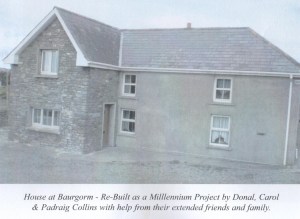
We got to work on the search for descendants and began by looking at four Sullivan siblings who left from Baurgorm, near Bantry, in West Cork, in the late nineteenth century. Their father Denis Sullivan of Baurgorm married Helena O’Leary of nearby Widdy Island. Denis built the farmhouse pictured above. Three of the Sullivan siblings (Patrick, Denis, and Helena) settled in Manchester, New Hampshire. The fourth sibling, Timothy, settled in Springfield, Massachusetts.

Once we had located the four siblings in the records, we turned our attention to their descendants. Some descendants have already been “found” and invited to the Sullivan O’Leary Baurgorm Bantry Gathering on June 15, 2013. Donal has a full slate of events planned, including a Mass, reception, food, video on the history of the family, and live entertainment. Donal told me he has a really great group of musicians lined up and is encouraging attendees to share their talent – be it a song, a story, or a dance.

Take a look at the invitation we sent to descendants found thus far!

Photo courtesy of Donal Collins

Photo courtesy of Donal Collins

Sounds like a great night! Now, we just need to get some American cousins to Bantry for the celebration. If you claim descent from the Sullivan or O’Leary families of Baurgorm/Widdy Island via Manchester, New Hampshire, leave a comment or send me an email. I will put you in touch with Donal right away. It is not every day you receive an invitation like this!

Here are some of the surnames associated with the Sullivan-O’Leary family in the United States:

  • Martin
  • McGillan
  • Sullivan
  • O’Leary
  • Rohrbaugh
  • Simard

If you think you might be related, or know someone who is, please contact us. Get in touch with your family history, see the farmhouse Donal and his wife Carol lovingly rebuilt in 2000, and learn the stories of the Sullivan and O’Leary families.

Click here to see some fantastic photos of the Baurgorm Stone Circle.

TheGathering_logo_Blue_R


5 Comments

Cobh: The Queenstown Story

Cobh, County Cork (photo: Regan McCormack)

Cobh, County Cork (photo: Regan McCormack)

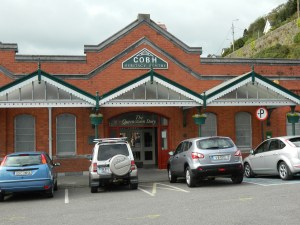
I once heard Cobh described as the saddest place in Ireland. I thought of this as my sister, Regan, and I walked into town one late September morning. With bright sun and fluffy white clouds in a beautiful blue sky overhead and a postcard-perfect harbor in front of us, I couldn’t imagine a more cheerful town. The usual quiet Irish morning bustle filled the streets as we made our way to the restored Victorian railway station and home of the Cobh Heritage Centre.

Cobh Heritage Centre (photo: Regan McCormack)

Cobh Heritage Centre (photo: Regan McCormack)

It wasn’t until we stepped in to the Heritage Centre’s multi-media Queenstown Story exhibit that Cobh’s sad reputation began to make sense. From 1848-1950, Cobh (or Queenstown) was the last of Ireland seen by over 2.5 million people whose ships departed Cobh Harbor \; emigrants leaving home for new lives in new worlds. These men, women, and children were fleeing famine and political unrest, leaving a country unable to give them even the most basic social and economic opportunities.

The exhibit does a nice job of bringing the Irish emigrant experience to life — the sound of waves crashing, dim lighting, and artifacts on display belonging to actual passengers combine to give visitors a glimpse into a nineteenth-century steerage compartment.  North America promised freedom, prosperity, and a future, but first the emigrants would have to say goodbye to their homeland and risk their lives on a treacherous ocean crossing.

In addition to the exhibit space, the Cobh Heritage Centre offers a genealogy consultation service, café, and shop. Regan and I were able to sit down with Christy Keating, the genealogist on duty. We were lucky that his 10:30 appointment did not show up because Christy is a very busy man, fielding genealogy queries from some of the 100,000 visitors to the centre every year.

Christy told us about the genealogy services they offer at the centre. We talked about the challenges in tracing Irish emigration – there are many online passenger list resources, but they usually are not useful without additional genealogical information. For example, a visitor from Connecticut in the United States walks through the exhibit and approaches Christy and says, “My great-great-grandmother Mary Sullivan came to America during the potato famine – can you tell me more about her?”

Christy politely asks a few follow-up questions, such as what year did she emigrate, what port did she enter, did she travel alone. where was she from, etc. These are often met with a blank stare. All this visitor knows is that their great-great-grandmother Mary Sullivan came from Ireland during the potato famine. Christy does his best to point people in the right direction for learning more about their ancestor, but a few basic details would help immensely.

A number of other family history professionals, genealogists, and archivists in Ireland echo this sentiment: if you are visiting Ireland and have an interest in learning more about your Irish roots, a little homework done before your trip (or visit to the National Library or Archives) can go a long way. Learn some basic information and they will better be able to help you find your ancestor in Ireland. Who knows? You may be able to connect to the county, parish, or townland your family member left all those years ago.

If you are planning a visit to Ireland and know you have some Irish heritage, but don’t have the time to research your roots, The Irish in America will do the work for you. Visit the Find Your Cousins tab at the top of this page to get started. We offer a free consultation and reasonable research rates.

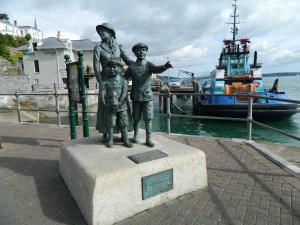
Annie Moore (Photo: Regan McCormack)

Annie Moore (Photo: Regan McCormack)

A statue of Annie Moore and her brothers stands near the Heritage Centre in Cobh. Annie was the first immigrant processed at the newly opened Ellis Island in New York harbor in 1892. Emigration can be a heart-breaking event, but this statue symbolizes the struggles and optimism of those who have left Ireland. Cobh is a sad place in the collective memory, but today it welcomes back the descendants of the emigrants who had to leave their home.

I think every American who is aware of their Irish heritage and visits Ireland should go to Cobh and take a moment to think about their ancestors.


8 Comments

An Orange for Baby Jesus

Maureen Teahan Murray helped us kick off the holiday season by sharing her Thanksgiving memories a couple of weeks ago, and she is back with a special story, just in time for the first Sunday of Advent…enjoy!

Continue reading


2 Comments

New Dungarvan Guide!

Exciting things are happening at the Waterford County Museum.

My sister, Regan, and I were lucky enough to visit Dungarvan this past September. Willie Whelan personally showed us around the Waterford County Museum and brought us on a quick tour of the town. A group of dedicated and talented volunteers make the museum happen, and they are doing a fantastic job. It is truly a gem, and this book is a must-have for anyone interested in Dungarvan or Irish history in general.

Read the press release for :

The Ideal Christmas Gift – Dungarvan: A Historic Guide & Town Trail
Waterford County Museum will launch their new 80 page guide book about Dungarvan on Wednesday 28th November. The guide book content includes a history of Dungarvan, articles on notable local personalities, historic sites in the locality, a town walking trail, numerous full page photos and maps. The book is produced to a very high standard and the museum will arrange shipping worldwide. All profits from the book go the upkeep of the museum.

One of the book’s authors William Fraher said that “I am delighted with the finish and appearance of the book. The larger scale landscape format allows the wonderful photographs from the museum archive to be seen to best advantage. I think it would make an ideal Christmas gift for anyone with relatives or friends living abroad”.

Co-author Willie Whelan stated that “We think this book will be attractive to local history enthusiasts, tourists, locals and school children. It also provides an authoritative basic historical guide to the Dungarvan area.”

Support from Waterford Leader Partnership has enabled the price of the book to be kept at €10 allowing as wide a range of people as possible access to their local history.

Pádraig Ó Cuirrín, President of Waterford County Museum welcomed the launch of the new book and added “I am really delighted that the museum has managed to produce such a quality publication. I would also like to acknowledge the support of the Waterford Leader Partnership in helping fund this book. Without the ongoing support that we receive from the Leader Partnership our work would be much more difficult. Dhéanfadh an leabhar seo bronntanas oiriúnach; go háirithe do cáirde agus gaolta thar lear.”

Dungarvan: A Historic Guide & Town Trail (printed by local company Printmaster) is available to buy in the museum at St. Augustine Street, Dungarvan for €10 or it can be bought on-line via www.waterfordmuseum.ie.

For more information about buying the book contact:
E-mail: history@waterfordmuseum.ie
Website: www.waterfordmuseum.ie
Phone: 058 45960

If you want to learn more about the Waterford County Museum…

1. Follow the Waterford County Museum on Twitter – every day they tweet great photos from their collection. Click here to follow them.

2. Browse around the website – there is a great search engine at the bottom where you chose a time period from the drop-down menu and search for articles about that era…try it out!

3. Get the Town Trail app from iTunes or Google Play for your iPhone (99 cents) or Android (free).


21 Comments

Macy’s Thanksgiving Day Parade Welcomes Two Girls From Milltown

Macy’s Thanksgiving Day Parade debuted in 1924. Macy’s began the parade in order to promote their department store for the Christmas season. Most of the participants in the parade were Macy’s employees who donned costumes, marched, and rode on floats pulled by horses, tracing the route from Harlem to Macy’s Herald Square store. Over 250.000 people watched the parade that first year and it became an annual event.

1940 Hippo balloon at Macy’s parade (photo from theweek.com)

The famous helium-filled balloons of animals first appeared in 1927, replacing the real animals that were sprung from the Central Park Zoo to march in the parade. By 1942, the rubber and helium from the balloons became necessary for the war effort and the parade was called off until 1945.

The November 28, 1947 s New York Times article describes the parade in great detail. The parade had clearly hit its pre-World War II stride with crowds, bands, floats, and the return of the giant balloons. The headline reads:

2,000,000 THRILLED BY MACY’S PARADE

Gas-Filled Giants Prance Again to Delight of Throngs Who Forget Cold

CLOWNS ADD TO THE FUN

Three Little Pigs, Peter Rabbit in the Line — Santa Bestows a Greeting.

What a line-up! The two million spectators lined the sidewalks of the parade route and “peered from open windows, crowded roof-tops, and marquees” to catch a glimpse of Humpty-Dumpty, the Pumpkin Float, and a gigantic panda balloon. Five-year-old Katharine had this to say about the parade: “I like the Jack O’ Lantern, I like the Funny Cop, I like loud music, I like the dancers, I like everything.”

Among the two million people gathered that Thanksgiving morning in 1947 were Maureen and Joan Teahan. Maureen and Joan were sisters who had just arrived in New York the previous day, November 26th. The sisters left their home in Milltown, County Kerry about a week earlier to begin new lives in the United States. Milltown’s population? About 100 people.

The girls experienced just a bit of culture shock upon arrival in New York City. Their Uncle Dan sponsored the sisters’ passage to the United States and made a point of telling them to lock the hotel room door. Maureen recalls that this was something she and Joan had not even considered.

So, what did Maureen think of the two million people plus a rocket ship from Mars full of blue invaders who were “mocked” by Peter Rabbit and the Mad Hatter while the Three Little Pigs “sang the praises of Thanksgiving” and the steady pounding of drums filled the air? Maureen admits she was overwhelmed.

What an introduction to the United States for Maureen and Joan. They walked right into one of the most cherished Thanksgiving traditions for families all over the United States – the Macy’s Thanksgiving Day parade, on a day that is uniquely American. That is a lot to process within the first forty-eight hours in a country.

Maureen and Joan stayed in New York for a week – shopping and seeing the sights – before settling in Lawrence, Massachusetts.

In a couple of weeks, I will publish a lovely story written by Maureen. It’s a Christmas story. But for now, a Happy Thanksgiving to all and enjoy the parade!

Special thanks to Mary Power for sharing the New York Times article, as well as her mother Maureen’s memories of the 1947 Macy’s Thanksgiving parade.