The Irish in America


Leave a comment

Ireland is a Small Country

Jim takes a moment to reflect on family, genealogy, and Ireland…

Ireland occupies 27,136 square miles of Mother Earth’s surface. As of 2011 about 4,581,269 people inhabit that area. As a comparison Minnesota, where I live in the United States has about 5,200,000 folks spread over about 86,934 square miles. Just how small was illustrated by an encounter I had on a recent trip to the homeland.

One of my goals on that trip was to meet the members of the Loughman/Kelly branch of my McCormack family tree. My grandfather’s youngest sibling Johanna McCormack who was born at Ballyedmond, Queens County (now Co. Laois) in 1874 married James Loughman from Killadooley in 1904. For many years Aunt Johanna, as she was called, corresponded with my aunt Nellie McCormack Marrin in Minneapolis. Johanna’s daughter Catherine Loughman, who would later marry Tom Kelly, continued the correspondence with my Aunt Nellie. As part of my search I had acquired several photos taken of family in Ireland when my cousin Eileen Hamm Garding had visited in the mid 1970’s. I had already identified the people in most of the photos. I was however stumped by a photo in which the only two of seven people pictured that I knew were Eileen and our cousin Kate Loughman Kelly. On my second day in Ireland I met Michael Kelly, Kate and Tom Kelly’s oldest son. The way that meeting came about is a story to be told another day. For our purposes today let it suffice to say that Michael was easily able to identify the other people in the mystery photo.
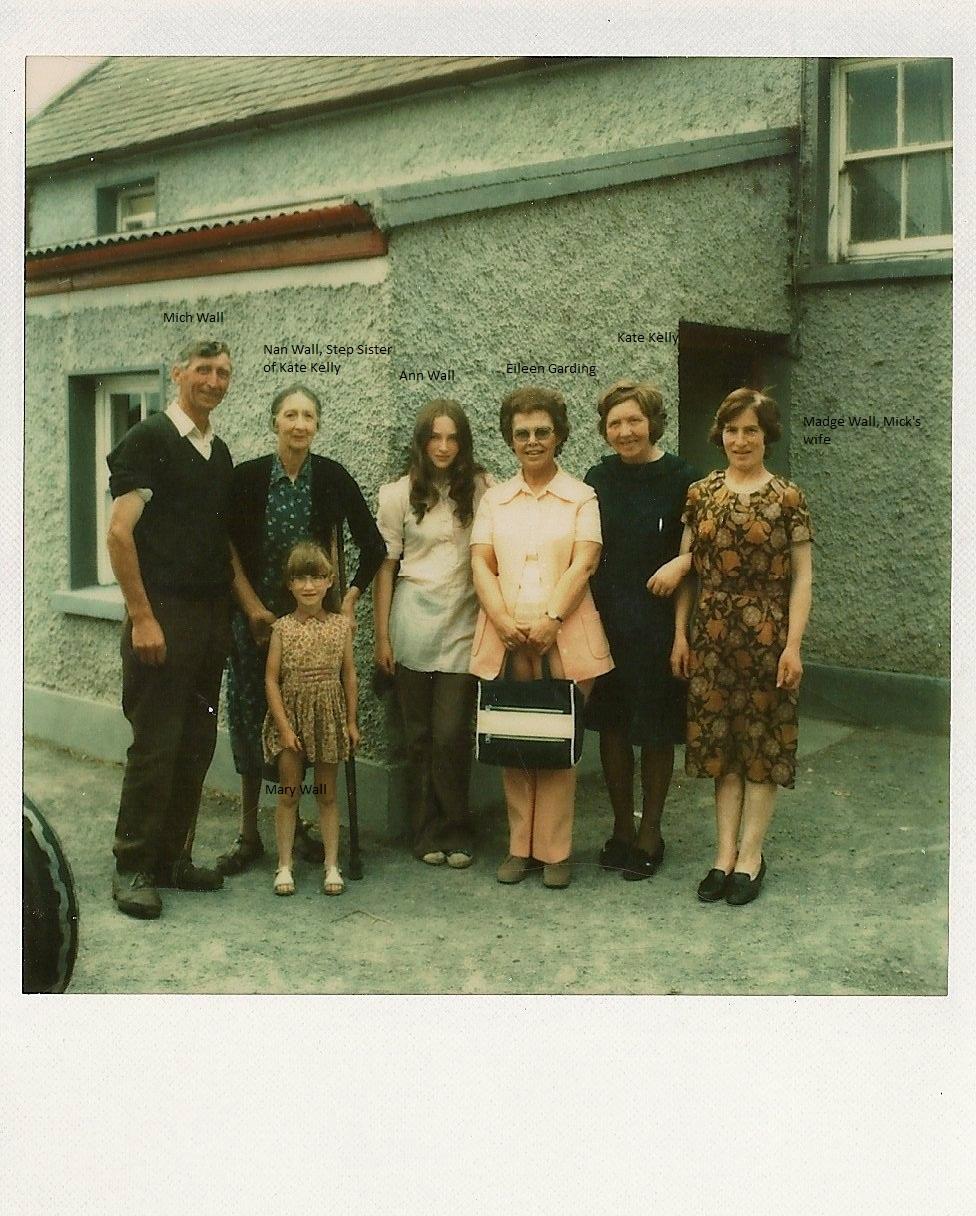
They were Nan Loughman Wall, Kate’s stepsister, Nan’s son Mick, his wife, and their two daughters. The names are only important because of what happened next.
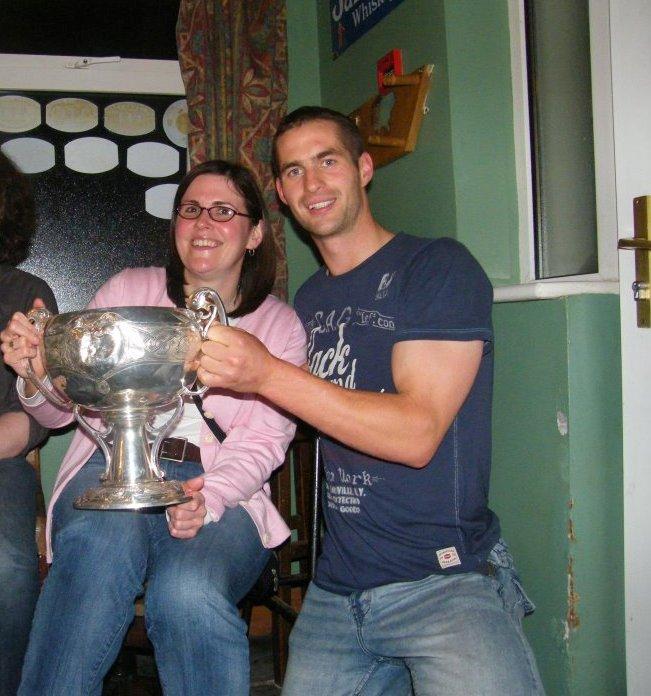
Regan McCormack, Johnny Delaney, and the cup

Two nights later my family and I were attending a victory celebration in a pub in Clogh. It just so happened that the Hurling team from Clogh/Ballacolla had recently won the County Laois Championship. The reason we were at the party is that another cousin Johnny Delaney was the captain and star of the team.

While enjoying the celebration at the pub I was introduced to a fellow named Mick Wall. The name sounded familiar but I could not place it. I do have about 1700 names in my family tree. After a few minutes it started to come to me. I asked him if his parents were Mick and Madge. Sure enough he was the son of the family in the mystery photo that had just been identified two days earlier. Where but in Ireland could a Yank from St. Paul Minnesota be celebrating with the team captained by a cousin in one of the smallest hamlets in the County run into the son of a man on the mystery photo?

2 Comments

Grandfather

Years ago I resigned myself to the fact that I would never knew much about my paternal grandfather, Bill McCormack. He died of a massive heart attack in 1957 and so much sadness surrounded this event and its implications, that people rarely spoke of him. I understood why this was so, but at the same time I wanted to know what kind of man was my grandfather. I had a couple of reasons for my curiosity: 1) I never had a grandpa and I felt like I was really missing out, and 2) I loved to ask questions and get to the bottom of things (What, are you writing a book or something? is the question my dad frequently asks me.)

My dad has thoroughly researched the family tree, and several years ago, he learned that his first-generation Irish American father had visited Ireland as a young man in the 1930s. My grandpa’s first cousin Paddy McCormack (of Rathdowney, County Laois) was a boy at the time and recalled the visit. This intrigued me and of course I had a bunch of questions that no one could answer. By default, my imagination took over and I created a dramatic tale surrounding my grandpa’s return to his father’s birthplace in Ireland.

Last month while in Ireland, my dad and I were chatting with Michael Kelly (see previous post). One of the first things out of Michael’s mouth that afternoon was, “The day my mother received word that Bill McCormack had passed away was a sad day indeed…” I had heard such sentiments over the years, but what made this different was what followed.

Michael went on to say that when my grandfather came to Ireland in 1934, his mother (and Bill’s first cousin) Katie Loughman showed my grandfather all around the area and introduced him to neighbors and relatives. Stories of horse races and touring, nights out and singing – it sounded like they had a fabulous time and Katie and Bill became great friends. Katie also corresponded with Bill’s sister Nellie for many years.

I was thrilled to hear Michael tell the stories of my grandfather’s Irish visit. For the first time I could associate joy, humor, and fun with my grandfather – things I always suspected about him, but I was unable to get past the sorrow of his untimely death.

My grandpa Bill McCormack, great-uncles Jimmy Flannery and Jim McCormack, early 1940s

Thanks for the stories, Michael Kelly. I am that much closer to learning about my grandfather.

Next time, guest blogger Jim with his observations on family history and his recent trip to Ireland.


2 Comments

The Proof is in the Picture

“You know, Jim, my brother Paddy met you before. It was in the early Seventies at Nellie Marrin’s home in Minneapolis,” Michael Kelly told my dad one afternoon last month shortly after we arrived in Ireland.

“I don’t think so…he must have me confused with someone else…I really don’t remember that at all,” my dad replied shaking his head.

Regardless of whether Paddy met my dad, I was curious how Paddy Kelly found himself at my grand-aunt Nellie McCormack Marrin’s house in South Minneapolis. I had heard my dad mention the Kelly name when he referenced his genealogy work in recent years, but this was the first time I had met a Kelly.

Paddy and Michael’s mother, Katie Loughman Kelly, was a first cousin of my grandfather Bill McCormack and his sister Nellie McCormack Marrin. This makes my dad, Paddy and Michael second cousins.

Michael shared a number of entertaining stories with us that afternoon. Over the years, he collected stories from his mother Katie, and passed her memories on to us with keen understanding and insight.

Katie considered her American cousins Nellie and Bill “kindred spirits” and enjoyed a life-long correspondence with Nellie. Katie never met Nellie in person, but Bill visited Ireland in 1934-35 and the two of them became good friends.

Michael invited us to dinner the following Sunday. We had a great time at their lovely home. Michael’s wife Moira is known for her culinary and hosting skills and the entire Kelly family was delightful.

Paddy Kelly stopped by and after introductions were made, Michael mentioned to Paddy that my dad didn’t remember meeting him. Paddy stood his ground – indeed they had met – and he went on to tell us how Nellie sat in her rocking chair, closed her eyes and recounted the name of every family on the road from Ballyedmond (County Laois, where her father’s home) to Rathdowney. This was truly a stroll down her father’s memory lane – the families Nellie listed were her father Andy McCormack’s neighbors before leaving for America. Nellie must have heard her father’s litany often enough for her to commit it to her own memory.

Paddy turned to my sister, mom, and me and said that he also met the three of us that day at Nellie’s.

Paddy let us stew a few minutes before pulling out a photograph taken at Nellie Marrin’s in 1972:

Jim, Eileen, Regan, and Aine McCormack - 1972

Sure enough…the four of us posed for a photograph for an Irish cousin (I am the camera-shy one on the right!) We had all met a Kelly before.

I don’t blame my dad for not remembering. After all he was twenty-seven-years-old, busy with his young family and his life.

So often people lament not talking to older relatives about family history or not asking more questions when they were young and there were people still around who could answer them. I say don’t be so hard on yourselves! As young people, most of us don’t care that much about what old people have to say, and sometimes the old people don’t want to talk anyway.

The photograph Paddy produced reminded me of the dozens of old, unidentified photos in my family collection. I think I will begin labelling them all as “cousins” of whichever relative they most closely resemble!

Next time I will take a look at the other side of the family history obstacle – when no one wants to talk about it. When we were in Ireland I finally learned a few things about my grandfather.


1 Comment

Reader suggestions…

John from Ireland wrote to me with a few suggestions for using the Irish Census data available on-line.  He began by pointing out www.census.ie which provides information on how the Irish census is used today as well as its role in history and as a valuable research tool.  Click here to go directly to the history portion of the site.  This page contains interesting information on the census and will also link you to the National Archives, the home of the 1901 and 1911 Irish census.

I suspect many of you researching your Irish roots are familiar with the Irish census data from 1901 and 1911 on the National Archives of Ireland website.  You have a couple of options for looking at the census: you can browse  or you can search.

If you know the county, parish, and townland of origin for your subject, why not take leisurely browse through the actual records.  This method can be a bit more time-consuming, but you may get a bit more of a feel for your subject’s life.

Of course, a search will get you to your goal a bit faster, and you can always browse the records from that point.  Either way, these records are fascinating and can provide valuable information for your family tree.

John pointed out a list of several links at the bottom of the main census page on the National Archives site that I had completely missed.  These photographs and articles provide some context to the 1901 and 1911 census data.  See a tram timetable from 1911 or a photograph of the 1903 All-Ireland champs from Kerry.  The eviction scene from County Galway (below) is one of the items listed.

Eviction - Woodford, County Galway

Speaking of browsing, I was completely sucked in by another collection John recommended, the digitized photograph collections at the National Library of Ireland .    The photographs are organized in several smaller collections, according to time period, region, and subject matter.  If one of the collections fits your area of research, click on the name and you will be able to further filter your search.  Or you can just browse through the photo collections.  The photographs can be downloaded, free of charge.

Many thanks to John for providing a fresh perspective on researching Irish roots!


Leave a comment

Packing Breather

I need a break from packing.  For the past ten minutes I’ve been staring at the full duffel bag on my bedroom floor and the stack of clothes waiting to (somehow) be stuffed into that full duffel bag.  What stays behind? What can’t I live without for two weeks in Ireland?  I don’t feel equipped to make such important decisions at the moment.

Instead, I want to daydream about my trip.  Several fun events have crept into my itinerary, including the 2012 Ireland Reaching Out Launch at the Loughrea Hotel, Galway Wednesday October 12th at 9pm.  David McWilliams is schedule to speak.  By all accounts the Week of Welcomes was a huge success this summer, so I am eager to hear about their plans for 2012.

My dad has “discovered” another branch of our family.  Some of the folks live very near to where we are staying, so I believe he has another party up his sleeve.  Hopefully it will go as well as our previous attempt at entertaining in Ireland – read the story here.

McCormack Family Gathering: Old Parochial House, Tipperary, 2009

I am excited to meet Elizabeth McEvoy at the National Archives in Dublin.  When I first had the idea for this blog I contacted her to ask if she had many Irish people looking for information on their emigrant relatives.  Elizabeth was very helpful and includes the link to this blog on the National Archives site.  I am most appreciative for the traffic that link provides!

Well, better get back to packing.  No clue where that stack of clothes will end up.  Oh dear, I just remembered about the Minnesota-themed gifts for my Irish friends and relatives in my closet… something’s got to give!

Follow me as I tweet from Ireland: @irish_america on twitter.  Let me know if there is anything I must not miss while I’m there!


Leave a comment

Just around the corner…

Adjacent to cemetery at Erke, County Laois

In less than a month, we leave for a two-week visit to Ireland.  Naturally, I can’t wait.  Although this is my seventh trip to Ireland, I think I am as excited as I was the first time I visited as a sixteen-year-old high school student in 1988.

Quite a bit has changed in the past twenty-three years, and each trip I’ve taken to Ireland has had its own unique flavor.  I have stayed in all types of accommodations (except this one…would love to try it!) and visited nearly every county in the Republic, as well as the North.

On previous trips, there may have been times when we’ve tried to do and see way too much, but not this time.  We are staying in the same place for the entire two weeks, and I am content to remain within a 15-mile radius of our rented house.  I will have everything I love in Ireland in that zone – brown bread, ruins, a good pub (or two), family, farmhouse ice cream, chocolate, a museum, and cows.  Now, the ice cream is a bit outside of the 15-mile zone, but it is still in County Laois.

Can’t wait to see the McCormack relatives.  We will be a few short miles from the farm my great-grandfather left behind when he came to America at the end of the nineteenth century.  My dad has been in touch with more relatives in the area, so he is planning another get-together (read about our first adventure in entertaining back in 2009 here.)  This makes me a little nervous…maybe last time was a case of beginner’s luck?

I am excited for Tuohy’s Bar, and I hope we can make it to the Monday night sing-a-long on our first night in Ireland.  I have never quite mastered the tricks to dealing with that initial day of jet-lag.  I never know if it is best to take a nap at some point and risk not waking up or to power through and nearly fall asleep at dinner.  I don’t want to snooze away my first day in Ireland, nor do I want to be so tired I see double.  Maybe I will actually get some sleep on the plane this time!

A bit of a diversion during the next month or so as we look at some Americans in Ireland, but I will also keep my eye on the Irish in America…


2 Comments

Mick Moloney and the Music of Irish America

Yesterday I heard a re-broadcast of an  Arts Tonight interview with folklorist and musician Mick Moloney on RTÉ Radio1.  Here is a little bit about Mick from his website:

Mick Moloney is the author of “Far From the Shamrock Shore: The story of Irish American History Through Song” released by Crown Publications in February of 2002 with an accompanying CD on Shanachie Records. He holds a Ph.D. in folklore and folklife from the University of Pennsylvania. He has taught ethnomusicology, folklore and Irish studies courses at the University of Pennsylvania, Georgetown, and Villanova Universities, and currently teaches at New York University in the Irish Studies program.

Mick has also recorded and produced more than forty albums, organized and performed countless concerts and productions, consulted on American Public Media programs, and earned a National Heritage Award from the National Endowment for the Arts.

The interview was very interesting because it reminded me that I can look to music as a historical resource for furthering my understanding of the Irish American experience.  When Mick was asked what he encountered when he came to the United States looking for Irish music, he said that he was amazed by the number of songs about the Irish that existed in America…songs about Irish railroad workers and Irish canal workers, Irish anthracite miners in Pennsylvania and Irish coal miners in Montana, big-city Irish politicians and pioneer Irish farmers, Irish activists and Irish gold-rushers  in California.  Songs covering most of the Irish experiences in America.  Mick’s conclusion?  The Irish “speak of our personal lives and our history as a people through music and song.”

Mick was impressed by the quality of the Irish music being played in American cities such as Philadelphia, Boston, New York City, and Chicago.  From the mid-1970s, Mick documented the music he found as he traveled all over the United States.  The result is a collection of recordings housed at the Taminent Library and Wagner Archives of New York University.  Click here to visit the library’s detailed guide to the Mick Moloney collection.


This looks like a great book.  It was published by Mick Moloney in 2002 and is accompanied by a sixteen song CD.  It is available from Amazon.com – click here to take a closer look.  I will be ordering myself a copy soon…can’t wait to read and listen to it!

I will leave you with a song…


3 Comments

Letters from North America

The New Brunswick Archive in Canada has a great collection of letters to and from Irish emigrants to the area.  You can read the actual hand-written letters, or if you prefer not to struggle with nineteenth century script, transcriptions are available for download. The collection contains items from the nineteenth century, as well as some from the early twentieth century.  Also included are a diary, family histories, and other documents.  Take a look around the site…fascinating stuff!

An example of what the New Brunswick archive has to offer…

The Laurence Hughes collection (MC2618 :: Laurence Hughes fonds) contains several letters written to Laurence Hughes of Fredricton, New Brunswick from relatives in Ireland and elsewhere in North America.  I think these letters are particularly interesting for they demonstrate the networks of Irish emigration and how that support facilitated further migration from Ireland and within North America. The letters span seventeen years (1837-1854) and see several relatives in Ireland considering emigration and dealing with the decision to stay.

In 1837 Laurence’s brother Thomas writes from Newry sharing the news from home.  Thomas encourages Laurence to move to Boston and gives him advice on how to be successful there:

Now before you go to Boston enquire of every respectable person that knows you if
they can give you a line or two of recommendations to any person they may be acquainted with…[damage]…the Catholic Priest of Fredericton…

Good advice, I would say.  Thomas provides his brother with options, outlining a plan for Laurence’s return to Ireland since, “It is only natural to expect you would prefer living in Ireland.”   Laurence stayed put in Fredricton, at least until 1854.  Thomas mentions that he had four children and was looking forward to more…”We calculate on having one every 13 or 14 months that’s not bad trade thank God.”

In the 1837 letter, Thomas mentions another brother, Edward, who had also gone to New Brunswick.  By 1852 he was living in Pennsylvania with a large family and looking to move west to Iowa:

I some times think of selling it to go live in the west. There is a fine
colony of settlers from Carlow in loway State sent out by Rev. James Heigher and they have fine schools there now for boys and girls. I think dear Lawrence if we would go there it would be a fine chance for our children but I am afraid it is not healthy there.

Read Edward’s full letter here.  I wonder if Edward ever made his way to Iowa?  Establishing Catholic colonies in the midwestern United States was popular during this time (until the mid-1880s.)  The goal of such projects was two-fold: provide opportunities for Irish immigrants to escape congested Eastern conditions and own land, farm, and raise families in a Catholic community, and to strengthen the American Catholic Church by populating the West with Catholic settlers.

These letters are full of interesting observations.  Edward comments on his fellow Irishmen who work on the railroad, a job many felt lucky to get:

There is a great deal of railroads making here but the most degrading characters work on them now. Some of this is a disgrace to the land that gave them birth.

This comment is important because it reminds us that all Irish immigrants were not treated equally in America, even by their fellow countrymen.  Clearly Edward was educated to some degree, and from his letter it is apparent he was a religious man who did not approve of drink.  Irish in America like him would have had little time for the poor, uneducated, Famine-era emigrants.  Edward and his brothers made the decision to come to North America before the worst years of the Famine hit Ireland while for many of the million who came during the Famine, the alternative was starvation.  This is not to say that conditions in Ireland were favorable at the time of the Hughes brothers emigration, but judging from the letters, it was not a case of emigrate or starve.

Research Help Requested…

Edward mentions a “Catholic Almanac” in his letter to Lawrence.  Has anyone ever heard of that before?  I would love to know where I could find 19th century copies!


5 Comments

Ireland Reaching Out, Portumna Workhouse, and a Family Reunion

Journalist Loretto Leary has written several articles, as well as conducted interviews, about the Portuma workhouse in South East Galway and posted them on her website Breise! Breise! (Extra! Extra!).  We have heard quite a bit about the South East Galway region recently for its participation in the Week of Welcomes, the pilot program of Ireland Reaching Out.  Local Portumna historian John Joe Conwell ties the workhouse, emigration, and the Ireland Reaching Out initiative together very nicely in Part 2 of the Irish Workhouse Center video (which appears midway down the page.)

Ursula Marmion is the project head of the Irish Workhouse Centre in Portumna.  It is an exciting and ambitious project to conserve the buildings, establish a visitor’s center, and tackle future redevelopment.  Ms. Marmion shares her thoughts in Part 1 and Part 2 of Irish Workhouse Center.  Videos and articles can be found on Loretto Leary’s site.  When you are finished with the Irish Workhouse information, take a spin around the rest of her insightful blog.  Thanks to Noreen Bowden (@noreenbowden) who introduced me to Loretto’s blog via a tweet yesterday.  Click here for a few photos of the Portumna workhouse.

More than simply a family reunion, the Irish Times calls the meeting of over 300 members of the McNamara clan in Loughrea, Galway the McNamara Festival!  This ambitious endeavor was inspired by the Ireland Reaching Out program, now perhaps it will inspire you to plan your own family reunion.  I am more than happy to help spread the word and help track down American relatives.  Leave a comment if you have ever considered organizing an Irish family reunion.


2 Comments

The Famine: Views from Ireland and Abroad

“The Coffin trade is the most flourishing one at present here.”

This quote appeared in the January 8, 1847 edition of the Cork Examiner.  Steve Taylor of Vassar College has compiled a fascinating collection of newspapers, illustrations, and other items from Irish and British sources pertaining to the Great Famine.  The collection, Views of the Famine, is available online and provides a glimpse into how the press was reporting the crisis, and what people were doing (or not doing) to cope with the disaster.

"The causes of emigration in Ireland." 13 January 1849 (from Views of the Famine)

The collection includes excerpts from the Cork Examiner during 1846-47.  The weekly reports of death by starvation and disease and a pervasive sense of hopelessness can be difficult to read.  Entire families perished, their lifeless bodies found on the dirt floors of make-shift huts, post-mortem exams showing not even a trace of food in their stomachs and intestines.  Columns reporting over-capacity in the workhouses appear alongside advertisements for steerage passage to North America costing more than most Irish could ever afford.

On September 1, 1847, a column Emigrant Disasters ran in the Cork Examiner.  The column explains why the journeys of emigrants bound for the United States were more “successful” than those destined for Canada.  The major difference was the ships used to transport emigrants to Canada were timber ships, vessels utterly unsuitable for passengers.  The Examiner explains: “…less attention to be paid to their [ship’s] sea-worthiness, since they are laden half the way with what can’t sink, and the other with a freight, which is thought no loss if it do.”

The passage to Canada (British America) was cheaper and the preferred route for much of the “assisted emigration” that took place during the Famine years.  Owners of the large estates in Ireland who favored a more “humane” method of getting rid of tenants, chose to send them to Canada rather than merely evict them from the land.

The destination for many of these emigrant ships was New Brunswick, Canada.  The New Brunswick Archive offers a collection of online databases pertaining to the Irish who came to Canada.  Specifically, there are some useful resources related to assisted emigration.

The Fitzwilliam Estate Emigration Books 1848-1856 lists the tenants evicted from the Coolattin estate of Lord Fitzwilliam in County Wicklow, Ireland.  The archive provides an informative introduction, a narrative by Jim Rees providing context, a finding aid, and a transcript, complete with genealogical information.  Quite an interesting and useful tool.

The New Brunswick Archive also has a collection of letters, transcribed and available online.  I will address some of these letters in my next post, but I would like to turn your attention to a group of letters, Letters from Irish Emigrants and others, put in by Sir Robert Gore Booth Bart: [1846-1849].  Click here and scroll to the last group to read these letters.  Sir Robert owned an estate in Sligo.  These letters speak to the conditions and challenges faced by the Irish in the New World.

For more information on the Famine Irish in New Brunswick, read this essay by Dr. Stewart Donovan of St. Thomas University, In the Wake of Dark Passage: Irish Famine Migration to New Brunswick.

Just a couple more examples of the resources available online to help us better understand the Irish experience in America (and Canada, too!)

Resources:

Views of the Famine

New Brunswick Irish Portal

Irish Canadian Cultural Association