The Irish in America


4 Comments

Ireland Reaching Out: Parish List

Mike Feerick of Ireland Reaching Out left a comment a couple of days ago and provided a complete list of the Galway parishes involved in the program:

The Full List of South-East Galway Parishes….. It’s a big part of County Galway!

Abbey and Duniry
Tynagh
Aughrim & Kilconnell
Ardrahan / Labane
Ballinakill & Derrybrien
Gort (Kilbeacanty & Beagh)
Kilconieran & Clostoken
Clonfert, Meelick and Eyrecourt
Clontuskert
Fohenagh and Killure
Peterswell
Kilchreest & Castledaly
Leitrim & Killeenadeema
Killimor
Tiranascragh
Fahy and Quansborough
Kiltullagh & Killimordaly
Laurencetown
Kiltormer
Loughrea
Mullagh, Killoran, Kilrickle, Cappataggle
New Inn & Bullaun
Portumna, Boula, Gortanumera
Woodford
Ballymacward & Gurteen

Do you trace your ancestry to one of the south-east Galway counties? If you can, you must visit the Ireland Reaching Out website!


1 Comment

Clancy Wrap-up

Two more Clancy girls in America…

Mollie Clancy sent Margaret $100 as a wedding gift in the 1960s, and Margaret recalled posting a letter to Flushing, New York, which may or may not have been for Mollie.  Mollie never married.

That’s what Jim had to go on we he began his search for Mollie Clancy.  He positively identified Mollie’s arrival in New York using the New York Passenger Lists database on Ancestry.com.  On September 28, 1907 the S.S. Campania from Queenstown, Ireland arrived at New York harbor with Mollie Clancy, a twenty-year-old servant from Moylough, County Galway on board.  Mollie was accompanied by two other young people from Moylough: Martin Cosgrove (laborer) and Maggie Lyons (servant).

Jim was unable to trace Mollie after her arrival.  More research time would definitely result in more information on where she lived.  Mollie showed up on Jim’s radar again with documentation of a return trip from Ireland in 1938. The US Passport Applications on Ancestry.com only go to 1925, so that would not help with Mollie.

Nora Clancy O’Hara remains a mystery, for now. Margaret told us she appeared on the 1901 Irish census, but not the 1911.  We could assume she made the journey to America sometime between 1905 and 1910, but she doesn’t appear in the passenger list database.  Again, I am sure that more time could produce results about Nora.  Jim did locate a Nora O’Hara in the Social Security Death Index who died in Flushing, New York in September of 1966, with a birth date of April 20, 1885.

The Other Clancy Siblings…

Margaret filled me in on the Clancy siblings who remained in Ireland.  Her grandfather Thomas stayed on the family’s homeplace, while a grand-uncle Pat built a house nearby.  Pat is said to have helped finance Nellie’s education as a teacher.

An interesting historical side-note: Margaret had an uncle Thomas who emigrated to England and who worked for the post office in London.  He returned to Moylough with his family for a couple of years during World War II, driven from London by the German bombing.  Margaret does not know when they came or when they left, and said that Tom never returned to Ireland.  However, Margaret paid him a visit in England in 1967.

Making the connection…

Margaret emailed me the other day, and she told me that she had phoned a granddaughter of Catherine (Clancy) and John Coogan living in California, and she was writing to her to fill her in on some family history. Jim identified the California woman as a very probable match.  Margaret wrote, “It is all slotting into place.”  I am pleased that we could help her fill out the American branch of her family tree.

Only two Clancy sibling would live out their lives on Irish soil.  This story is by no means unusual for the time and the place, but that does not diminish the profound emotional impact emigration had – and continues to have – on families.  Profound enough that over one-hundred years after her grand-aunts and uncle left Ireland for America, Margaret was curious enough about what happened to her relatives to search for answers.

That’s all on the Clancy family…for now.  We will see if Margaret learns any new bits of information from her new-found American cousin!  I hope that this example has shown you how easy it can be to trace your American relatives.

Note: In an earlier post on the Clancys I mentioned their father’s name was listed as Theo. (Theodore)…I was wrong, it was Tho. (Thomas)…Thomas was Margaret’s great-grandfather’s name.


2 Comments

Ireland Reaching Out: The Newsletter

More on the Clancy family of Moylough, County Galway coming up, but first I wanted to share something I found in my inbox this morning.

Click here to get the latest information and updates on the Ireland Reaching Out program of south-east Galway.

If you live in one of the parishes involved in this pilot program, you obviously are aware of the efforts to connect with members of the Diaspora throughout the world.

Some of the parishes involved…

Ardrahan

Aughrim

Clostoken & Kilconieran

Clontuskert

Fohenagh & Killure

Gort & Kiltartan

If you can trace your Irish ancestry to any of these parishes in south-east County Galway, contact info@irelandxo.com. I am sure they would be delighted to hear from you…

Please leave a comment if you would like to share any information about the IRO program, searching for your Irish roots, or tracing a relative who emigrated to the US.  We would love to hear what you have to say!

Read the first edition of the IRO newsletter here.


Leave a comment

Out from Moylough: The Clancy Family in America

Over the past several months I have had the pleasure to exchange emails with Margaret from County Galway.  Margaret has shared memories and stories about relatives who emigrated to America in the early twentieth century.  I would like to show you how we were able to take Margaret’s memories, add some Irish Census evidence, throw in Ancestry.com, and put it all in the hands of an experienced researcher to identify the American branch of Margaret’s family tree.

In the pursuit of family history research, there are times when every path seems to lead to a dead-end.  Other times the bits and pieces of information fit together effortlessly to tell a wonderful story of your history.  Luckily for us, the data slid right into place.  To get up to speed on Margaret’s research quest, click here.

Moylough Church, Galway - compliments of http://www.irelands-directory.com

When Margaret first told me about the Clancy siblings, her relatives who left Ireland for America, she shared some memories – Trimmings after the Rosary for the “boys in the war”, an old letter that mentioned debris from the Lusitania scattered in the sea as a young woman sailed to America, a generous wedding present from an American relative in New York.  Great stories that provide priceless clues for the researcher, but a few dates will always make the research process easier.

Margaret delivered again and gave us the birth dates and places for the five Clancy siblings.  She was unsure of exact emigration, but she provided information from the Irish Census – whether or not someone appeared on the 1901 or 1911 census helped us narrow our search and make positive identifications.

And did we make identifications!  Margaret may well learn more about her Clancy relatives than she ever wanted to know!

Jim, a senior research associate from Archival Solutions , stepped in and began to put the pieces of the puzzle together.  Jim told me that this project was made much easier by the information Margaret provided, and he said that the information he gathered is just the tip of the iceberg – there is much more out there, on both sides of the Atlantic and in cyber space.  This brings up a key point to remember: When you begin family research of any kind, gather all known information at your disposal – the more you have, the easier your search will be.

Over the next week, I will highlight examples from this project that will illustrate the types of information you can expect to find when you embark on researching your family history in America.  I will begin with a story with its foundations in the once-popular and treasured item, the emigrant’s letter home.

Margaret recalled an old letter belonging to her aunt.  It was from her father’s cousin Nellie Clancy who went to America.  In the letter, Margaret remembered a vivid description of the debris from the Lusitania floating in the sea as Nellie’s ship sailed for America.  Margaret believed this letter was sent when Nellie returned to America after a holiday in Ireland.  The letter is long gone, but the image of Lusitania wreckage stayed with Margaret.

Panoramic view of the Lusitania - 1907

Jim found Nellie Clancy on S.S. St. Paul ship’s manifest right away.  She sailed from Liverpool on May 8, 1915 – the day after the Lusitania was sunk on May 7, 1915.  Nellie was not returning from a holiday in Ireland as Margaret believed, but rather this was her first voyage to America.  Nellie didn’t travel alone – she was accompanied by her younger brother and the youngest of the Clancy siblings, James.  James is listed as an eighteen-year-old farmer,  and the twenty-year-old Nellie’s occupation was listed as teacher.  Their closest relative in Ireland is given as,  father Theo. Clancy, Moylough, Ireland.  All of this information is included in the Ship Passenger Manifest.  What a way to start your new life, amongst the wreckage of a torpedoed ship!

The 1920 U.S. Federal Census shows Nellie and James living in a rooming house in Brooklyn, and the 1930 U.S. Census has Nellie married and living in New York, while a James Clancy is shown living in a house with two new Clancys – Teddy and Anna.  Margaret will have to let us know if there were a couple more Clancys hanging around.  Remember back to the ship’s manifest?  The Clancy father was named Theo., so there is a chance James wasn’t the youngest Clancy after all.

Next time we will look at the “Boys in the War”: the American soldiers remembered in the nightly prayers of a family in Galway.



1 Comment

What’s the most Irish town in America?

The 2010 US Census returns are in and the “most Irish town” in the country is Scituate, Massachusetts.  Scituate is located about 30 miles from Boston in an area known as the “Irish Riviera” – read the story from the Irish Central here.

In the article Richard Finnegan of Stonehill College in Easton, Massachusetts explains the Irish migration from inner-city Boston to the South Shore suburbs as the natural path in light of improved economic and social positions  attained by the Irish during the twentieth century.  It is interesting that the Irish seemed to replicate their urban neighborhoods in the new suburban landscape.  Professor Finnegan says that, “Family goes where their family and friends are.”  This was true of the nineteenth century Irish immigrants and it remains true for Irish Americans and new twenty-first century immigrants as well.

Professor Finnegan’s statement helps to make family history research a bit more manageable.  Searching US Census records on Ancestry.com for a family member who emigrated to America?  When you find a match, take a minute to look at the names of the neighbors…you might recognize names from your home town in Ireland. The same is true when searching passenger lists – especially those from the twentieth century which sometimes indicate a family or friend’s name and address in the US – the emigrant’s destination.

And when you reach a dead-end with your research, just remember what Professor Finnegan said…”Families go where their family and friends are.”  This simple and spot-on description of the Irish migratory experience may lead to new discoveries.

For more on Scituate, Massachusetts visit the town’s website.

If you would like to learn more about the Irish in Boston, click here.


Leave a comment

The Unmarked Grave

I have exchanged emails with Margaret from County Galway regarding her American relatives.  When I first heard from Margaret, I thought her request was fairly standard: she was looking a relative, Catherine McLoughlin Dempsey, who was born 1887 in Coolcalliga, Moylough, County Galway and emigrated to the US.  Catherine and a daughter returned to Ireland for a visit in the 1960s.

I was easily able to find Catherine by doing an Ancestry.com search.  In addition to the census and passenger list data, there was a family tree that had been submitted by an ancestry.com user.  This family tree included Catherine McLoughlin Dempsey with the exact birth date and place.  I have attempted to make contact with the author of the family tree, but as yet have been unsuccessful.

Margaret was quite pleased to learn about Catherine’s life in America, but she wanted to learn if there were any surviving members of the family.  You see, Catherine’s mother, Margaret Clancy McLoughlin, is buried in Moylough without a grave marker.  Margaret (also Margaret Clancy before she was married) had hoped to locate a direct descendant who might help remedy that.

An Irish Cemetery (not in County Galway, but County Kildare) - photo by Regan McCormack

I am competent in historical research, but tracing living people is another story.  I found a Dempsey in the Long Island town where Catherine died, but when Margaret contacted him she learned he was a recent arrival to the area and unrelated.

There are more of Margaret’s relatives I have yet to fully research, but I was thrilled with the information on them that Margaret shared.  Here is a portion of her email:

Nora  Clancy  married an O.Hara They had 2 children (may have been adopted) mary and ?John I think he was in the Korean war AS were the Coogans .Their mother wasCatherine or maybe Kate .Her husband was from Kilkerin CoGalway  we prayed for them every night after the rosary in what we called Trimmings  They were known as:” The boys in the War.”4 of the Coogans visited Ireland late sixties or early seventies ,no one seemed to have exchanged addresses!!!    we also had Nellie clancy married Nick guerin ;They lived in Fortlauderdale on retirement.and Ive a faint recollection of Posting mail to:Flushing Newyork. ;where they had a sister Mollie  never married,She sent me 100 dollars when I got married in 1967!!! . There was a brother James  died 1952 I think,He wasnt too popular with the sisters… He never came back to Ireland, I think Nellie was the only one to visit,She was  returning to the states when the Lusitania sank,I remember finding an old letter when my aunt died and reading about the debris floating on the sea!

Margaret provides many interesting details, but I especially liked the bit about how they prayed for the “Boys in the War” each night after the Rosary.  She has so much information on these relatives.  I will trace these relatives and share the results here.  In the meantime, maybe someone will read this with ties to these Clancy siblings…


Making the Connection

Leave a comment

The first comment left on this blog was from Mai in County Wexford back in early October.  Mai was interested in learning about her mother’s cousins who left Ireland and settled in Pennsylvania, USA.  With the few details Mai provided, I was able to do a quick search of US genealogy records and find her family.

Mai told me the names and birth dates for her mother’s aunt and uncle who emigrated to the USA.  She also knew the place-name of their residence, as well as the names of the children.  These details were just enough for me to identify the family on a passenger list on a ship from Ireland, their residences in the US Census for 1920 and 1930, and listings in the Social Security Death Index.

Last week I received an email from Mai:

Hi Aine Thanks for your help in finding my relatives in Pennsylvania. I  have made contact with them and we now e-mail  regularly. They are delighted at finding us too. Thanks again…

I am not surprised that Mai’s American relatives were delighted to hear from her; there are many Irish Americans who would be thrilled to receive an email from a long-lost Irish relative.

Have you reached out to your American relations, or have you been contacted by an Irish relative?  Please share your experiences by leaving a comment!  I would love to hear your stories…

This gallery contains 0 photos


16 Comments

Week of Welcomes: McCormack Style, Part I

Over the past twenty-two years I have visited Ireland six times, and it wasn’t until my last trip in 2009 that I actually spent time with my Irish relatives.  My heritage is completely Irish, but I was always hesitant to establish a connection with my Irish relations.  While this attitude may have its roots in a general feeling of shyness, it was cemented by experiences I had in Ireland.  I was content to remain a casual visitor who had a great time in Ireland and leave the sentimental homecoming production to other Irish Americans.

Two examples of encounters I had in Ireland explain why I chose to forgo the pursuit of my Irish family.  The first occurred during a visit to Ireland when I was sixteen-years-old on a summer program for American high school students called The Irish Way.  On a free day from classes, I  accompanied a friend on a day trip to visit her relatives who lived in the village where her grandmother was born.  My friend was anxious and excited to meet her relatives, the family of whom her grandmother spoke so fondly.  The entire situation made me nervous, but I was only a spectator.

Sixteen and somewhere in Galway in 1988

The afternoon was a complete disaster.  Meeting the family did nothing to calm our nerves.  They weren’t rude, just not very  friendly, and for some reason they seemed suspicious of us.  We both felt uncomfortable, unwelcome, and overly scrutinized.  There was no connection; no family chemistry.  My friend was disappointed and hurt – she had expected a warm welcome by people just like her grandmother, but instead received the cold shoulder.

The second encounter that stayed with me was a conversation I had with a wonderful woman from near Belfast.  We were chatting one evening at the Nesbitt Arms Hotel in Ardara, County Donegal.  She told me that Irish people dread the sight of Americans on their doorstep, searching for their grandmother’s birthplace, or trying to locate cousins they hadn’t heard from in years.  I can hear her saying with a laugh, ” You hear the doorbell and look out and see a couple of Americans in their khaki pants and runners, looking so pleased with themselves…”

I certainly did not want to be one of those Americans, nor did I want the disappointment of meeting my relations only to have them be disinterested, unfriendly, and annoyed.  So, I remained content to visit Ireland, have a fantastic holiday, and leave any notions of locating relatives to my imagination.

I provided the background so that you might better understand why I was caught off-guard by the Week of Welcomes (to steal the phrase from the pilot program described here) my family experienced in 2009 when we visited Ireland.  Actually, it was nearly three weeks of great times with relatives and friends all over Ireland, but I will begin with the warm welcome offered by the McCormacks of Ballyedmond, County Laois.

Our week was punctuated by two great parties – one at the beginning, and one at the end.  My father, mother, aunt, sister, and I arrived at the home of Jimmy and Helen McCormack late in the afternoon on Saturday and immediately received ribbing for our late arrival.  My father had done extensive genealogy research and had reconnected with the McCormacks in Ballyedmond about ten years prior to our visit.  Irish Jimmy and my father Jimmy are second cousins – their grandfathers were brothers.

The Jimmys having a laugh outside the old house in Ballyedmond

Read the story of our parties with the McCormack clan here.  In my next post, I will share the details of our week with the McCormacks, including a trip to their local, a tree-planting ceremony, and what I learned along the way.


2 Comments

Family and Emigration

While reading up on Irish emigration, I found an interesting article by County Fermanagh historian John Cunningham on the Cassidy family website.  In the article Mr. Cunningham considers the effects emigration has had on Ireland and the Irish people.  Click here to read the article, which is actually a lecture given by Mr. Cunningham.

Mr. Cunningham uses his own experiences to show how family members who stayed in Ireland felt about emigration.  He tackles the often complex and emotional issue of emigration in a straightforward manner with a bit of humor thrown in for good measure.  I found the account of his mother’s visit to America particularly insightful, as well as the description of the parcels and letters from America.

As his mother learned firsthand, letters home to Ireland often didn’t tell the whole story of the emigrant’s experience in their new home.  Regardless of their accuracy, letters are one of the best resources for learning about your emigrant relative by providing tangible evidence as to where the relative lived, possibly where they worked, or names of spouse and children.  Consider yourself lucky if you have an emigrant letter!

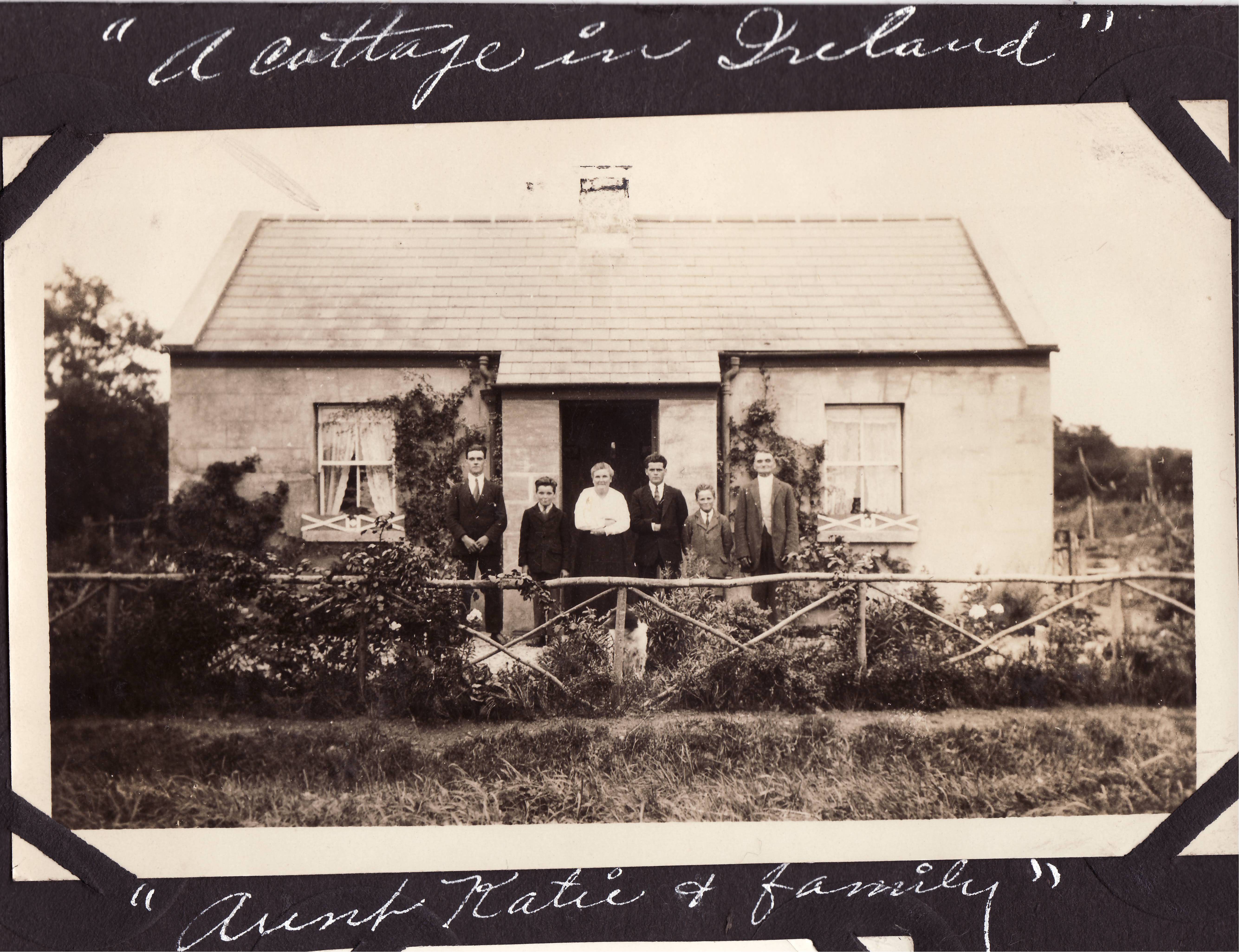
My great-grandmother came to the United States in 1899, joining an older sister who had arrived six years earlier.  A sister and a brother remained in Ireland, and one sister has previously emigrated to Manchester, England.  Unfortunately, no letters survive (on the American side) from relatives at home, but there are a few postcards, greeting cards, and photographs that were sent to my great-grandmother and her sister.  The following photograph was included in an album belonging to a niece of my great-grandmother who lived in Montana, USA.

John and Catherine (Hill) Howe Family, Johnstown Co. Kildare

John and Catherine (Hill) Howe Family - Johnstown, Co. Kildare (courtesy of M. Jeffrey Harshman)

Among the few items belonging to my great-grandmother is a sweet little Christmas card from her sister Katie (Catherine, pictured above), as well as a torn and tattered photo postcard depicting a Whitsunday parade.  It is intriguing to see what pieces of someone’s life survive for later generations.  These bits and pieces have helped us learn a great deal about my great-grandmother’s life before she came to America.

So, if you don’t have a letter, all is not lost in your quest for information about your emigrant relative.  Letters can make the initial search easier, but other information can prove to be as useful.

I invite you to share your family’s emigrant stories by leaving a comment!  Let me know what clues you have, and I will help you begin your search for information on your relative.  If you think you don’t have any information to go on, but really want to learn about what may have happened to a relative, you should leave a comment, too.  We never know what we will find when we start looking!