It is that time of the year again and Seamus Hora shares a poem about the GAA, tradition and home. Seamus writes:
As the summer draws to a close in Ireland if there is one subject which creates more conversation than the weather it’s the GAA now that my adopted county has once again reached the semi finals in what promises to be the game of the year…
Who will meet Kerry in the final? The Mayo-Dublin semi-final match is next Sunday, August 30th @ 3:30pm at Croke Park, Dublin.
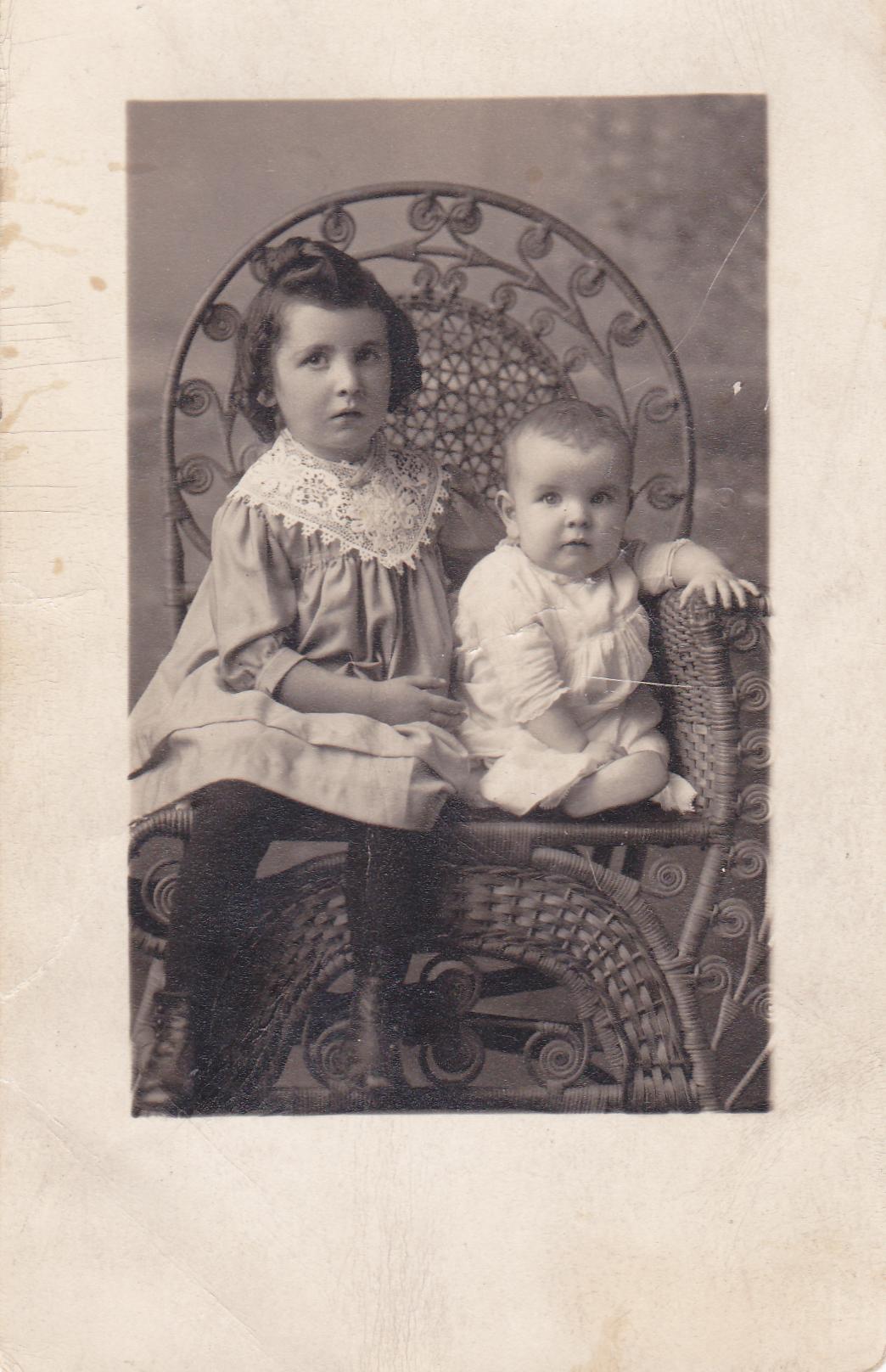
Margaret and Frank McMahon, 1914 (ATMR Family Collection)
My grandma was meant to be in this photograph, but she wouldn’t sit still. Every time the photographer carefully posed the three youngest McMahon children and turned his back to go to the camera, my grandma would get up and run to her mom.
Grandma was just under two-years-old at the time of this photo. She claimed she could walk from the age of nine months, telling me, with a chuckle, that she was so short that she could walk clear under the kitchen table, with room to spare.
Grandma managed to stay put for this photo, up on a chair with mom right behind her.
John Foley and my grandpa John Regan were good friends. They spent their early childhood together in Clontarf, Minnesota. John Foley moved to Minneapolis with his family in the mid 1920s.
It was only natural that the two boys were friends. Their paternal grandfathers (Patrick Foley and John Regan) were friends in their native Kilmichael, County Cork, and they came to America together, settling in Fisherville, New Hampshire before venturing to Clontarf, Minnesota in the late 1870s.
I don’t know if “the Johns'” fathers (Tim Foley and Neil Regan) were friends when they were young. Clontarf was (and is) a small place, but from what I have heard, the two had little in common. If I consider as evidence my grandma’s collection of studio portraits of many of the young men of Clontarf, Tim and Neil were not close. – there are no photos of the two of them together. However, the evidence does show that John’s uncle John Foley and Neil were friends (see below and click here to read about it).
Cornelius Regan and John Foley seated, around 1900 (ATMR Family Collection)
As I mentioned earlier, Clontarf’s a very small place so even when folks moved to Minneapolis, as so many did in the 1920s and 1930s, families remained close, supporting one another as they made their ways in the big city. The community was strong whether it was in the rural west or the largest city in the state. It was sometimes difficult to see where family ended and neighbors and friends picked up. It could all get very complicated…
For example:
One day in late 1930s Minneapolis, my grandma’s Aunt Bid Foley (John Foley’s mom) invited her over for cards. Have I mentioned yet that John Foley and my grandma, Agnes McMahon were first cousins? How about that they were double first cousins?
John Regan was staying with his old friend John Foley at the time of the invitation. Agnes and John Regan had crossed paths over the years, but it wasn’t until Uncle Tim asked Agnes to take his place in a cribbage game with John Regan, that sparks flew.
I don’t know who won that game, but I bet it was fiercely contested. They fell in love over a cribbage board and were married in 1941. They were a perfect couple.
Agnes and John Regan, with guess who as the best man…
Agnes’ maternal grandfather was Patrick Foley and John Regan’s paternal grandfather was….John Regan. The two friends from Kilmichael, County Cork.
When we visited Kilmichael Parish in Cork, Ireland several years ago, we learned that the connection between Patrick Foley and John Regan may have been stronger than we thought. John Regan’s mother was Ellen Foley. Patrick and John were cousins.
I thought this was very cool. Then my sister mentioned how that would have made grandma and grandpa some sort of cousins, too. Distant, of course, going back to their great-grandparents generation. In 19th century rural Ireland that must have happened a lot…right?
Distant cousins, yes, but friendship connected the Foley and Regan families through the generations, across an ocean and into a new world.
And I didn’t even tell you how my grandma’s mom and grandpa’s aunt were life-long besties….
Margaret, Rose & Agnes McMahon (mid 1930s) ATMR Family Collection
When I think of the Irish in America, snapshots like this one come to mind. My grandma Agnes with two of her three older sisters, young and happy in the midst of the Great Depression.
The McMahon sisters were second generation Irish Americans. However, my grandma told me they didn’t spend any time thinking about their heritage when they were young. She made up for it when she grew older and had a highly inquisitive granddaughter. She shared with me stories and songs, old sayings and recipes, passed down to her from her parents and Irish-born grandparents. Grandma was my link to our family history.
I am not sure if this is at the house in Columbia Heights where the McMahons lived, or if it is in south Minneapolis at the Foley house. Maybe my mom will help us out and leave a comment!
I am currently scanning and organizing my grandma’s collection of photographs and ephemera. Moving forward I will share some of my favorite items.
As a single woman, I find myself drawn to the stories of the single women who populate my family tree. We see those conspicuous spots where the branch just stops. Sometimes these nubs result from the early deaths of infants or children, but often they are the result of men and women who (gasp) never married nor had children.
Many of these men and women lived long meaningful lives, but with no descendants to keep their stories alive, they’ve been forgotten over the years. It is no wonder – I read somewhere the best people can hope for is to be remembered for 80 years after death.
In this series I am going to introduce you to some women I have come across in my family history research. They are daughters, sisters, aunts and great-aunts who deserve a little bit of attention.
I am straying a bit from my basic family tree for my first selection, Catherine Theresa Foley born in Minneapolis, Minnesota on September 17, 1884.
Catherine Foley
My great-grandmother was Mary Foley before she married and said she and Catherine Foley were “shirttail cousins”. Catherine’s nubby branch would only appear on the most comprehensive of my family trees, but I often heard references to Catherine and her family by my grandma and her sisters.
A more technical explanation of the shirt-tail cousin relationship follows – it’s a bit convoluted and boring. Personally, I like “shirt-tail cousins” better! Catherine’s parents were John Foley and Mary Casey, both born in Macroom, County Cork. My Foley great-great-grandparents (Patrick and Mary) were also born in that area of Cork, and once they immigrated to the United States, they lived in Fisherville, New Hampshire. So did Catherine’s parents. From what I can surmise, John Foley and Patrick Foley were first cousins.
Mary Foley married Thomas McMahon and the family farmed in Clontarf, Minnesota until 1924 when they moved to Minneapolis. My grandma’s sister Rose McMahon (known as Dodo to her family) worked for Catherine Foley in Minneapolis in the 1930s.
According to census and city directories, Dodo worked as a “housekeeper” at the Foley house, located at 1329 East 22nd Street in Minneapolis. Catherine’s father was a County Sheriff who had done quite well for himself.
The idea of Dodo as a “housekeeper” always made me chuckle. She didn’t seem the housekeeper type to me. Grandma said she spent most of her time lounging under trees, napping and eating apples, rather than doing her chores on the farm. I wondered how much work got done for Catherine Foley!
Although growing up I heard her name quite a bit, I know very little about Catherine. She was a musician. She gave private piano lessons and played the organ at Holy Rosary Catholic Church in Minneapolis.
Catherine seemed to have excellent taste (or at least similar to me!) My favorite table-cloth is a woven Jacquard floral – red and piney green, which came to me from Catherine’s house via Dodo. I also have a wooden box with enamel decorated flowers on top that was Catherine’s. It is very fancy, lined in a padded pink satin. I wonder what treasures she used to keep in the box?
I enjoy those items, but perhaps Catherine Foley’s most important legacy to my family was her house at 1329 East 22nd Street, or simply, 1329. When Catherine died in 1937, Dodo and my grandma bought the house from Catherine’s brother. It became Grand Central Station for the McMahon family. Everything happened at 1329 – from ping-pong matches at the kitchen table to my grandparent’s wedding reception. Many memories were made at 1329.
A few months ago I sent for Catherine’s death certificate. I was curious. Catherine died on September 30. 1937. Cause of death was a coronary thrombosis. She had an enlarged heart as a result of 11-years with endocarditis. She was just 53-years-old. I suspect she kept Dodo around as much for her company as her housekeeping skills. I can just hear Dodo laughing in this photo!
Rose McMahon: Not your typical housekeeper
I wonder if there are any Foleys out there – descendants of John Foley and Mary Casey? It would be cool to hear from you……
Maureen’s Memories takes a spooky turn with this Halloween offering. Get ready for goosebumps – Maureen shares ghosts stories from her native Milltown, County Kerry and her present home in Massachusetts. The origins of our Halloween celebrations can be traced to Ireland. Maureen tells us about Irish traditions at Halloween such as barnbrack and bobbing for apples. Harry Houdini even gets a mention! Do you believe in ghosts?
Sunset in New Hampshire
Haunting Halloween
When I was child in Milltown, Halloween was very much a time of religious observance. We attended daily Mass but All Saint’s Day and All Soul’s Day were when we remembered all those who had passed away.
I don’t think we carved turnips, the original Jack-o-Lanterns, but “bobbing for apples” was one of the traditional children’s games we played. A favorite Halloween treat was the chestnuts that we gathered from the nearby Kilderry Woods. Our Mam would roast the nuts in the hot coals of the hearth-fire. We always ate Barnbrack, a fruit bread with a tacky gold ring baked inside. Legend was whoever got the ring would be married within the year. As young children, that struck us as funny, being too young to be wed. We bought the brack from Miss Hannah Sugrue’s shop on Church Street, but it was probably baked at Larkin’s Bakery on Main Street.
A friend recently told me that when she was in her pram, over 80 years ago, her Mam wheeled her along the Killarney Road and up to the entrance where Billy Whelan’s Boreen stood. Right there, they came upon the apparition of a priest in old-fashioned cassocks, reading his breviary. But he never looked up to acknowledge them. Her brothers and sisters were so frightened they ran home, screaming all the way. Their mother followed frantically, pushing the pram close behind.were so terrified of the ghost that they didn’t look up that road for over a month.
I once read a story of a parish priest who was so loved in Milltown that he was buried a total of three times. He was transferred to and died in North Kerry, but was beloved by the parishioners of Milltown because he was so good to the poor. They clandestinely disinterred and reburied him in Milltown, but the people of North Kerry came and took his remains back to North Kerry and reinterred him there.
Another friend tells the story of the haunting of her family farmhouse just outside of town. Her sister lived alone and, almost every night, while she sat by the fire, she saw a ghostly figure in the kitchen window. Sometimes she even heard the sound of horse-hooves when she saw the spooky specter. This went on for quite a while before the culprit was finally caught and literally uncovered. It turned out it was a neighbor wearing a white sheet who wanted to scare her off and buy the land. He wore bed-sheets and stood at the window every night trying to scare the living daylights out of her––and very nearly succeeded.
Once, when my son, Will, was visiting a friend in upstate New York I was home alone. In the morning, I went downstairs only to find that the front door that I’m certain I locked was wide open. Will’s friend was Walter Gibson, the creator of the pulp-fiction character, “The Shadow” a fellow magician and friend of the famous Harry Houdini. Walter also ghost-wrote some of Houdini’s books. Gibson was known to attempt to contact his friend Harry by séance on Halloween, but never made after-life contact. But there I was, home alone and on the next morning I calmly started down the stairs, this time certain I’d once again find the door open. Two days in a row the front door was not only unlocked but opened-wide when I was certain I’d locked it up tight, being by myself for a few days.
The man who sold us that house was the only remaining member of his family. He told us that he was happy to sell to a family with children and that he had turned down better offers from single people. The first night we lived there was a very hot August night, with barely a breeze of fresh air to be found in the old house. However, we hardly slept a wink as the doors kept slamming all night long! Later, we often would hear footsteps during the night no matter what floor we slept on. Neighbors subsequently told us that the 1880s-era home had been vacant for several years before we moved in, and that it had a reputation of being haunted.
We kept in touch with the previous owner throughout the years, so I knew that his brother, Warren, died in the hospital from heart disease as a young man. Once, in the 1970’s I picked up my phone to make a call and heard an exceptionally clear “crossed-line” conversation. As distinct as a bell, I heard Warren and his parents talking. The call ended when both of his parents said, “Good-bye. I love you, Warren.” Warren replied: “I love you too, Mom and Dad.”
About the author…
Maureen Angela Teahan was born in September 1928, Milltown, County Kerry, Ireland. She was the firstborn of a large family. The household included a maternal grandfather and an older cousin, all living in a small thatched home. Maureen was educated at Presentation School and received her Leaving Certification from Presentation Secondary School, Milltown, 1944. She emigrated from Ireland in 1947 and lived in Lawrence, Mass. Maureen worked at the Wood Worsted Mills for two years until they closed and moved their operations south. After that she was employed as a nanny for a year, also in Lawrence. Then she moved to Boston and worked for the First National Stores (FINAST) in the meat department. During that time she met her future husband and left FINAST when she married Patrick Murray in 1952. Maureen raised three children and was active with volunteer work, the church and community. Her hobbies included reading, sewing, cooking and gardening for as long as she was able.
October 24th is the 185th anniversary of my great-great-grandfather John Regan’s birth.
John Regan was born in the townland of Clashbredane, Kilmichael, County Cork, Ireland on October 24, 1829. His parents were Cornelius and Ellen (Foley) Regan, and his godparents John Connor and Johanna Regan. John was the fourth of ten children, the second son.
When I first looked into John’s story, I was struck by how he never provided an accurate age when asked for it. Be it a ship’s officer, a census-taker, a priest, or a city clerk – never did John report his real age. John did not know how to read or write. English wasn’t even his native language. He could have not understood the question, but I have a hunch John thought his age was his own business.(I will always note his real age.)
In 1864, John arrived at New York harbor aboard the City of Baltimore. He is listed as a 24-year-old laborer (34). The names John Regan, Patrick Foley, and Timothy Galvin appear consecutively on the ship’s manifest. My grandma Agnes McMahon Regan always told me that John Regan and Patrick Foley came to America together from County Cork, that their families were close in the old country. According to John’s birth record, they were more than friends, they were cousins. Was Timothy Galvin an old friend from Ireland or a new friend from the ship? We will never know.
Once in the United States, Regan and Foley made their way north to find work in the jobs-rich industrialized Concord, New Hampshire, while Galvin went west and farmed in Illinois. Thirteen years later the three Irishmen would be reunited and among the pioneer settlers of Tara Township in Minnesota.
The 1870 United States Federal census lists an unmarried laborer John Regan, age twenty-five (40). He is living with seventy-year-old Ellen Regan, his mother. I wonder when Ellen joined John? Maybe she came with his younger brother Jeremiah, who also settled in New Hampshire? The 1870 census record is the only mention I have found of Ellen Regan in America.
The photo above is an old tintype and the only one I have of John Regan. I believe it was taken about the time of his marriage to Mary Quinn on May 19, 1872. The couple was united in Concord, New Hampshire. John was twenty-eight (42) and Mary was twenty-five.
Three children were born to John and Mary in New Hampshire – Cornelius, Ellen, and Patrick – while John worked at a local machine shop. By 1878, the Regans had saved enough money to move from the crowded city of Concord, west to Minnesota. On August 17, 1878 John Regan purchased 240 acres in section 7 of Tara Township near Clontarf, Minnesota for $1,745.24.
John added to his family and his land holdings over the next ten years. Three more children were born – John, Jeremiah, and Mary. John’s wife Mary died of consumption on June 17, 1895 at the age of forty-nine. Their youngest daughter Mary was just eight years old and John was fifty-six. By this time John had amassed over 600 acres in Tara Township.
Regan House – Tara Township
John continued to work hard on the farm until he sold his holdings for $31,650 on April 1, 1913. John must have seen his son Jerry as most likely to succeed him in farming, or perhaps most in need of his help. He purchased a section of land once owned by his old friend Timothy Galvin. John built a lovely two-story home which dominates the flat landscape of Tara Township to this day. John spent the rest of his life in this house. He died on January 21, 1924 of pneumonia. His death certificate says birth date was unknown, but age estimated at ninety-years-old (94).
Francis Byrne, a grandson of John, remembered only a gruff old man nearly blind with cataracts, but his mother told him stories of “Old Johnny”. He was tough as nails and fiercely independent. When the local postmaster and general store proprietor tried to tell Old Johnny how to vote, he defiantly went the other way. He was a determined man who kept to himself.
Even in the end, John’s age was not recorded correctly. After years of claiming to be younger than his real age, John’s gravestone says he is two years older.
My dad, Jim McCormack, finished his book: The Ballyedmond McCormacks in Ireland and America. I am proud of him and in awe of the achievement.
The author and his cousin sharing a laugh outside McCormack cottage in Ballyedmond
What I am most impressed with is how Dad went the extra mile to tell the stories of ALL the McCormacks who came from Ballyedmond, near Rathdowney in County Laois, Ireland. He could have told the story of his grandfather and great uncles who came to America in the 1870s through the 1880s. That would have been enough for most family historians and genealogists.
But Dad included the stories of the McCormacks who came to America the generation before his grandfather. This is such a well-researched book. It seemed as though every few months Dad would say he had just met a new cousin. He got to know so many cousins, learning their stories, identifying photographs, and filling in the gaps. The book explores the strong links between the American and Irish branches of the McCormack family – links I have talked about on this blog.
What Jim has to say about the book…
This labor of love was almost 20 years in the making. I drew on resources in America and in Ireland, including family oral tradition and memoirs, verified wherever possible, church and civil records, newspaper accounts and a few secondary sources. The result was a 240 page volume including about 300 photos and charts.
Today is the 141st anniversary of my great-grandfather Cornelius “Neil” Regan’s birth. He was born in Fisherville, New Hampshire to John Regan of Kilmichael, County Cork and Mary Quinn of County Clare, Ireland.
I paid tribute to Neil on his birthday last year – click here to read the post.
My mom, Eileen, remembers her grandpa looking out the front window of their South Minneapolis home on June 14th, smiling, and saying, “Well, how nice of everyone to raise the flag for my birthday!” Those were the days when nearly every house on your block would proudly hang Old Glory on her special day.
My grandma told me that after she married Neil’s son, John, the couple lived alone for less than one year before Neil moved in with the newlyweds. I commented that must have been a pain, but Grandma shook her head. “Oh not at all. Neil was such a kind man, so agreeable. He kept to himself and never caused me any trouble. And once Eileen was born, he was such a good grandpa. We were lucky to have him.”
Grandma remembered the one time Neil got upset. Just one time. A neighbor dropped by with a big bunch of tiger lilies from her garden. Grandma was ao pleased with the stunning orange blooms. She filled a large vase and set it on the dining room table. Something to really brighten up the house.
When Neil came home from an afternoon of cards with his cronies in the park and saw the flowers, he immediately swiped them from the table and threw them outside.
In a stern tone Grandma had never heard pass from Neil’s lips he instructed, “I never want to see those orange flowers in my house again!” Neil went in his room and closed the door.
Grandma could not believe the scene she had witnessed. She had never seen someone react that way to a beautiful bouquet. And stranger still was that gentle, mild-mannered Neil would display such outrage.
Turned out it wasn’t really the flowers he objected to, it was the color of the flowers. Grandpa explained to Grandma that his father had inherited a distaste for the color orange from his Cork-born father, John Regan, who never allowed anything orange in his house. By all accounts, John Regan was a feisty man who did not stand for anyone telling him what he could do or where he could do it. And to this Catholic Irish immigrant, that is precisely what the color orange symbolized.
I like that John Regan’s oldest son was born on Flag Day. Flag Day commemorates the day in 1777 when some other people who didn’t like the British government telling them what they could do and where they could do it adopted the primary symbol of the United States of America: Stars and Stripes. Old Glory. Our flag.
What a cool project! Playwright and Limerick native Helena Enright is looking for people to talk to about the River Shannon and how it has figured into their lives.
Helena is collecting stories of the Shannon – from folklore passed down from Irish emigrants in America to modern first-hand experiences of life in Ireland. Read on to learn more about the project and how to contact Helena…
From The River Shannon Project Facebook page
For immediate release: Tuesday 4th March 2014
The River Shannon Project begins with your stories.
Limerick City stands at the point where the River Shannon meets the sea water of the estuary. It is an integral part of the landscape and the folklore of the city. How do you relate to the river? What does the River Shannon mean to you? Perhaps you have a story to tell about the River Shannon or know of friends or relatives who have?
Viva Voce, in collaboration with Limerick born playwright and actress Helena Enright, are creating and developing a new performance which will celebrate the people of Limerick’s real life associations with the River Shannon. The play will be performed on a boat on the river in Limerick as part of the Limerick City of Culture 2014.
‘I am look for all sorts of stories relating to the river Shannon. As our longest river it has a special place in the folklore and literature of the country and I am interested as to how it features in people’s lives today. Perhaps people have Irish ancestors who have told stories of the river or perhaps they themselves have visited Ireland and made a special connection to the river. The main focus of the project is oral testimony so I would like to interview people about their memories of the river or what the river means to them. I cannot make this project happen without the people of Limerick both here and abroad. I would love the project to include memories and stories from Limerick people all over the world.’
A Facebook page has been set up where people can upload pictures and comments about the River Shannon. There is also a Twitter page @rivershannonpro and we are encouraging people all over the world to leave a tweet describing the river in 140 characters or less. You can also follow our board in Pinterest http://www.pinterest.com/Hels75/the-river-shannon-project/
The River Shannon Project began as part of the Elemental Arts and Culture Festival in Limerick in 2012 and in for the 2013 festival Helena created an audio walk along the banks of the river. There are also plans to stream the play live on a boat in Boston and New York. Helena will be visiting New York and Boston in early April to meet with and interview people.
Dr Helena Enright is an experienced researcher and freelance theatre practitioner whose has been working in the arts for over twenty years. She has worked as an actress and producer in both theatre and film, and also as a teacher and facilitator on many outreach, community, school and university theatre projects in both Ireland and the UK. She is also an award winning playwright and director whose plays include Less Than a Year (2006), Walking Away (2007), Under Pressure (2008), Aquéro (2010) and The Exeter Blitz Project (2012).
Four of these plays have incorporated the testimony of real people and have dealt with subjects such as domestic violence, cancer, road fatalities and war. In 2011 she completed a PhD in Performance Practice at the University of Exeter on the staging of personal testimony.








 The Irish in America