Just in time for the Savannah Irish Festivalthis weekend, Arcadia Publishing released it’s newest pictorial history, Irish Savannah, by Sheila Counihan Winders earlier this week. Irish Savannah is for sale online at arcadiapublishing.com and folks in Savannah can pick it up at local retailers.
Take a look at what the publisher has to say about this exciting new book and its author…
Irish Savannahjoins more than twenty volumes in Arcadia’s series highlighting the contribution and impact of the Irish on communities throughout the United States. And you know what’s really great about these books? The pictures! If you are like me and you can’t get enough of old photographs and the history of Irish America, then you have hit the jackpot with Arcadia’s Irish series. Click here to get started building your collection. (Psst…it looks like you can get 20% off when you sign up for their newsletter.)
Congratulations to Sheila Counihan Winders and the lovely city of Savannah!
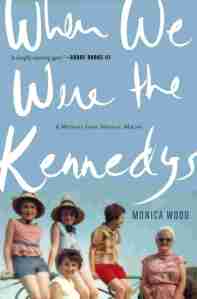
From the moment she began reading When We Were the Kennedys, my sister, Regan, could not stop talking about the book. Regan reads a lot, but we don’t usually share what we read. I think it’s because our literary tastes differ quite a bit. But that all changed when Regan read, When We Were the Kennedys. As she finished the book and handed it off to me, she said, “Hurry up now and finish it so we can talk all about it!” (Please keep reading to learn about your chance to win a copy for yourself!)
The Kennedy name surely caught Regan’s eye initially – the iconic Irish American family has always intrigued her – but the blurb on the back sold her. The story begins in 1963 with the close-knit Wood family living in Mexico, Maine. Mexico is a town physically, psychologically, and fiscally dominated by the Oxford Paper Company. The author’s father dies suddenly on his way to work at the Mill one day and life for the Wood family changes forever. We see how the family mourns (at one point with the entire country) and how they begin to make their way back.
Poignant, but never sappy, it is a truly a beautiful memoir. One reviewer said he had never pulled as hard for a family. That is exactly how I felt, and I wanted to learn more about its author, Monica Wood. She mentioned in an interview that both her parents’ families came from an Irish enclave on Prince Edward Island, Canada and that her father was a natural storyteller with a gift for language, but I wondered how else she felt her heritage as an Irish American.
Monica Wood
Monica was gracious enough to chat a bit and answer a few questions. I began by asking Monica if growing up she was aware of her Irish roots. Monica said very much so and went on to describe the lilting accents of her grandparents and the “many, many Irish expressions that were built into our family lexicon. Lots of colorful expressions.”
I asked if she remembered any and Monica came up with: “Arriving with one arm as long as the other.” Meaning? “You brought nothing to the table.” That’s one I can definitely hear my Irish American relatives saying!
Monica also remembered songs such as “Whiskey You’re the Devil” and “Danny Boy” filling the air of her childhood.
I was interested if Monica ever felt she was treated differently as an American of Irish descent. Mexico, Maine was a town of immigrants and the children of immigrants, so she never felt out-of-place because of her heritage. Monica was proud of it: “…I remember as a child in my town, we still identified by our families’ roots. When a kid asked, ‘What are you?’, my answer was ‘Irish.'”
Monica recently visited Ireland for the first time, spending part of her visit on a houseboat on the Shannon. She was amazed at how, although many generations removed from Ireland, she felt at home in Ireland. The Irish embrace their history and their folklore in such a way that a common ground emerges when descendants of those who left, return. This is why it can feel like coming home for many Irish Americans.
I’d like to share what Monica told me about her visit to Ireland:
My sister Cathe had been there just last year and told me it would feel like coming home. I didn’t think that would be true. But it was. For one thing, so many people reminded me of aunts and uncles and cousins! And they are so very warm, and they LOVE to talk, and sing, and lift a glass to almost anything. The night before we left (I was there with my husband) we ended up singing for 100 people in a pub in Ennis. By the time I got to the final chorus, everyone had learned the song (“Hard Times” by Stephen Foster) and was singing with me. I got the chills, literally, and realized: This is my tribe.
I can imagine that Monica was a big hit with the people of Ennis that night – they do love when you bring a song!
I am so happy to have read When We Were the Kennedys, and if you don’t win the Author-Signed Copy in our little competition here at The Irish in America, you will just have to go out and buy one for yourself, but it probably won’t be signed. Monica even agreed to personalize the inscription (actually it was her idea!)
So, how do you win? It’s easy! Just “like” this post – either click the button below on the blog or like it on Facebook (click here) – and your name will be entered in a drawing to win. Only one entry per person, please. You only have until 11:59pm (EST) Sunday, January 26th. We will announce the winner here on the blog early next week. For more information on the contest, please visit our CONTESTpage.
Good luck!
Take a look at this short video and hear Monica talk about When We Were the Kennedys:
Click here to read reviews of When We Were the Kennedys by Monica Wood.
Philadelphia is full of things which photographs (and words) do not do justice – the Liberty Bell, the seventeenth-century residential street Elfreth’s Alley, and the steps scaled by the iconic film character Rocky Balboa are just a few of the sights one really needs to experience in person to fully appreciate.
But, until you all can get to Philly, I will share some of the photos from our trip last week. Let’s begin with a few of Regan’s snaps at the Irish Memorial.
The story of the Irish Memorial.
photo credit: Regan McCormack
Memorial with Benjamin Franklin Bridge in background.
photo credit: Regan McCormack
Another view.
photo credit: Regan McCormack
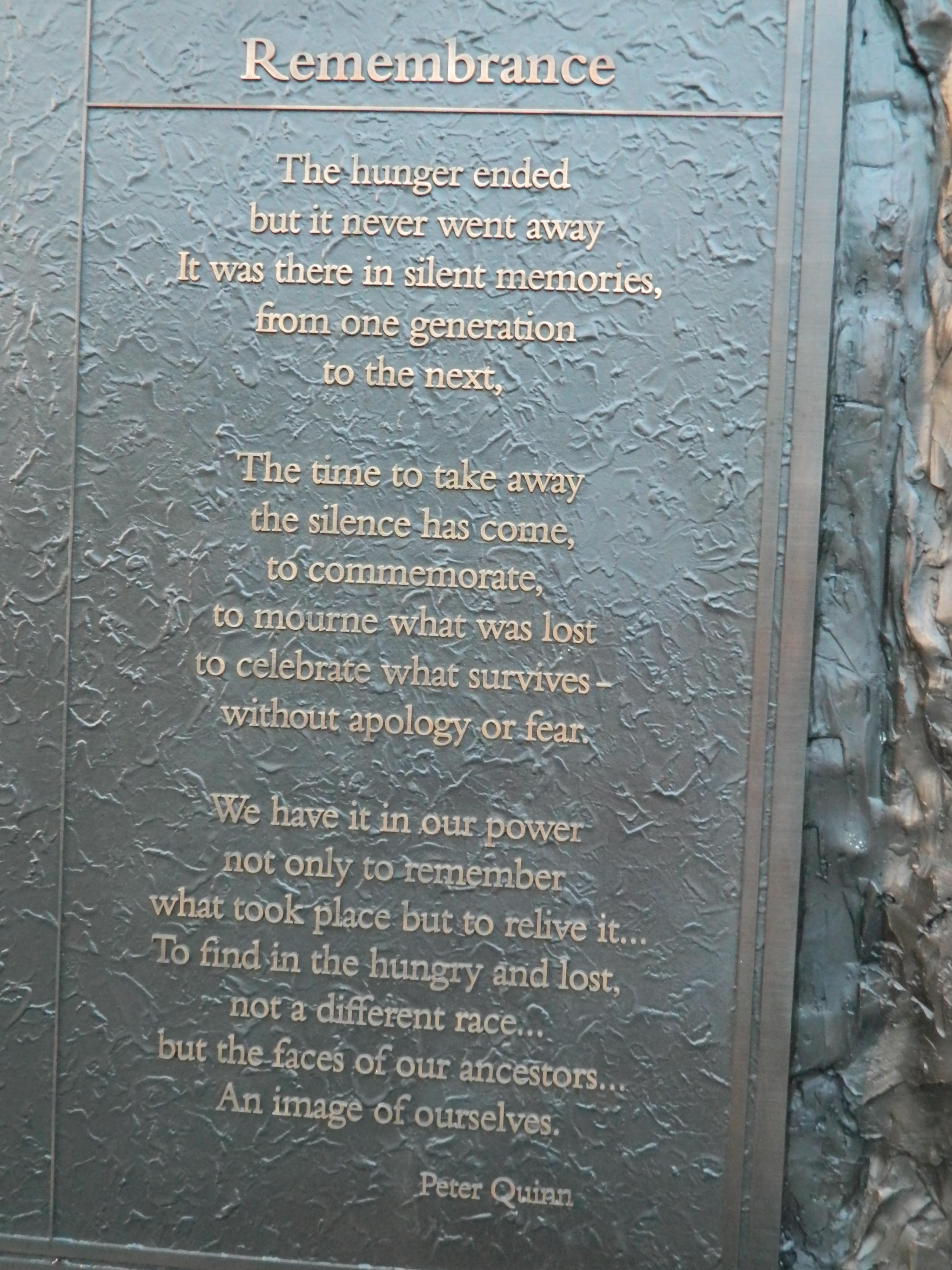
I love this poem by Peter Quinn, located at the memorial.
photo credit: Regan McCormack
The Irish Memorial is a beautiful tribute to our Irish ancestors and a poignant reminder of their struggles, tragedies, and triumphs.
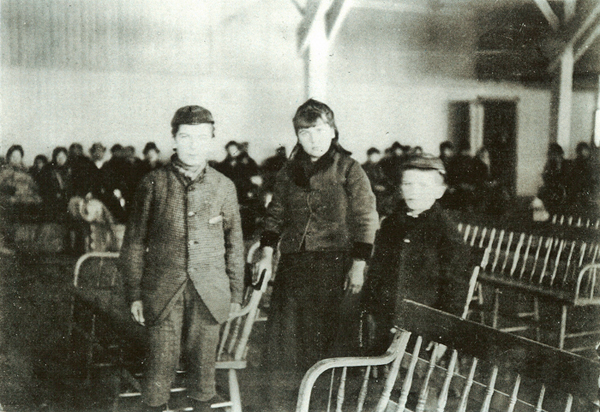
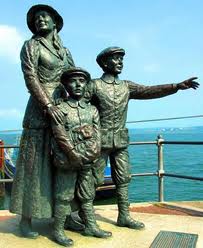
Annie Moore with brothers Anthony and Philip, Ellis Island, 1892
Megan Smolenyak is on a mission. She wants the world to know the real Annie Moore. You have probably heard of her – Annie Moore was the first immigrant to arrive at Ellis Island when it opened on January 1, 1892. Annie became an instant celebrity that day, but just as quickly as the gold and silver coins were distributed and attention enveloped this girl from County Cork, Annie melted into the masses and another Annie Moore took her place in history.
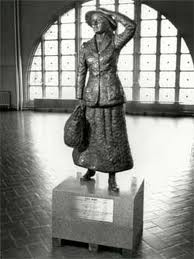
Annie Moore sculpture at Ellis Island
We didn’t know of Annie’s identity crisis until 2005 when Megan Smolenyak decided to pitch a story idea to PBS for a documentary on American immigrants. Megan had always been fascinated with Ellis Island and the immigration story, and why not explore the genealogy of Ellis Island’s first immigrant, Annie Moore?
Megan is a well-known and respected genealogist, author, blogger, lecturer, finder of President Obama’s Irish roots, contributor to TV programs (Who Do You Think You Are?) and documentaries. Megan didn’t set out to bust any myths, she simply saw that little was known about Annie Moore and she wanted to see what information she could find on this important figure in American history.
As she began to trace Annie Moore, Megan came across one inconsistency after another. It wasn’t long before Megan realized that the Annie Moore everyone accepted as THE Annie Moore was born in Illinois, not the first immigrant on Ellis Island. And there is more…click here to see the proof Megan has compiled showing that the wrong Annie Moore had become the heroine of the story. Megan was determined to set history straight.
Last month I had the pleasure of listening as Megan shared her Annie Moore research journey via her wonderful Legacy Family History webinar, Annie Moore of Ellis Island – A Case of Historical IdentityTheft. Megan explained the process of making things right – finding evidence of the real Annie Moore, contacting Annie’s descendants, bringing them together for a reunion, and even helping to get a headstone for Annie’s previously unmarked grave.
The real Annie Moore didn’t go West. In fact, she never made it out of New York’s lower east side tenements. You can follow Megan’s research here. Megan has put together links, videos, audio clips, and photos to tell this fascinating story. It amazes me that so many people could be so wrong about Annie’s identity for so long. No one even thought to look into Annie’s story…until Megan. Thank you, Megan, for your persistence and dedication to learning the truth.
Annie Moore with brothers at Cobh, County Cork
Megan’s discoveries have tremendous impact on how each of us views our genealogy research and the lives of our immigrant ancestors. It is important that we do not simply accept stories we hear as the truth because, “That’s what Grandma always said…” Family lore is priceless, but it can be useful to back those stories up with research. That’s how we turn the stories into history.
This case of mistaken identity reminds us to value all the experiences of our Irish immigrant ancestors. They didn’t all come to America and follow the path of dreams, adventure, and success that read like a Hollywood film script. But neither did all immigrants struggle in poverty-stricken urban slums. Many fell somewhere between; there is great diversity to the Irish immigrant experience and it is important to keep an open mind when researching your family’s history.
I can’t wait to see what Megan finds out about Annie’s life in Ireland, before she became the first immigrant at Ellis Island. Stay tuned…
You might know that Irish artist Jeanne Rynhart is responsible for the bronze sculpture of Annie and her brothers at Cobh, as well as Annie at Ellis Island. What other famous sculpture in Ireland is also the work of Ms. Rynhart? Another trivia question…who actually cast the bronze statues? Leave a comment if you have either answer!
Recently, in an exchange of emails with Danny Tobin about a couple of family gatherings he has planned for this summer (click here to read more about the Tobin and Coughlan family gatherings) I learned of the connection between the Sheepshead Peninsula in West Cork and Casper, Wyoming in the United States.
Danny told me that many of the emigrants from Sheepshead had gone to Casper to, naturally, work on the sheep ranches. He suggested I check out History of Casper’s Irish Colony.
What a fantastic recommendation! The site is actually a complete version of the book Register: The Story of Casper’s Irish Colony, written by Harry Arundel Ward. The site includes the full second edition published in 2003, as well as later corrections and additional information compiled since publication.
Register provides a history of Casper, Wyoming and explores the role of Irish immigrants in the foundation and growth of the town. It also includes vast biographical information on each Irish immigrant who made Casper home and presents it all in an easy to search tables (I just used the “find” function to explore the tables.) The tables include over 500 names, many more than the author, Harry Ward, anticipated:
When I undertook the project, I expected to collect 50 or 60 names at the most. Had I realized how large the project would be, I may never have started.
It is possible to SEARCH the entire site – click here, The author provides detailed HOW TO instructions for navigating the site – click here.
Whenever I read about immigrants who settled the American West – the farmers, the railroad workers, the ranchers, the miners – I marvel at how brave they were. They left their homes for new lives in a place so very different from where they came. In the case of Casper, the Irish who came may have had experience raising sheep, but imagine their thoughts upon first setting foot on a Wyoming ranch. Desolate, dusty, and twenty miles to town.
Click here to read Casper 1887-1987: An Irish Legacy, by Linda L. Doherty.
So, if you are planning a Gathering this year and the old family stories tell you that a relative moved to Wyoming to in the late 19th to early 20th centuries, definitely check out History of Casper’s Irish Colony. The author also includes information on other Irish settlements throughout the Western United States – Nebraska, Montana, and Oregon – click here.
Psst…if you are a native of Casper and claim Irish heritage, drop us a line. Someone may just be looking for you!
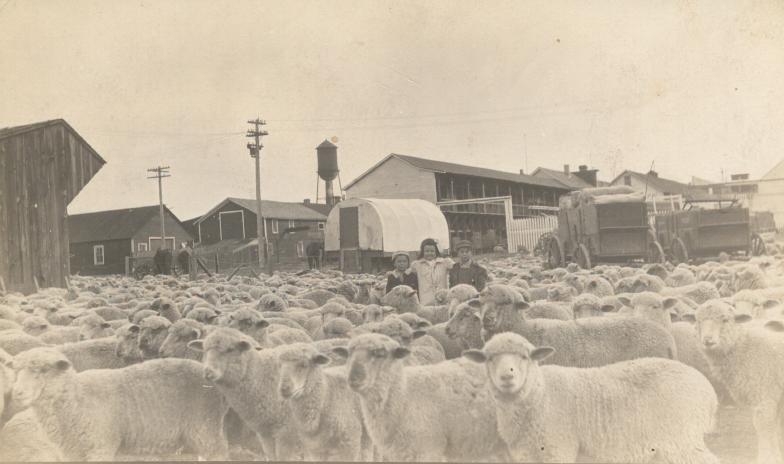
Lucille O’Brien and some sheep in Chinook, Montana (closest I could get to Casper!)
Can’t believe an entire year has passed since I posted this in honor of my great-grandmother’s birthday last year. Hope your 2013 is off to a good start — thanks so much for reading. Now, better get to baking that spice cake… Continue reading →
St. Patrick’s Day is all about getting your fake Irish on, whether it be decorating yourself in various cheap green crap that was no doubt made in China, not Ireland; busting out the one Pogues song you have on your iPod; or choking down a breakfast of green eggs and ham at your local Irish(ish) pub. It’s about that, and having an excuse to drink before 10 a.m. But Michigan has plenty of authentic Irish heritage to hang your hat on (even the oversized Leprechaun headgear you got at Meijer last night). Here’s a roundup of some of Michigan’s real-deal Irish heritage you might not have known about—and a nod to some of the fake stuff, too.
Blouin’s entire article is interesting, but the section titled, Beaver Island: Mormon turned Irish Kingdom, definitely caught my eye. I had never heard of Beaver Island. What a fascinating history…click here for Blouin’s full article. Read what he has to say about Beaver Island, then come back for more on the research taking place.
The University of Notre Dame’sHistorical Archaeology of Irish America project investigates the nineteenth century Irish settlement of Beaver Island, Michigan. The head of the investigation is Deb Rotman, Ph.D., RPA of Notre Dame. On the project blog Professor Rotman explains:
This archaeological and historical project allows scholars and students to investigate an aspect of the Irish Diaspora that is currently virtually unknown – that is, the lived experiences of Irish immigrants who settled away from the large urban centers on the East Coast…
Since 2006, my students and I have been investigating Irish immigrant experiences in South Bend, Indiana, including archaeological excavation in the city as well as archival research and oral history collection in both Ireland and the United States. Beginning in 2010, this project expanded to include Beaver Island, Michigan, which was inhabited in the late nineteenth century by immigrants from Árainn Mhór off the coast of Co. Donegal.
What I like best about this project is that it is taking a serious look at the lives of Irish settlers in America’s rural Midwest. Professor Rotman points out that little research exists on any Irish immigrant settlements other than the urban centers of New York City and Boston. The Irish were pioneer settlers in much of the Western United States, and it is about time attention be paid to their lives and the contributions they made to their communities and adopted country.
The project website includes a number of papers completed by students involved with the Beaver Island project. The papers explore the history and sociology of the island using the archaeological evidence they have unearthed. Check out the blog here.
Professor Rotman, perhaps when you finish up with Beaver Island, you might want to take a look at Clontarf, Minnesota and nearby Tara Township? I have always wanted to do a dig by my grandfather’s birthplace in this rural American Irish settlement…just think about it!
Click here for more information about the history of Beaver Island – from its days as a “Mormon Kingdom” to a land full of names like Gallagher, Boyle, and O’Donnell, where Irish was the language of choice. I wonder what the folks in Donegal have planned for next year’s Gathering Ireland 2013…will the people of Beaver Island be welcomed “home” to Ireland?
The first time I visited Ireland in 1988, I was struck by the number of derelict farmhouses dotting the countryside. “Why doesn’t someone just tear those old houses down?” I wondered. “That’s what we do in the good ol’ USA…we don’t leave houses to fall down on themselves. If we don’t want or need them, we get rid of them and build something new and better…”
Abandoned house near Ballyedmond, County Laois (all photos by Regan McCormack)
This sentiment came from a teenage girl from the city who spent more time in the countryside during six weeks in Ireland than she had in sixteen years back home – in the “good ol’ USA”. I thought I was so smart…
Fast-forward twenty years and I am closer to home, driving the country roads of Tara Township, crisscrossing its thirty-six square miles in Swift County, Minnesota. My maternal great-great-grandparents were among the pioneer 1870s settlers of this township on the vast prairie of Western Minnesota. This was my first visit to Tara. I had traveled three thousand miles from home on a number of occasions to visit Ireland, my “ancestral homeland”, yet I had never bothered to drive a few hours west to see where my people settled when they came to Minnesota.
Granted, as far as vacation destinations are concerned, Ireland is a bit more attractive than Western Minnesota, but it turns out, the two places have some things in common.
There are the obvious similarities in place names in this part of Minnesota. Bishop John Ireland established several colonies of Irish Catholic settlers with names like Avoca, Kildare, Tara, and Clontarf. Hundreds of Irish families from cities and communities in the Eastern United States seized the opportunity to own land and live in a community with its own church and priest, surrounded by fellow Irish Catholics.
The Depression came early to rural communities and persistent crop failures and changing farming practices combined to make farming unviable for most small farmers. My relatives moved to Minneapolis, as did several other Tara families. Some of the original Irish settlers had left Tara even earlier, moving further West, always in search of better land.
So, I wonder why I was surprised to find this in Tara Township?
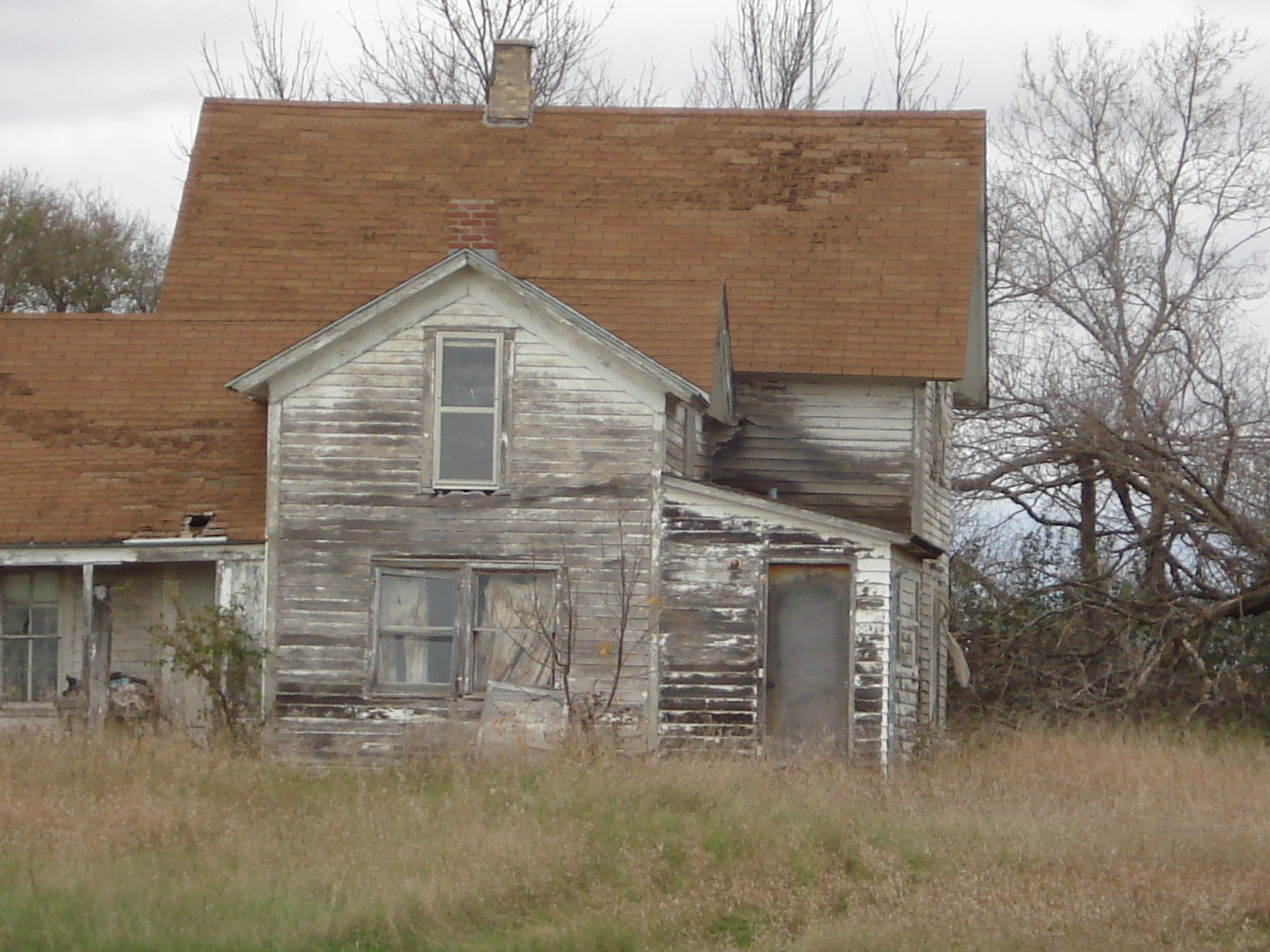
Section 22 of Tara Township – the McMahon place
On nearly every section of land in the township stands an abandoned farmhouse, or at least a grove of trees planted by the original settlers to protect a house. And this in the “good ol’ USA” where we tear things down!
Folks in Ireland and Tara Township have the same reaction when I ask them why they don’t simply tear down the abandoned houses. They shrug and say that they are no bother and they can be used for storage. That is the practical response, but I wonder if there is something a bit more sentimental lurking beneath?
The abandoned houses got me thinking…A similar hopelessness that drove millions of Irish to America during the 19th and 20th centuries could be seen in rural Americans who fled the farm for the city in the 1920s. Major difference, of course, is there was not a famine like Ireland experienced, however there was tremendous poverty, crops failed miserably, families were split up, and life changed permanently and dramatically.
I am rather ashamed of my sixteen-year-old self for not being as smart as she thought she was. She should have realized that the same reason this stands today in Ireland…
Near Ballyedmond, County Laois – 2011
might be why this…
Cahir Castle, Tipperary – 2011
and this…
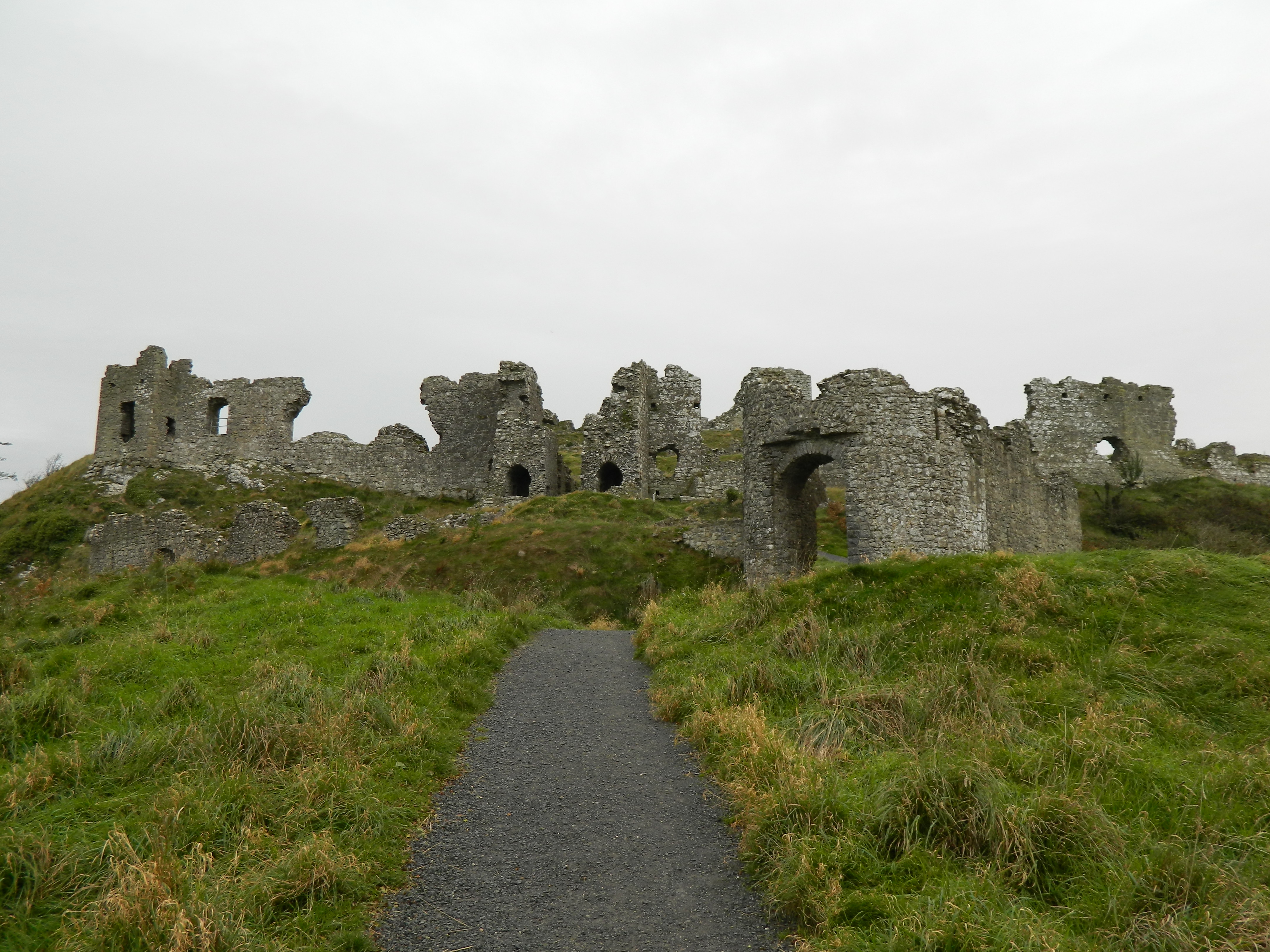
Rock of Dunamase, County Laois – 2011
and this…
Johnstown, County Kildare – 2009
are still here today. I doubt that the farmhouse ruins will have the staying power of the castles and abbeys of centuries gone by, but in the meantime they can remind us from where we came. Whether it is a farmhouse in Ireland or Tara Township, Minnesota.
Now, if I could only get Jimmy to fix up this old house…
Two Jimmy McCormacks at old family house in Ballyedmond – 2009
Minnie was my great-grandmother, and according to my grandma she absolutely hated the nickname “Minnie”. Please forgive me, Great Grandmother, but I think it is a cute name, and since your real name Mary is shared by at least 75% of the women in your family tree, I chose to call you Minnie.
Minnie Foley was born in Fisherville, New Hampshire on January 2, 1875. She was the fourth of five children born to Patrick Foley and Mary Crowley (their eldest son did not survive infancy.) Patrick emigrated to the United States from Kilmichael, County Cork in 1864. Mary came a year earlier in 1863, also from County Cork.
Minnie was baptized on January 24, 1875 at St. John the Evangelist Catholic Church in Concord, New Hampshire. John Foley and Mary Casey were her godparents.
Three years later, Minnie and her family moved west to Clontarf, Minnesota with several other Irish families from the Concord, New Hampshire area, including the Regan family. John Regan and Patrick Foley emigrated together in 1864 from Kilmichael. The families settled on farms in Tara township. Minnie and Nellie Regan were best friends from a very young age.
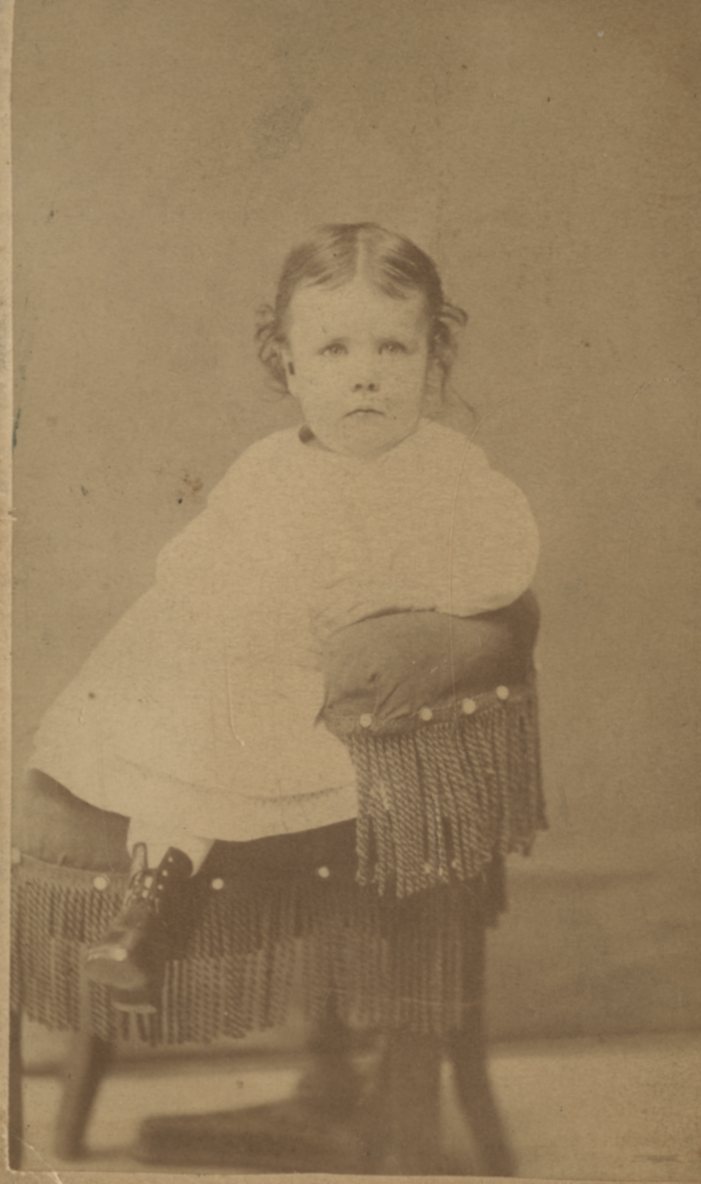
First-Generation American Girls: Minnie and Nellie in about 1886
My grandma told me that Minnie worked hard her entire life, and that included working on the family farm in Tara Township while she was growing up. Her sister Maggie worked inside, while Minnie and her younger brother Jackie worked outside. My grandma confessed, she wasn’t sure where Minnie’s older brother Tim worked!
The McMahons, an Irish family from County Fermanagh, lived about a mile from the Foleys in Tara. Minnie married Thomas McMahon at St. Malachy Catholic Church in Clontarf on June 28, 1904. Minnie’s sister Maggie and Tom’s brother Frank were their witnesses. I imagine Minnie and Hoosie (as Tom is referred to in Minnie’s autograph book) having secret meetings over hay bales and missing chickens during their courtship…
Minnie and Tom raised seven children and after giving farming all they had the McMahons moved to Minneapolis in 1925.
When she died in 1945, Minnie was living with my grandma, her husband John Regan, and their new baby (and my mother) Eileen. My grandma said that Minnie was smitten with Eileen. Minnie would say that she had never known a baby to sleep as much and as well as little Eileen. Minnie marvelled at how Eileen would even fall asleep with a bottle in her mouth.
In many ways things came full circle for Minnie. Also living with my grandma in 1945 was Neil Regan, Nellie’s older brother and my grandpa’s father. Eighty years earlier Patrick Foley and John Regan had journeyed to the United States. After Fisherville, New Hampshire and Clontarf, Minnesota, the families came together again in Minneapolis…a long way from Kilmichael.
In my grandma’s recipe book are a few recipes attributed to Minnie, her “Ma” – I think I will make “Ma’s Spice Cake” in Minnie’s honor today.
The New Brunswick Archive in Canada has a great collection of letters to and from Irish emigrants to the area. You can read the actual hand-written letters, or if you prefer not to struggle with nineteenth century script, transcriptions are available for download. The collection contains items from the nineteenth century, as well as some from the early twentieth century. Also included are a diary, family histories, and other documents. Take a look around the site…fascinating stuff!
An example of what the New Brunswick archive has to offer…
The Laurence Hughes collection (MC2618 :: Laurence Hughes fonds) contains several letters written to Laurence Hughes of Fredricton, New Brunswick from relatives in Ireland and elsewhere in North America. I think these letters are particularly interesting for they demonstrate the networks of Irish emigration and how that support facilitated further migration from Ireland and within North America. The letters span seventeen years (1837-1854) and see several relatives in Ireland considering emigration and dealing with the decision to stay.
In 1837 Laurence’s brother Thomas writes from Newry sharing the news from home. Thomas encourages Laurence to move to Boston and gives him advice on how to be successful there:
Now before you go to Boston enquire of every respectable person that knows you if
they can give you a line or two of recommendations to any person they may be acquainted with…[damage]…the Catholic Priest of Fredericton…
Good advice, I would say. Thomas provides his brother with options, outlining a plan for Laurence’s return to Ireland since, “It is only natural to expect you would prefer living in Ireland.” Laurence stayed put in Fredricton, at least until 1854. Thomas mentions that he had four children and was looking forward to more…”We calculate on having one every 13 or 14 months that’s not bad trade thank God.”
In the 1837 letter, Thomas mentions another brother, Edward, who had also gone to New Brunswick. By 1852 he was living in Pennsylvania with a large family and looking to move west to Iowa:
I some times think of selling it to go live in the west. There is a fine
colony of settlers from Carlow in loway State sent out by Rev. James Heigher and they have fine schools there now for boys and girls. I think dear Lawrence if we would go there it would be a fine chance for our children but I am afraid it is not healthy there.
Read Edward’s full letter here. I wonder if Edward ever made his way to Iowa? Establishing Catholic colonies in the midwestern United States was popular during this time (until the mid-1880s.) The goal of such projects was two-fold: provide opportunities for Irish immigrants to escape congested Eastern conditions and own land, farm, and raise families in a Catholic community, and to strengthen the American Catholic Church by populating the West with Catholic settlers.
These letters are full of interesting observations. Edward comments on his fellow Irishmen who work on the railroad, a job many felt lucky to get:
There is a great deal of railroads making here but the most degrading characters work on them now. Some of this is a disgrace to the land that gave them birth.
This comment is important because it reminds us that all Irish immigrants were not treated equally in America, even by their fellow countrymen. Clearly Edward was educated to some degree, and from his letter it is apparent he was a religious man who did not approve of drink. Irish in America like him would have had little time for the poor, uneducated, Famine-era emigrants. Edward and his brothers made the decision to come to North America before the worst years of the Famine hit Ireland while for many of the million who came during the Famine, the alternative was starvation. This is not to say that conditions in Ireland were favorable at the time of the Hughes brothers emigration, but judging from the letters, it was not a case of emigrate or starve.
Research Help Requested…
Edward mentions a “Catholic Almanac” in his letter to Lawrence. Has anyone ever heard of that before? I would love to know where I could find 19th century copies!













 The Irish in America