We are excited to announce the first ever competition offered by The Irish in America. We couldn’t think of a better time of the year than the St. Patrick’s Day season to celebrate our Irish heritage with a fun contest!
You could win this gorgeous signed and numbered, limited edition print created by
Mayo artist Jane Steger-Lewis designed this print for her I Love Mayo line. The subject is inspired by an exhibit Jane saw at the Museum of Country Life at Turlough Park near Castlebar which included a display of the rosette badges worn by children on St. Patrick’s Day in years past.
The details:
Signed and numbered by the artist
Limited edition, winner will receive #1 of 20 printed
Entries accepted until 11:59pm (CST) Saturday, March 16, 2013. The lucky winner’s name will be drawn by our official contest judges, and announced here and on Twitter on Sunday, March 17th.
Official judges Maryn and Ainsley take their jobs very seriously
Be sure to check out Jane’s fantastic I Love Mayo website of prints, paintings, posters.
Macy’s Thanksgiving Day Parade debuted in 1924. Macy’s began the parade in order to promote their department store for the Christmas season. Most of the participants in the parade were Macy’s employees who donned costumes, marched, and rode on floats pulled by horses, tracing the route from Harlem to Macy’s Herald Square store. Over 250.000 people watched the parade that first year and it became an annual event.
1940 Hippo balloon at Macy’s parade (photo from theweek.com)
The famous helium-filled balloons of animals first appeared in 1927, replacing the real animals that were sprung from the Central Park Zoo to march in the parade. By 1942, the rubber and helium from the balloons became necessary for the war effort and the parade was called off until 1945.
The November 28, 1947 s New York Times article describes the parade in great detail. The parade had clearly hit its pre-World War II stride with crowds, bands, floats, and the return of the giant balloons. The headline reads:
2,000,000 THRILLED BY MACY’S PARADE
Gas-Filled Giants Prance Again to Delight of Throngs Who Forget Cold
CLOWNS ADD TO THE FUN
Three Little Pigs, Peter Rabbit in the Line — Santa Bestows a Greeting.
What a line-up! The two million spectators lined the sidewalks of the parade route and “peered from open windows, crowded roof-tops, and marquees” to catch a glimpse of Humpty-Dumpty, the Pumpkin Float, and a gigantic panda balloon. Five-year-old Katharine had this to say about the parade: “I like the Jack O’ Lantern, I like the Funny Cop, I like loud music, I like the dancers, I like everything.”
Among the two million people gathered that Thanksgiving morning in 1947 were Maureen and Joan Teahan. Maureen and Joan were sisters who had just arrived in New York the previous day, November 26th. The sisters left their home in Milltown, County Kerry about a week earlier to begin new lives in the United States. Milltown’s population? About 100 people.
The girls experienced just a bit of culture shock upon arrival in New York City. Their Uncle Dan sponsored the sisters’ passage to the United States and made a point of telling them to lock the hotel room door. Maureen recalls that this was something she and Joan had not even considered.
So, what did Maureen think of the two million people plus a rocket ship from Mars full of blue invaders who were “mocked” by Peter Rabbit and the Mad Hatter while the Three Little Pigs “sang the praises of Thanksgiving” and the steady pounding of drums filled the air? Maureen admits she was overwhelmed.
What an introduction to the United States for Maureen and Joan. They walked right into one of the most cherished Thanksgiving traditions for families all over the United States – the Macy’s Thanksgiving Day parade, on a day that is uniquely American. That is a lot to process within the first forty-eight hours in a country.
Maureen and Joan stayed in New York for a week – shopping and seeing the sights – before settling in Lawrence, Massachusetts.
In a couple of weeks, I will publish a lovely story written by Maureen. It’s a Christmas story. But for now, a Happy Thanksgiving to all and enjoy the parade!
Special thanks to Mary Power for sharing the New York Times article, as well as her mother Maureen’s memories of the 1947 Macy’s Thanksgiving parade.
On November 9th The Gathering Ireland announced its latest tools to attract visitors next year. From the Press Release…
The Gathering Ireland 2013 has partnered with An Post to distribute postcards to 1.8 million households in Ireland this November.The postcards are being distributed to encourage Irish families to invite someone home for the Gathering Ireland in 2013 and should land in people’s houses over the coming days. The initiative is an important part of the Gathering campaign in order to encourage invitations to be sent to the four corners of the world. Everyone is being asked to use these postcards to send a message to family, friends and loved ones abroad and invite someone home next year for the Gathering Ireland 2013.
In theory this is a great way to spread the Gathering word. There are a lot of people in the United States who have not yet heard about The Gathering. For example, I had dinner with an Irish-American friend last Saturday and when I mentioned the Gathering, I saw a blank look on her face. She had no idea what I was talking about. My friend has Irish heritage on her both maternal and paternal sides of her family tree, she visited Ireland for the first time as a high school student as a participant in the Irish American Cultural Institutes‘s Irish Way program, and she later returned to Ireland with family. My friend loves Ireland and looks forward to returning one day. She (and her family) are exactly the Americans The Gathering should target. A postcard inviting her back to Ireland might be just the incentive she needs to book a trip…
How do those in Ireland feel about the postcards? Will you send them? And who will you send them to? Do you feel pressure to send the cards (see Emeralds blog post about the cards)? Please share your thoughts on this initiative – leave a comment.
On the receiving end, I would love to hear from anyone outside of Ireland who finds one of these postcards in their mailbox. Let me know what you think of it – will you take them up on the invitation?
I hope my Irish cousins don’t waste one of their postcards on me. I have never waited for an invitation before to visit Ireland!
St. Patrick’s Day is all about getting your fake Irish on, whether it be decorating yourself in various cheap green crap that was no doubt made in China, not Ireland; busting out the one Pogues song you have on your iPod; or choking down a breakfast of green eggs and ham at your local Irish(ish) pub. It’s about that, and having an excuse to drink before 10 a.m. But Michigan has plenty of authentic Irish heritage to hang your hat on (even the oversized Leprechaun headgear you got at Meijer last night). Here’s a roundup of some of Michigan’s real-deal Irish heritage you might not have known about—and a nod to some of the fake stuff, too.
Blouin’s entire article is interesting, but the section titled, Beaver Island: Mormon turned Irish Kingdom, definitely caught my eye. I had never heard of Beaver Island. What a fascinating history…click here for Blouin’s full article. Read what he has to say about Beaver Island, then come back for more on the research taking place.
The University of Notre Dame’sHistorical Archaeology of Irish America project investigates the nineteenth century Irish settlement of Beaver Island, Michigan. The head of the investigation is Deb Rotman, Ph.D., RPA of Notre Dame. On the project blog Professor Rotman explains:
This archaeological and historical project allows scholars and students to investigate an aspect of the Irish Diaspora that is currently virtually unknown – that is, the lived experiences of Irish immigrants who settled away from the large urban centers on the East Coast…
Since 2006, my students and I have been investigating Irish immigrant experiences in South Bend, Indiana, including archaeological excavation in the city as well as archival research and oral history collection in both Ireland and the United States. Beginning in 2010, this project expanded to include Beaver Island, Michigan, which was inhabited in the late nineteenth century by immigrants from Árainn Mhór off the coast of Co. Donegal.
What I like best about this project is that it is taking a serious look at the lives of Irish settlers in America’s rural Midwest. Professor Rotman points out that little research exists on any Irish immigrant settlements other than the urban centers of New York City and Boston. The Irish were pioneer settlers in much of the Western United States, and it is about time attention be paid to their lives and the contributions they made to their communities and adopted country.
The project website includes a number of papers completed by students involved with the Beaver Island project. The papers explore the history and sociology of the island using the archaeological evidence they have unearthed. Check out the blog here.
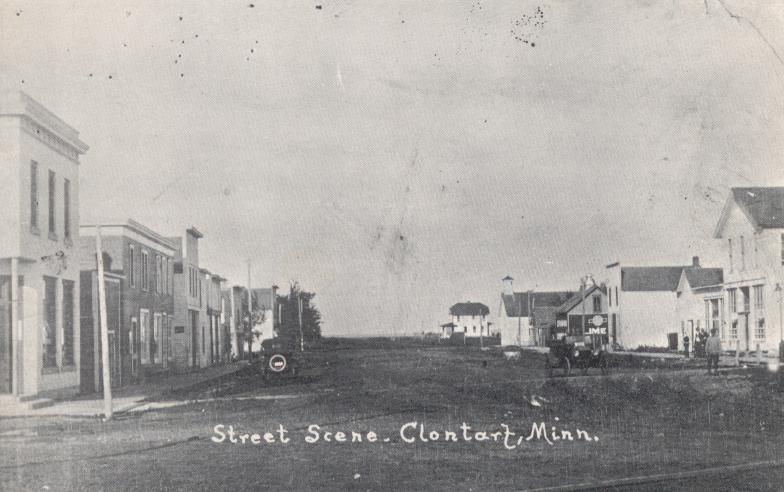
Professor Rotman, perhaps when you finish up with Beaver Island, you might want to take a look at Clontarf, Minnesota and nearby Tara Township? I have always wanted to do a dig by my grandfather’s birthplace in this rural American Irish settlement…just think about it!
Click here for more information about the history of Beaver Island – from its days as a “Mormon Kingdom” to a land full of names like Gallagher, Boyle, and O’Donnell, where Irish was the language of choice. I wonder what the folks in Donegal have planned for next year’s Gathering Ireland 2013…will the people of Beaver Island be welcomed “home” to Ireland?
Wondering what’s been happening at the Irish Workhouse Centre? Click here for the very latest on the Portumna, County Galway, Ireland workhouse restoration and redevelopment.
I first learned about the Irish Workhouse Centre on Loretto Leary’s fantastic website, Breise! Breise!Loretto has written several articles on the project, as well as conducted interviews with the folks involved – see it all here.
The inaugural newsletter of the Irish Workhouse Centre is full of great information, including an article on the Female Orphan Scheme which sent orphaned girls from the workhouse to Australia.
As an introduction to Irish workhouses, the following historical tidbit appears in the newsletter:
Did you know that 163 workhouses were built in
total in Ireland? 112 were built from 1839 to
1842. It must have been a strange sight at the
time to witness all these huge, foreboding
buildings springing up in the main towns.
All the workhouses were designed by George
Wilkinson. The workhouses were built by private
contract and would have taken about two years to
build.
Psst…if you haven’t read it yet, the September issue of Irish Lives Remembered Genealogy Magazineis available (and free!) online. Click here to view and be sure to check out the article on page 26.
I am extremely excited for my trip to Ireland next month. We have quite a bit on the agenda, but will be wrapping the trip up with a week in the heart of Ireland, County Laois.
My great-grandfather Andrew McCormack came from Ballyedmond, County Laois in the late 1880s and settled in Minnesota. My father has done extensive research on his McCormack lineage over the past fifteen years.
I had no hand in this research, but I have enjoyed all the fruits of my father’s labors. Click here and here to read about the fun we have had connecting with our McCormack relations.
My dad won’t be along on this trip, so I may need to don the family historian cap – if only to keep my sister straight on who’s who! I had better review my dad’s printouts…
While in Laois I am planning a visit to the County Archives and Local History Department in Portlaoise. It may have taken a while, but I have learned that a good first step when looking into the history of your Irish ancestors is to go to the County Council website.
The council website for any given county in Ireland will have all the information necessary to live in that county – from where you should dump your trash to the operation hours of the local branch of the library. But they are a great resource for visitors as well. Often these websites provide extensive history and heritage information, including details on genealogy, archives, and special collections.
Like any good researcher, I plan to do my homework before showing up on the archive’s doorstep in September. It looks like they have quite a bit to offer. Maybe I will even find some emigrant letters in some of the personal collections listed on the Laois Archivespage.
The Local History Onlinelink brings you to the Ask About Ireland website. This is a very cool site, a must-visit for anyone interested in what the libraries, museums, and archives of Ireland have to offer.
AskAboutIreland and the Cultural Heritage Project is an initiative of public libraries together with local museums and archives in the digitisation and online publication of the original, the unusual and the unique material from their local studies’ collections to create a national Internet resource for culture. (from http://www.askaboutireland.ie)
Ask About Ireland also features Griffith’s Valuation, the first valuation of property in Ireland, published from 1847 to 1864. You are able to search the Valuation, and of course the more information you have, the better.
Returning to the Local Studies Department, we find an extensive collection of newspapers, cemetery records, photographs, maps, local files, and folklore. All are available to view by appointment. Bridget told me that the microfilm machine is a much sought-after appliance, so set your appointment early to ensure you will have access to the newspapers and records available on microfilm.
I am definitely looking forward to my visit to Portlaoise and the Laois County archives and local studies department. Can’t wait to see what I can dig up!
Recently I submitted my great-grandmother Annie Hill Regan to Rachael Flynn’s Irish Women of our Past – Book of Namesproject. Here’s how Rachael describes her very exciting project:
The BOOK OF NAMES is a project which aims to recognise the women in our past who have made the journey from Ireland to other lands.
Artist-researcher Rachael Flynn is currently working on an arts project through which people will be able to submit the names of their female Irish ancestors in order to build up a record that seeks to pay honour to their struggles and successes.
By adding the names of their Irish mothers, grandmothers, great grandmothers, aunts, cousins… the people who add names to this collection will have the chance to effectively ‘light a candle’ in memory of these relatives.
Rachael asks for some basic information in order to add a female Irish relative to the Book of Names: name, date and port of departure, destination, and your contact information. Very simple.
I had the data about my great-grandmother’s emigration, but I wanted to revisit the passenger list I had copied from Ancestry.com ages ago. I remembered how exciting it was to locate this information because I knew for certain it was my Annie. I struggle with genealogy at times, becoming distracted and discouraged quite easily. It always seems to me that it shouldn’t be so difficult to find the information you are looking for…
I had spent hours looking for other relatives, so I prepared myself for a long search. There was the question of her first name – would she be listed as Annie, Anne, Anna, or Ann? It had appeared in each form in some official document or anther. Then her surname – Hill can be English, Irish, Swedish, German, etc. And she emigrated to the United States around 1900, along with hundreds of thousands of other people!
I lucked out and found Annie on a passenger list not long after I began the search. I had not expected the departure port to be Glasgow, and I was a bit surprised that the list said Annie came from Kilkenny (Kildare was her home county) but I was certain I had located the right Annie when I read that her passage was paid by her brother-in-law Mr. O’Brien of Clontarf, Minnesota and her final destination was also Clontarf. Clontarf was a tiny town, this had to be my great-grandmother.
This morning I came across the following posting on a RootsWeb message board from 2008:
From the London Times of April 21, 1899 comes this ad:
ANCHOR LINE.–GLASGOW to NEW YORK.
Furnesia, 5,495 tons, April 27; Ethiopia, 4,001 tons, May 11.
Excellent accommodation. Cabin fares from £9 9s.; second cabin,
from £6.–A.H. Groves, 14, Rue du Helder, Paris; T. Cook and
Son, Paris and London; Henderson Brothers, 18, Leadenhall st. E.C.
The following comes from the NY Times shipping news:
May 13: “SS Ethiopia. (Br.,) Capt. Wadsworth.
(from Glasgow.) sld. from Moville for New York to-day.”
For days the NY Times lists her as expected on
Sunday, May 21. On May 22, however, she is listed
as expected that day. On May 23, “SS Ethiopia,
(Br.,) Wadsworth, Glasgow May 11 and Moville 12,
with mdse. and passengers to Henderson Bros.
Southest of Fire Island at 5:35 P.M.
– submitted by Marj Kohli
S.S. Ethiopia
Thank you Marj Kohli of Canada! I wonder where Annie boarded the S.S. Ethiopia? In Glasgow (she had sisters living in Manchester, England) or did she make the journey up to Moville on Donegal’s Inishowen Peninsula? I don’t believe it says on the passenger list, but I will check it again.
I also wonder what held the Ethiopia up? It was supposed to arrive in New York on May 21st, but didn’t make it until May 23rd. Adventure on the high seas? Too bad Annie didn’t keep a travel diary (or if she did, too bad it didn’t survive!)
I am honored to have her name included in Rachael’s Book of Names along with all of the other incredible Irish women who made the journey to a new life. I encourage all of you with an Irish mother, grandmother, great-grandmother, cousin, or auntie to submit their name and their story to Rachael’s project. Visit her website here and follow her on Twitter for all the latest information. It is really a very easy process – take a few minutes and honor your Irish relatives!
Who will you submit? I have some more Irish ladies to get to – a couple more great-grandmothers, some great-great-grandmothers, and a few great-grand-aunts. I better get busy!
Annie and her chickens on her farm in Tara Township, near Clontarf, Minnesota
By now you must all know how much I love letters, so let’s take another look at the Stephen Owens Collection. Discovered at the Old Skerries Historical Society in County Dublin in the late 1970s by well-known Irish Emigration historian Kerby Miller, this is a small collection of letters sent from Stephen Owens of Clontarf, Minnesota in the USA to his niece Celia Grimes in his native Skerries, County Dublin, Ireland. The letters are from the first few years of the twentieth century.
I began to look at the letters of Stephen Owens in an earlier post (click here to get caught up.) I will pick up the action with a letter dated July 20, 1900.
Mr. Owens starts right out with the weather (typical Irishman and Minnesotan!) It is the hottest and driest summer in over twenty-five years in Minnesota. No rain and scorching heat have left the farmers with little in the way of grains to cut come harvest time:
Corn and potatoes are Pretty good but the American likes to live on flowers instead of potatoes.
Mr. Owens writes of his younger cousin, a daughter of his Uncle John, who works for a family in Lynn, Massachusetts. He had a letter from her in which she describes her employer and their summer holidays in New Hampshire. She wants very much to come out West to visit her cousin which leads Mr. Owens to write, “I would like to see all my friends before I Die, God bless us all.”
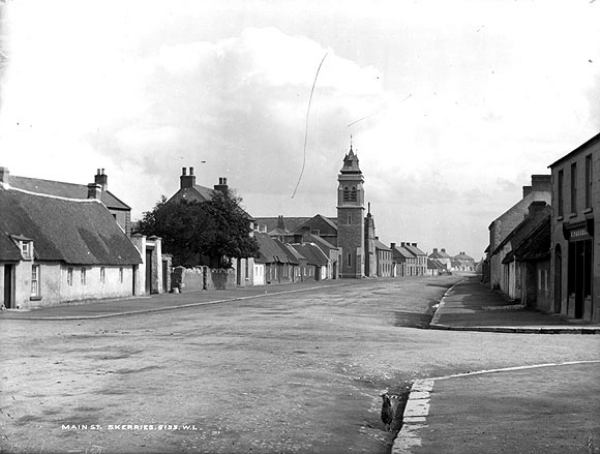
The next letter to Celia is dated April 1, 1902. Mr. Owens tells her of the new priest in Clontarf and how the beloved Father McDonald died of consumption. He goes on to tell Celia that she may miss her brother who recently left home for America, “but it is 49 years last February since I seen your Mother, my sister Eliza.” All those years later, Mr. Owens still misses his sister and family. He even misses Celia, and she was not even born when he was last in Skerries!
In a previous letter Celia must have told her uncle that there is something of an Irish language revival in Skerries because he writes:
Skerries is a great old Town. It is getting very patriotic. I am glad to hear the young People are learning their Country’s language. It is a good sign…
The last letter from Mr. Owens in the collection is dated November 10, 1903. The tone of this letter is less than up-beat. He has been ill for five weeks and sometimes is unable to stand for the pain in his back and legs.
Mr. Owens is pleased to hear that Celia was reunited with her brother who came back from America, and he comments on the latest wave of migrants from Ireland:
…you sent 11 people out from Skerries lately. Them is the kind that is wanting, Old People is only in the way here in America they don’t want them. I suppose it’s that way in every country…
Mr. Owens is clearly facing the fact that he has reached the twilight of his years and he has apparently given up the notion of returning to Ireland to see all of his old friends and family – “I think when we meet next it will be in heaven.” It was another two years before Mr. Owens passed away in December 1905.
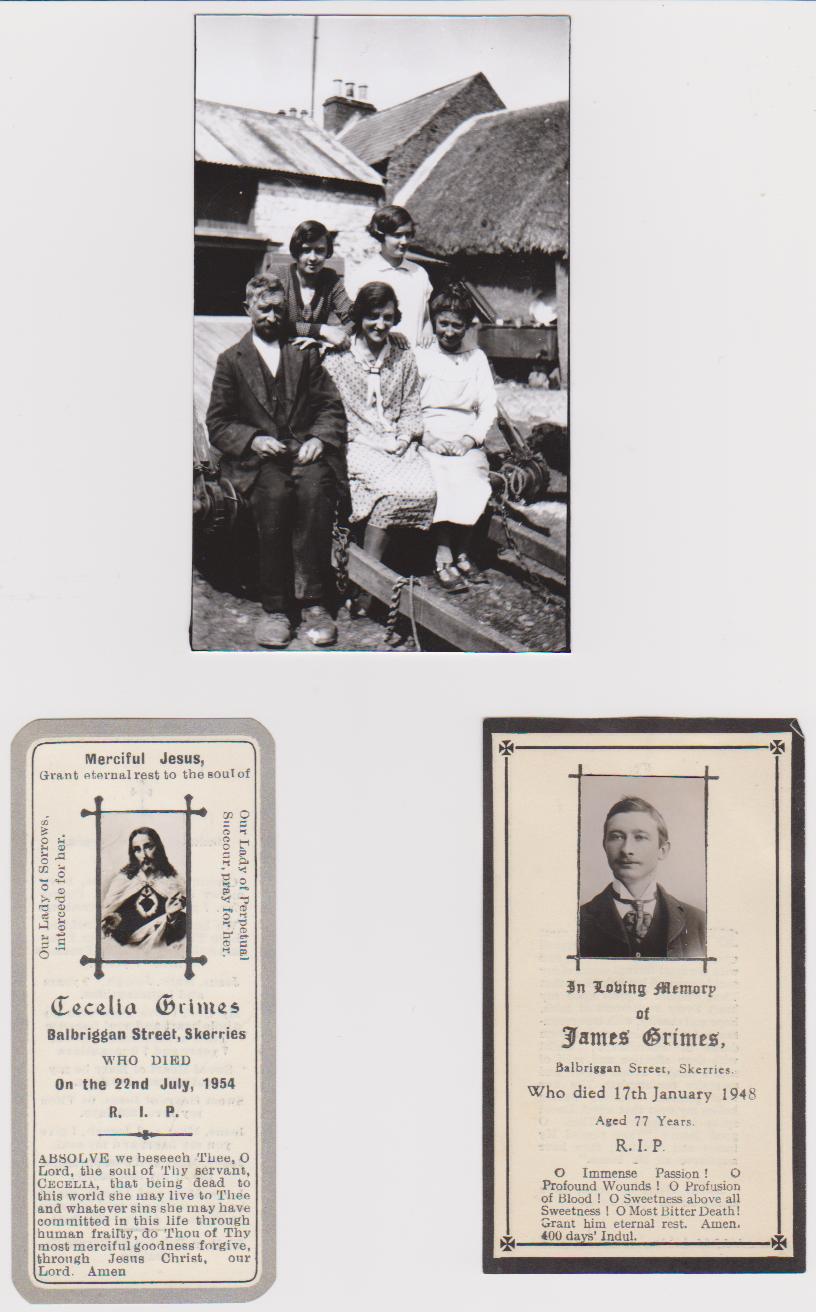
I contacted the Skerries Historical Society to see if they had the originals of these letters – I only have copied transcripts. Maree Baker, the librarian at the Society got right back to me and said that they did not have the original letters. She sent along a couple of items from the Grimes family that are part of their collection – a photo from the late 1920s and two memorial cards. Celia’s brother James is on the left in the photo and Maree said Celia could be one of the women to the right.
Several years ago, the following essay won second prize in the Kansas City Irish Fest writing competition. I think there were three entries…
With Saint Patrick’s Day fast approaching, I know I think about my Irish heritage a bit more than usual. How about you? How do you define your Irish-ness? Complete the form at the end of the post or add a comment. I would love to hear from you!
It was usually around Thanksgiving when the teacher would tell us to sit down in a circle and we would take turns sharing our ethnic background with the class. The goal was to show how America had welcomed people from all over the world to form the great melting pot. As my classmates struggled to piece together their intricate heritage pie charts (“I’m one-eighth French, one-eighth German, one-half Swedish, one-fourth Norwegian…”), I waited patiently for my turn. I had it easy.
“I am 100% Irish.”
Although I was proud to be Irish-American and liked the ease of being 100% something, I had never given it much thought.
I was not cognizant of it, but early in my life, my dad defined Irish for me. He was passionate about Ireland– from the history and the music to the legends and the poetry. He would sing along to the Clancy Brothers and Tommy Makem as he worked at his desk. I can remember his favorites like “Roddy McCorley” blaring from the stereo speakers in his den.
My dad is a bit of a romantic with a flair for the dramatic. He gets misty-eyed when reciting a poem by Yeats or when recounting the struggles the Irish have faced throughout history. Sometimes the music was a little loud and my dad a little sappy, but this is what I knew of being Irish.
One Spring day in 1981, I came home to find an Irish flag draped across our front porch. I could only imagine what my dad was up to, but when I went inside, he was not home. I found my mom and asked her why Dad put up the flag. She told me it was to show support for Bobby Sands and his hunger strike in Northern Ireland. My mom explained the situation to me – the IRA, Sands, and the unjust treatment of the prisoners. Sands just wanted to be recognized and treated as a political prisoner.
Well, that certainly sounded like something my dad would get behind.
“But, Aine, your dad didn’t put up the flag. I did.”
Now this was a surprise. I had not even considered that my mom would do something so bold, so dramatic. She barely hummed “Too-Ra-Loo-Ra”. It seemed my mom was just as Irish as my dad, just in a different way. I began to pay attention to what it meant to be Irish-American, and I realized there is not one neat definition. I have embraced the complexities of my heritage and thankful for such a rich and diverse background.
Looking back, it was the other kids who had it easy. I doubt many of them spent time wondering what it meant to be Franco-German-Swedish-Norwegian-American. They could quantify their heritage. They had a pie chart.
John from Ireland wrote to me with a few suggestions for using the Irish Census data available on-line. He began by pointing out www.census.ie which provides information on how the Irish census is used today as well as its role in history and as a valuable research tool. Click here to go directly to the history portion of the site. This page contains interesting information on the census and will also link you to the National Archives, the home of the 1901 and 1911 Irish census.
I suspect many of you researching your Irish roots are familiar with the Irish census data from 1901 and 1911 on the National Archives of Ireland website. You have a couple of options for looking at the census: you can browse or you can search.
If you know the county, parish, and townland of origin for your subject, why not take leisurely browse through the actual records. This method can be a bit more time-consuming, but you may get a bit more of a feel for your subject’s life.
Of course, a search will get you to your goal a bit faster, and you can always browse the records from that point. Either way, these records are fascinating and can provide valuable information for your family tree.
John pointed out a list of several links at the bottom of the main census page on the National Archives site that I had completely missed. These photographs and articles provide some context to the 1901 and 1911 census data. See a tram timetable from 1911 or a photograph of the 1903 All-Ireland champs from Kerry. The eviction scene from County Galway (below) is one of the items listed.
Eviction - Woodford, County Galway
Speaking of browsing, I was completely sucked in by another collection John recommended, the digitized photograph collections at the National Library of Ireland . The photographs are organized in several smaller collections, according to time period, region, and subject matter. If one of the collections fits your area of research, click on the name and you will be able to further filter your search. Or you can just browse through the photo collections. The photographs can be downloaded, free of charge.
Many thanks to John for providing a fresh perspective on researching Irish roots!











 The Irish in America