The Irish in America


2 Comments

Letters from North America

The New Brunswick Archive in Canada has a great collection of letters to and from Irish emigrants to the area.  You can read the actual hand-written letters, or if you prefer not to struggle with nineteenth century script, transcriptions are available for download. The collection contains items from the nineteenth century, as well as some from the early twentieth century.  Also included are a diary, family histories, and other documents.  Take a look around the site…fascinating stuff!

An example of what the New Brunswick archive has to offer…

The Laurence Hughes collection (MC2618 :: Laurence Hughes fonds) contains several letters written to Laurence Hughes of Fredricton, New Brunswick from relatives in Ireland and elsewhere in North America.  I think these letters are particularly interesting for they demonstrate the networks of Irish emigration and how that support facilitated further migration from Ireland and within North America. The letters span seventeen years (1837-1854) and see several relatives in Ireland considering emigration and dealing with the decision to stay.

In 1837 Laurence’s brother Thomas writes from Newry sharing the news from home.  Thomas encourages Laurence to move to Boston and gives him advice on how to be successful there:

Now before you go to Boston enquire of every respectable person that knows you if
they can give you a line or two of recommendations to any person they may be acquainted with…[damage]…the Catholic Priest of Fredericton…

Good advice, I would say.  Thomas provides his brother with options, outlining a plan for Laurence’s return to Ireland since, “It is only natural to expect you would prefer living in Ireland.”   Laurence stayed put in Fredricton, at least until 1854.  Thomas mentions that he had four children and was looking forward to more…”We calculate on having one every 13 or 14 months that’s not bad trade thank God.”

In the 1837 letter, Thomas mentions another brother, Edward, who had also gone to New Brunswick.  By 1852 he was living in Pennsylvania with a large family and looking to move west to Iowa:

I some times think of selling it to go live in the west. There is a fine
colony of settlers from Carlow in loway State sent out by Rev. James Heigher and they have fine schools there now for boys and girls. I think dear Lawrence if we would go there it would be a fine chance for our children but I am afraid it is not healthy there.

Read Edward’s full letter here.  I wonder if Edward ever made his way to Iowa?  Establishing Catholic colonies in the midwestern United States was popular during this time (until the mid-1880s.)  The goal of such projects was two-fold: provide opportunities for Irish immigrants to escape congested Eastern conditions and own land, farm, and raise families in a Catholic community, and to strengthen the American Catholic Church by populating the West with Catholic settlers.

These letters are full of interesting observations.  Edward comments on his fellow Irishmen who work on the railroad, a job many felt lucky to get:

There is a great deal of railroads making here but the most degrading characters work on them now. Some of this is a disgrace to the land that gave them birth.

This comment is important because it reminds us that all Irish immigrants were not treated equally in America, even by their fellow countrymen.  Clearly Edward was educated to some degree, and from his letter it is apparent he was a religious man who did not approve of drink.  Irish in America like him would have had little time for the poor, uneducated, Famine-era emigrants.  Edward and his brothers made the decision to come to North America before the worst years of the Famine hit Ireland while for many of the million who came during the Famine, the alternative was starvation.  This is not to say that conditions in Ireland were favorable at the time of the Hughes brothers emigration, but judging from the letters, it was not a case of emigrate or starve.

Research Help Requested…

Edward mentions a “Catholic Almanac” in his letter to Lawrence.  Has anyone ever heard of that before?  I would love to know where I could find 19th century copies!


2 Comments

One of the Foleys: What do you think?

Unidentified from the Foley family collection

Several years ago, my mother received a trio of photographs from her cousin Lorna.  Lorna knew that two of the photos were her great-grandparents (see below), but she had no idea about the identity of the woman pictured above.  All that Lorna could offer was, “Well, I am sure she’s one of the Foleys…”

Do you think she could be this guy’s mother?

Patrick T. Foley

This is my great-great-grandfather Patrick Foley who arrived in America in 1864.  He came from Kilmichael Parish, County Cork and settled in Fisherville, New Hampshire before heading West to Clontarf, Minnesota in the late 1870s.

Or, could the caped woman be this lady’s mother?

Mary Crowley Foley

Mary Crowley married Patrick Foley on November 13, 1869 at St. Joseph Catholic Church in Providence, Rhode Island.  Mary also came from County Cork.  Patrick and Mary’s photographs are tin-types.

I really can’t tell who she is, nor do I know where the photo was taken.  If anyone has input or information regarding these photos, please leave a comment.  I would love to know more about the costume in the first photograph, and if you see any resemblance.


2 Comments

She Liked Nice Things

Over the past several months, I have used the items left behind by my great-grandmother Annie Hill Regan to help tell the story of an Irish woman who came to the United States at the turn of the last century.

Items have included a sweet Christmas card from a sister in Ireland, a small photo-pin of a priest, some memorial cards, and a Whitsun postcard.

I find these remnants from Annie’s life fascinating, and they have provided tiny, yet invaluable peeks into her life.  They have also complicated my vision of Annie, creating new questions and contributing to ongoing mysteries.  This is especially the case with the photographs.

Nearly all of Annie’s photographs are unidentified.  There is ONE photo with the label, John’s Aunt Mary.

John's Aunt Mary

Initially I was so excited to find an identification that I forgot I had no idea who this Aunt Mary was!  I assumed the “John” was my grandpa, and he had an Aunt Mary Regan, but she died when she was thirty-years-old.  This Aunt Mary appeared older than thirty.  And the photo was one of Annie’s, so this Aunt Mary must have come from her side.  I knew so little about Annie’s family, so I set the photo aside and I would think about it later.

Later turned out to be seven years ago my mother and I began looking into our family history.  When we learned that Annie had a sister named Mary Hill O’Brien who lived in Montana, I remembered the photo.  Some lucky timing brought me in contact with Mary’s grandson who still lived in Montana.  Jack O’Brien has this same photograph of his grandmother, Mary.

Here is one last postcard that was among Annie’s things.  This is from Mary to Annie:

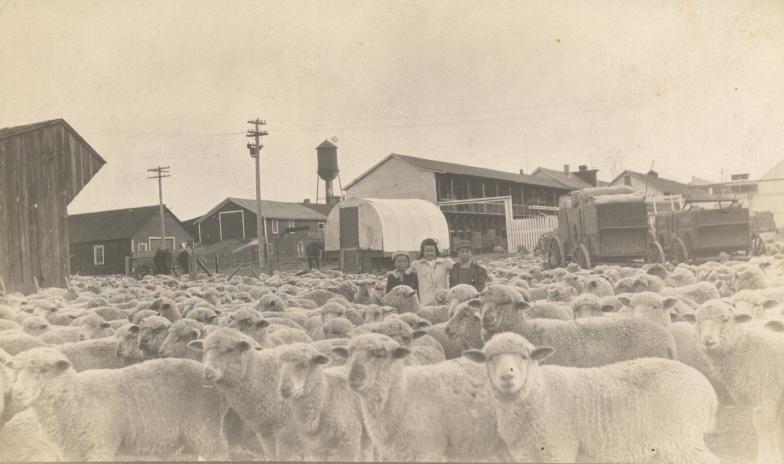
Lucille O'Brien amongst the sheep

from Mary to Annie

Annie, ca. 1900

Click here to read my story in the current issue of Irish America magazine about how meeting two of my great-grandmother’s nephews has brought me closer to developing an understanding of the woman Annie was.


4 Comments

What’s Whit Week?

Whit Week Procession (postcard sent to Annie Hill Regan)

Whit Week is here and that can mean only one thing…hmmmm…I wonder what that could be?  If this was the early twentieth-century in Manchester, England, odds are it would mean donning a new white dress and marching in a Whit week procession like the ladies pictured above.

Since the demise of the Whit Monday bank holiday in the UK in 1967 and Ireland in 1973, I am not sure how much attention is  paid to the week following Pentecost (read more about Whitsun by clicking here.)

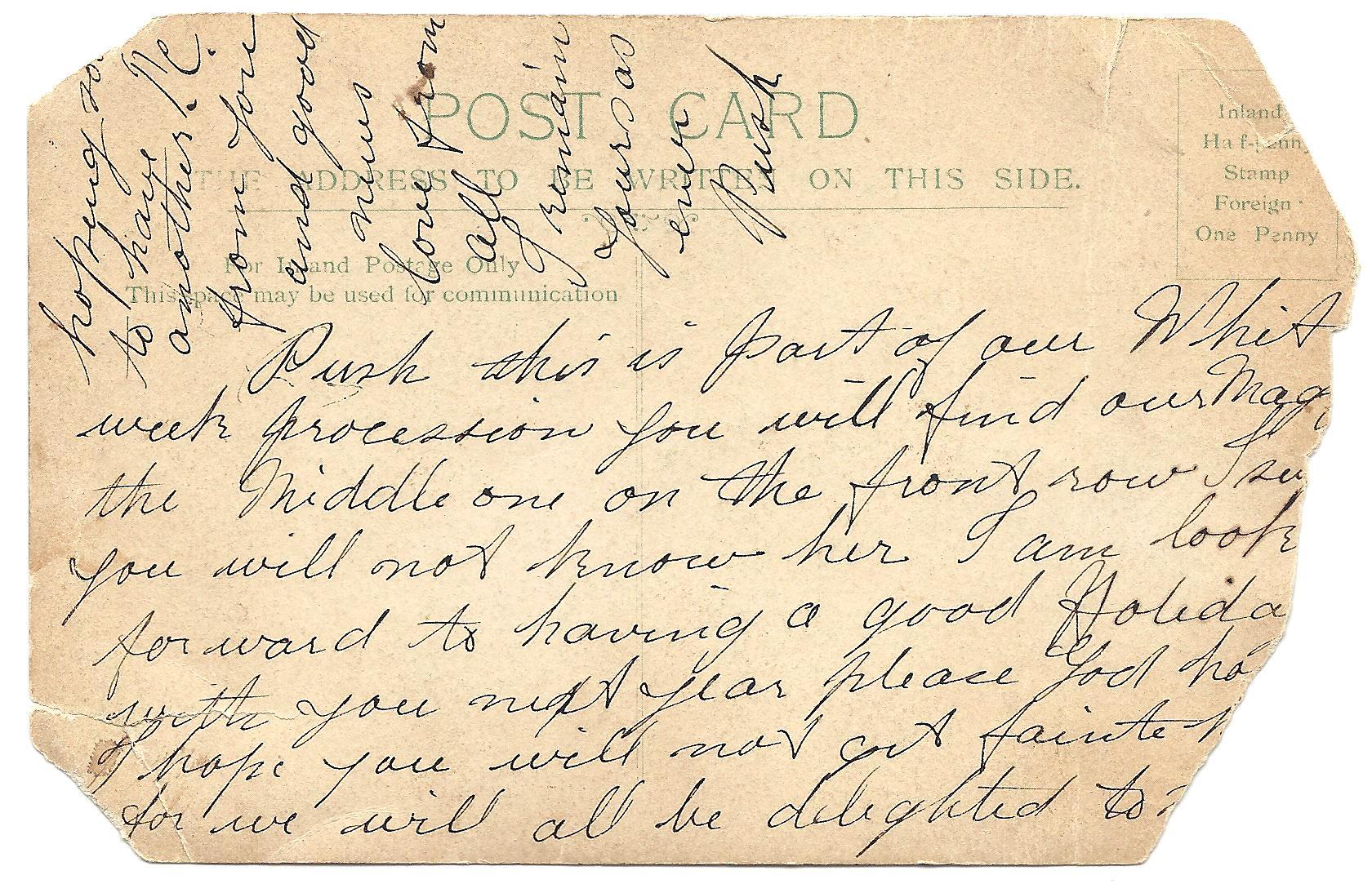
This photo of a Whit Week parade appears on a postcard from the early twentieth century, and survives in a small collection of photos and cards that belonged to my great-grandmother Annie Hill Regan (born in Kildare, emigrated to Minnesota 1899.)  With no postmark, no address, and rather ambiguous greeting and signature (both are Push), this little card is a bit puzzling.  My best guess is that the card came to Annie from her younger sister Bridget Hill Reynolds of Manchester, England.  From what I have read, processions like this were more popular in England, and the postcard mentions “our Maggie” – Bridget had a daughter named Maggie, who eventually emigrated to America joining her Aunt Annie in Minnesota.

The card mentions looking forward to a visit “next year.”  I wonder if Annie ever did travel from Minnesota to Manchester, England to visit her sister’s family?  Did she return home to Ireland on this visit?  I have searched for possible documentation of such a journey, but so far have come up empty.  I will have to keep at it and see what I can find.

Reverse of postcard

Maybe you can help me figure this photo out…

  • Have you seen Push as a nickname or slang in correspondence from the early 20th century?
  • Do the dresses provide a more concrete date to this photo?
  • Is Whitsun or Whit Week still observed in Ireland and England?

Any ideas?  Please leave a comment!

Have a good week!


2 Comments

In Loving Memory

On several occasions I have mentioned my great-grandmother Annie Hill Regan and the small collection of photographs and greeting cards she left behind.   Among the mysterious photographs from Manchester England, a photo-pin of a priest, and a charming Christmas card from a sister, are two memorial cards.  Below is the card for her father who passed away the year before Annie came to the United States.

William Hill memorial card, 1898 (click to enlarge)

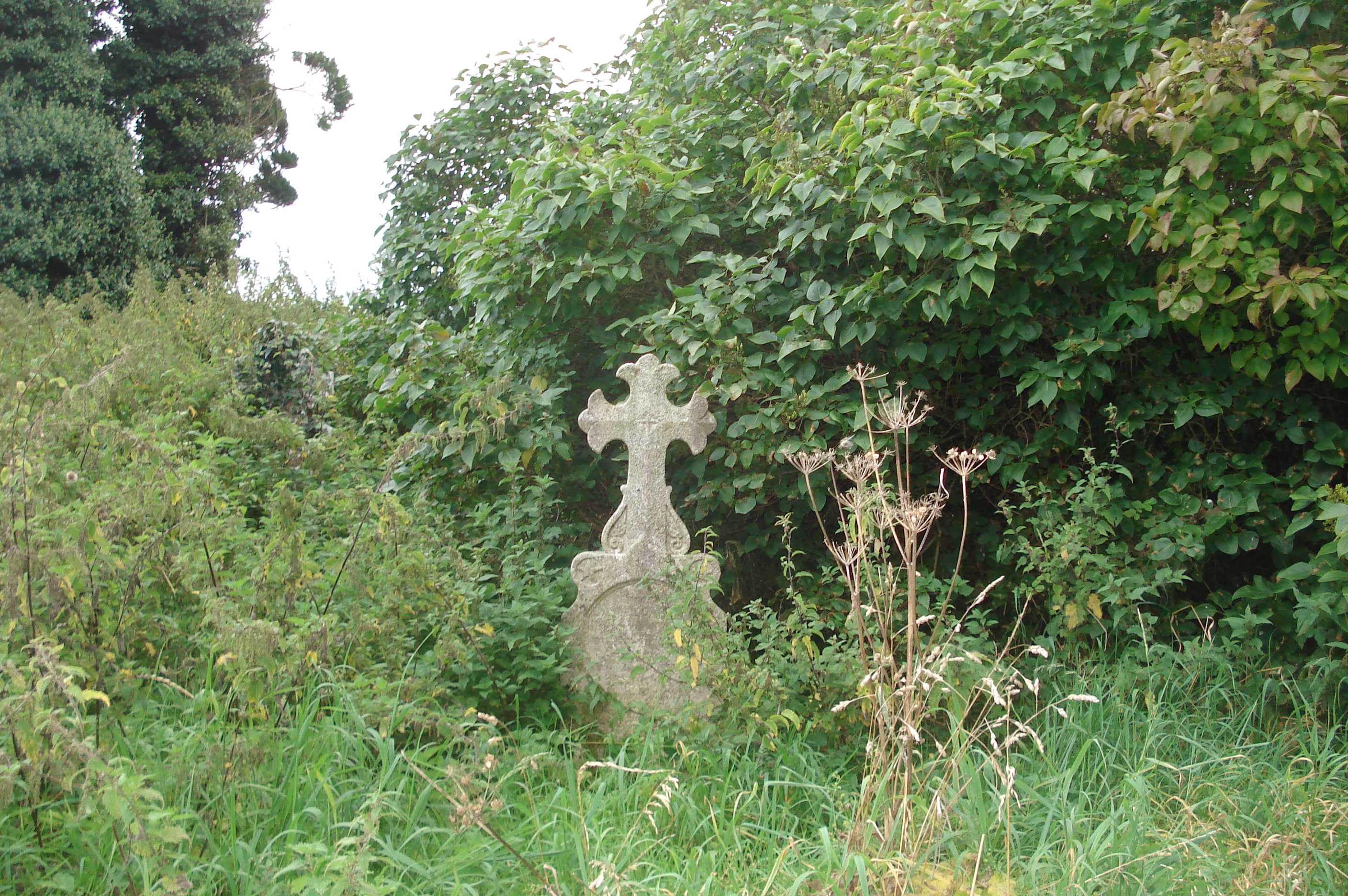
In 2009 I visited Rathmore Churchyard.  I was unable to locate William’s grave, but I suspect it rests hidden in the overgrown grass, somewhere amidst the gravestones of Hill relatives of whom I am not familiar.

Rathmore Churchyard, County Kildare (2009 Regan McCormack)

The other card is for James Hill.  I assume James was a nephew, and one can imagine this loss was felt deeply by the entire family.

James Hill memorial card, 1895 (click to enlarge)

Memorial cards can provide great information to the genealogist or family historian.  In the case of Annie’s father, I knew his name from her birth certificate, but I learned his birth year, date of death, and place of burial only from this memorial card tucked into a stack of old photographs.  But memorial cards can also raise more questions than they answer, and prove to be as frustrating as an album full of unidentified photographs or a postcard with faded text.

Because they are so portable, I am sure a great many memorial cards crossed the Atlantic, mailed to emigrant daughters and sons in America, accompanying letters detailing all the latest news from home.

Share your stories about how items like memorial cards have assisted you in the search for your family history.  Perhaps a memorial card is all that is left to tell of an emigrant relative’s life in America?  I would love to hear your stories, so please, leave a comment!


13 Comments

Oops…was it a mystery or memory block?

Father John J. Molloy

The “mystery” from last time was actually solved a few years back.  My mom reminded me that we confirmed the identity of the priest when we compared the photo-pin to a photograph of Father John J. Molloy that we found in the book Meet Shieldsville, by Mary L. Hagerty.  I spaced this discovery out, and I must admit that this was not entirely an accident.  At times I become overwhelmed with my own family history research, and when a discovery opens up a new can of worms and I don’t have the time or energy to deal with it, I will slip the cover back on and vow to deal with it at a later date.  This is precisely what happened with good old Father Molloy.

Priest Pin

Above is a reproduction of the photo of Father Molloy.  It is not of the highest quality, but I think you can appreciate the resemblance to the photo-pin on the right.  My great-grandmother worked as Father Molloy’s housekeeper (1905-1910) before she was married.  While I was pleased to learn the identity of the priest, it meant that there was even more to learn about Father Molloy.  The first thing I wanted to know was how Annie came to know Father Molloy.

John J. Molloy was born in County Mayo, Ireland and educated at St. Patrick’s College Maynooth, County Kildare.  He was ordained in 1891 and arrived in Minnesota later that year.  Father Molloy served as an assistant pastor for a number of parishes throughout Minnesota before settling at St. Patrick’s in Shieldsville.  He served the community for fifty-two years.

All of that was well and good, but I couldn’t find anything in the biographical information on Father Molloy that could point to a connection to my great-grandmother.  That was until I read in his obituary that he was survived by one sister named Delia in Manchester, England.  Immediately I  thought of the dozen or so photographs taken in the studios of Manchester, England that Annie had saved.  Of course, none of the photographs were identified, but I assumed they were of family members.  Annie had one sister who moved to Manchester and raised a family (Bridget) and another sister who lived there for a few years before returning home to Kildare (Catherine, who I have mentioned before.)  Manchester could be the connection, but it made my head hurt and I told myself I would tackle this another day.

I believe the day has come.  It is time to dust off my Manchester file and see if I can’t figure this one out.  A wonderful book, The Reynolds Letters, provides considerable insight into the lives of Irish emigrants living and working in Manchester during the 19th and early-20th centuries.  I will use the resources available on ancestry.com and elsewhere on the internet to see if I can learn anything more about a possible Molloy-Hill connection in Manchester. 

Here are some of my of mystery Manchester photographs…


Probably one of the Hill girls...

Unknown Couple from Manchester

Perhaps Annie's sister and family?

The Hill sisters that I believe spent time in Manchester are:

Margaret (Maggie)

b. 1866

Catherine (Katie)

b. 1872

m. John Howe

Bridget (Delia)

b. 1876

If anyone has experience researching Irish emigrants in England, specifically Manchester, please let me know.  I will keep you posted…


Leave a comment

Out from Moylough: The Clancy Family in America

Over the past several months I have had the pleasure to exchange emails with Margaret from County Galway.  Margaret has shared memories and stories about relatives who emigrated to America in the early twentieth century.  I would like to show you how we were able to take Margaret’s memories, add some Irish Census evidence, throw in Ancestry.com, and put it all in the hands of an experienced researcher to identify the American branch of Margaret’s family tree.

In the pursuit of family history research, there are times when every path seems to lead to a dead-end.  Other times the bits and pieces of information fit together effortlessly to tell a wonderful story of your history.  Luckily for us, the data slid right into place.  To get up to speed on Margaret’s research quest, click here.

Moylough Church, Galway - compliments of http://www.irelands-directory.com

When Margaret first told me about the Clancy siblings, her relatives who left Ireland for America, she shared some memories – Trimmings after the Rosary for the “boys in the war”, an old letter that mentioned debris from the Lusitania scattered in the sea as a young woman sailed to America, a generous wedding present from an American relative in New York.  Great stories that provide priceless clues for the researcher, but a few dates will always make the research process easier.

Margaret delivered again and gave us the birth dates and places for the five Clancy siblings.  She was unsure of exact emigration, but she provided information from the Irish Census – whether or not someone appeared on the 1901 or 1911 census helped us narrow our search and make positive identifications.

And did we make identifications!  Margaret may well learn more about her Clancy relatives than she ever wanted to know!

Jim, a senior research associate from Archival Solutions , stepped in and began to put the pieces of the puzzle together.  Jim told me that this project was made much easier by the information Margaret provided, and he said that the information he gathered is just the tip of the iceberg – there is much more out there, on both sides of the Atlantic and in cyber space.  This brings up a key point to remember: When you begin family research of any kind, gather all known information at your disposal – the more you have, the easier your search will be.

Over the next week, I will highlight examples from this project that will illustrate the types of information you can expect to find when you embark on researching your family history in America.  I will begin with a story with its foundations in the once-popular and treasured item, the emigrant’s letter home.

Margaret recalled an old letter belonging to her aunt.  It was from her father’s cousin Nellie Clancy who went to America.  In the letter, Margaret remembered a vivid description of the debris from the Lusitania floating in the sea as Nellie’s ship sailed for America.  Margaret believed this letter was sent when Nellie returned to America after a holiday in Ireland.  The letter is long gone, but the image of Lusitania wreckage stayed with Margaret.

Panoramic view of the Lusitania - 1907

Jim found Nellie Clancy on S.S. St. Paul ship’s manifest right away.  She sailed from Liverpool on May 8, 1915 – the day after the Lusitania was sunk on May 7, 1915.  Nellie was not returning from a holiday in Ireland as Margaret believed, but rather this was her first voyage to America.  Nellie didn’t travel alone – she was accompanied by her younger brother and the youngest of the Clancy siblings, James.  James is listed as an eighteen-year-old farmer,  and the twenty-year-old Nellie’s occupation was listed as teacher.  Their closest relative in Ireland is given as,  father Theo. Clancy, Moylough, Ireland.  All of this information is included in the Ship Passenger Manifest.  What a way to start your new life, amongst the wreckage of a torpedoed ship!

The 1920 U.S. Federal Census shows Nellie and James living in a rooming house in Brooklyn, and the 1930 U.S. Census has Nellie married and living in New York, while a James Clancy is shown living in a house with two new Clancys – Teddy and Anna.  Margaret will have to let us know if there were a couple more Clancys hanging around.  Remember back to the ship’s manifest?  The Clancy father was named Theo., so there is a chance James wasn’t the youngest Clancy after all.

Next time we will look at the “Boys in the War”: the American soldiers remembered in the nightly prayers of a family in Galway.


Making the Connection

Leave a comment

The first comment left on this blog was from Mai in County Wexford back in early October.  Mai was interested in learning about her mother’s cousins who left Ireland and settled in Pennsylvania, USA.  With the few details Mai provided, I was able to do a quick search of US genealogy records and find her family.

Mai told me the names and birth dates for her mother’s aunt and uncle who emigrated to the USA.  She also knew the place-name of their residence, as well as the names of the children.  These details were just enough for me to identify the family on a passenger list on a ship from Ireland, their residences in the US Census for 1920 and 1930, and listings in the Social Security Death Index.

Last week I received an email from Mai:

Hi Aine Thanks for your help in finding my relatives in Pennsylvania. I  have made contact with them and we now e-mail  regularly. They are delighted at finding us too. Thanks again…

I am not surprised that Mai’s American relatives were delighted to hear from her; there are many Irish Americans who would be thrilled to receive an email from a long-lost Irish relative.

Have you reached out to your American relations, or have you been contacted by an Irish relative?  Please share your experiences by leaving a comment!  I would love to hear your stories…

This gallery contains 0 photos


Leave a comment

Well now, of course they did!

When I read the headline, How the Irish Saved Thanksgiving, on IrishCentral.com, I was curious, but not surprised.  After all, what aspect of American culture and society has not been influenced, and quite often saved, by Irish immigrants and their descendants?

Everyone knows that the Kennedy clan changed the face of American politics, and it is impossible to imagine American business and industry without Henry Ford, but did you know that the co-founder of Southwest Airlines, Herb Kelleher, is of Irish descent?  Or Tom Monaghan, the founder of Domino’s Pizza, claims a couple of Irish grandparents?  Perhaps they did not “save” the airline industry and home pizza delivery, but these two Irish Americans have had tremendous influence on how business is done in America.

While the story on IrishCentral.com was entertaining, I am not certain I agree with the premise that the Irish saved Thanksgiving.  The contributions of Irish immigrants have definitely made America a better place.  And not just for inexpensive, home-delivered pizzas…

Happy Thanksgiving!


16 Comments

Week of Welcomes: McCormack Style, Part I

Over the past twenty-two years I have visited Ireland six times, and it wasn’t until my last trip in 2009 that I actually spent time with my Irish relatives.  My heritage is completely Irish, but I was always hesitant to establish a connection with my Irish relations.  While this attitude may have its roots in a general feeling of shyness, it was cemented by experiences I had in Ireland.  I was content to remain a casual visitor who had a great time in Ireland and leave the sentimental homecoming production to other Irish Americans.

Two examples of encounters I had in Ireland explain why I chose to forgo the pursuit of my Irish family.  The first occurred during a visit to Ireland when I was sixteen-years-old on a summer program for American high school students called The Irish Way.  On a free day from classes, I  accompanied a friend on a day trip to visit her relatives who lived in the village where her grandmother was born.  My friend was anxious and excited to meet her relatives, the family of whom her grandmother spoke so fondly.  The entire situation made me nervous, but I was only a spectator.

Sixteen and somewhere in Galway in 1988

The afternoon was a complete disaster.  Meeting the family did nothing to calm our nerves.  They weren’t rude, just not very  friendly, and for some reason they seemed suspicious of us.  We both felt uncomfortable, unwelcome, and overly scrutinized.  There was no connection; no family chemistry.  My friend was disappointed and hurt – she had expected a warm welcome by people just like her grandmother, but instead received the cold shoulder.

The second encounter that stayed with me was a conversation I had with a wonderful woman from near Belfast.  We were chatting one evening at the Nesbitt Arms Hotel in Ardara, County Donegal.  She told me that Irish people dread the sight of Americans on their doorstep, searching for their grandmother’s birthplace, or trying to locate cousins they hadn’t heard from in years.  I can hear her saying with a laugh, ” You hear the doorbell and look out and see a couple of Americans in their khaki pants and runners, looking so pleased with themselves…”

I certainly did not want to be one of those Americans, nor did I want the disappointment of meeting my relations only to have them be disinterested, unfriendly, and annoyed.  So, I remained content to visit Ireland, have a fantastic holiday, and leave any notions of locating relatives to my imagination.

I provided the background so that you might better understand why I was caught off-guard by the Week of Welcomes (to steal the phrase from the pilot program described here) my family experienced in 2009 when we visited Ireland.  Actually, it was nearly three weeks of great times with relatives and friends all over Ireland, but I will begin with the warm welcome offered by the McCormacks of Ballyedmond, County Laois.

Our week was punctuated by two great parties – one at the beginning, and one at the end.  My father, mother, aunt, sister, and I arrived at the home of Jimmy and Helen McCormack late in the afternoon on Saturday and immediately received ribbing for our late arrival.  My father had done extensive genealogy research and had reconnected with the McCormacks in Ballyedmond about ten years prior to our visit.  Irish Jimmy and my father Jimmy are second cousins – their grandfathers were brothers.

The Jimmys having a laugh outside the old house in Ballyedmond

Read the story of our parties with the McCormack clan here.  In my next post, I will share the details of our week with the McCormacks, including a trip to their local, a tree-planting ceremony, and what I learned along the way.